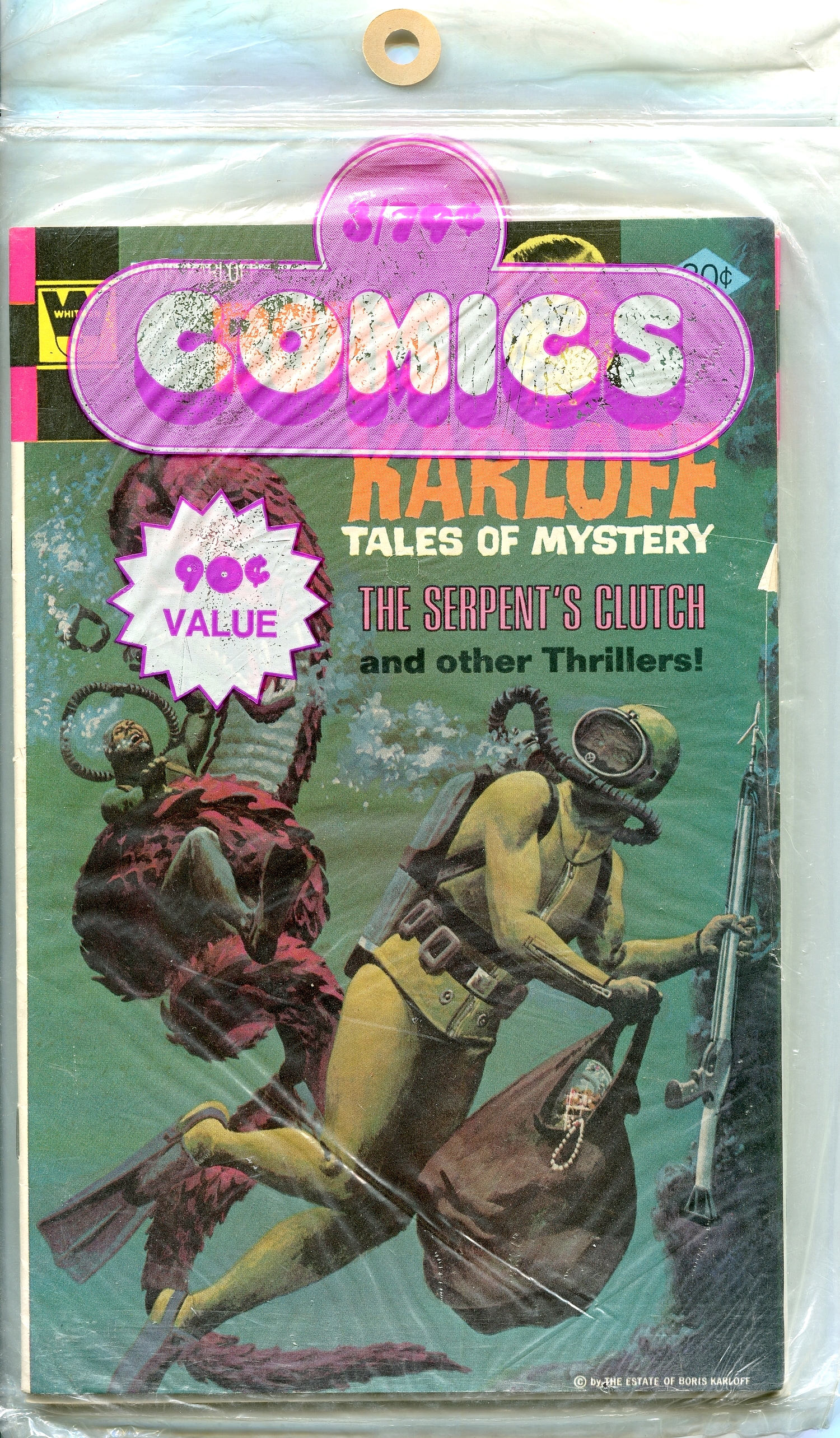
|
 |
WHITMAN
DIRECT MARKET
MARVEL
COMIC BOOKS
1977
- 1979
|
|
|
|
| |
|
| |
| |
WESTERN PRINTING
& WHITMAN PUBLISHING
|
|
| |
| Incorporated in 1910 in Racine
WI, the Western Printing & Lithographic
Co. - who adopted the name Western
Publishing Co. when going public in 1960
(Halasz, 2025) - acquired the assets of the
Chicago-based Whitman-Hamming Publishing Co.
in 1916, which in turn became a subsidiary of
Western under the name Whitman Publishing Co. Whitman became well-known for
its inexpensive children's books in the 1930s and
its Hollywood licensing deals (W. McClure, 2010),
the latter providing them with the exclusive
rights to produce publications featuring the
stars of the Disney, Warner Brothers, MGM, and
Walter Lantz studios. This in turn lead to a
business partnership in 1938 between Western and
Dell, who had been a major publisher of comic
books since the late 1930s. Western produced the
physical comics and provided distribution, whilst
Dell was in charge of the content. This
arrangement lasted until 1962, when Western
started their own line of newsstand comics, using
their many licences, under the imprint brand name
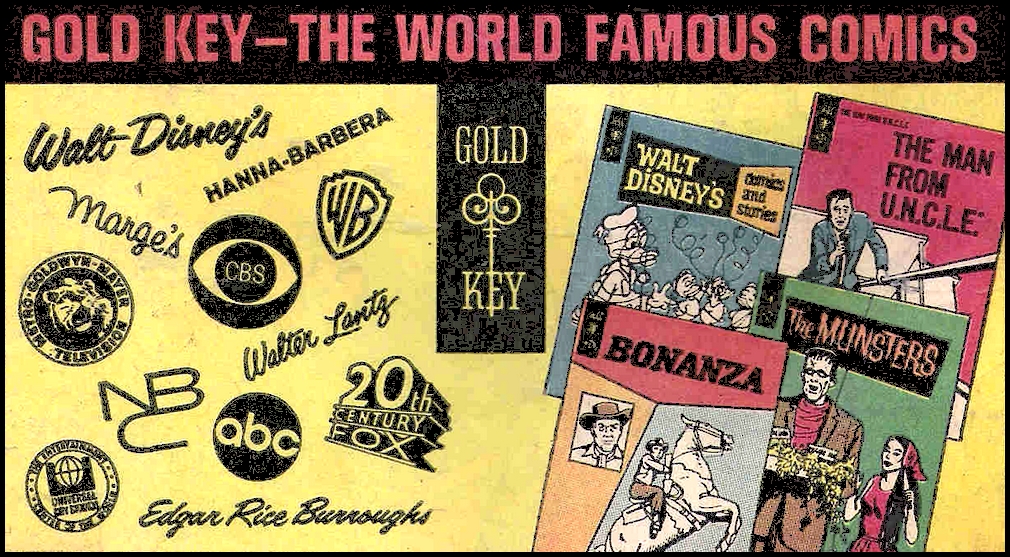
Gold Key.
|
|
 
|
|
| |
 |
|
The first
Gold Key comic books hit the newsstands
in June 1962, with titles generally
continuing to feature a number of licensed
properties from both Walt Disney and
Hanna Barbera as well as Warner Brothers,
along with TV series and movie
adaptations, plus a few original titles.
Whilst titles such
as Star Trek and Twilight
Zone were published for many years,
a good number of Gold Key licensed titles
were characterised by short runs,
sometimes consisting of no more than one
or two issues.
Western's Gold Key comic
books were distributed through the
newsstand channels, and as such soon
began to face the harsh reality that the
comic book industry was rapidly losing
its traditional sales points. Small
stores that had carried comic books were
being pushed out of business by larger
stores and supermarkets, and newsagents
started to view the low cover prices
and tiny profit margins as a nuisance.
|
|
|
| |
| Comic book
publishers desperately needed to open up new sales
opportunities and and tap into a new customer base, and
one place these potential buyers could be found were
supermarkets, chain stores and gas stations. But in order
to be able to sell comic books at these locations, the
product would have to be adjusted. |
| |
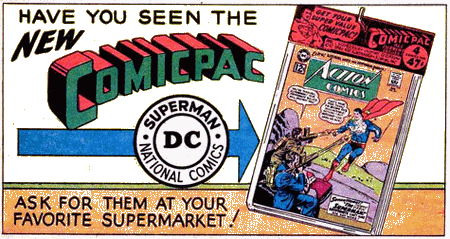
| Handling
individual issues clearly was no option for these
outlets - so DC Comics came up with the Comicpac
concept in 1961, which proved to be both a simple
and brilliant way of breaking into this promising
new market: simply package several comic books
together in a transparent plastic bag. This
resulted in a higher price per unit on sale,
which made the whole business of stocking them
more worthwhile for the seller. The packaging
also clearly showed the items were new and
untouched, while at the same time blending in
with most other packaged goods sold at
supermarkets - and it offered parents (and
their kids) the opportunity
and convenience to pick up a few comics whilst
doing their general shopping (Wells, 2012).
|
|
 |
|
| |
| DC's
"comicpacks" were a success with high
distribution numbers (Evanier, 2007), and other
publishers quickly started to copy the concept -
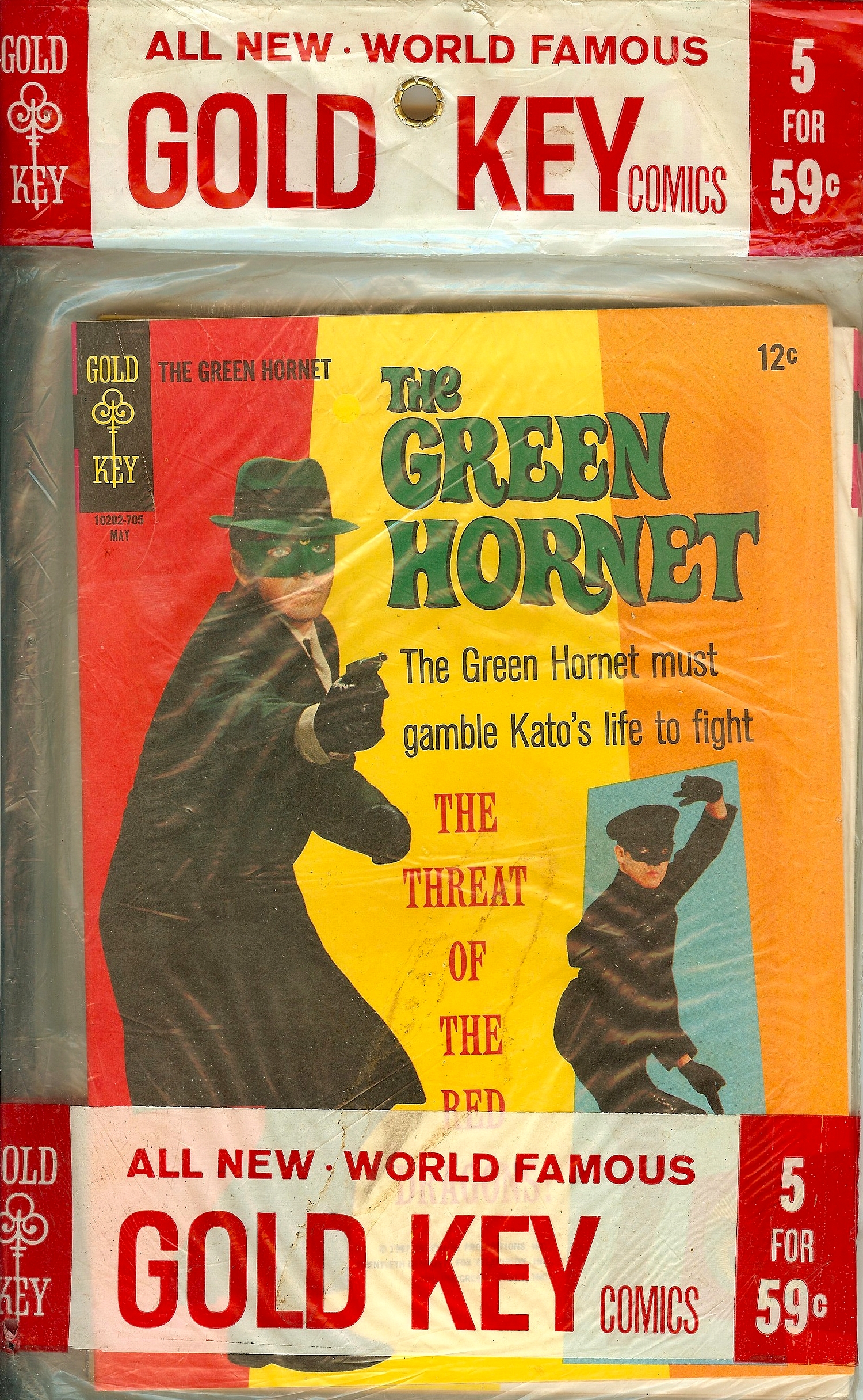
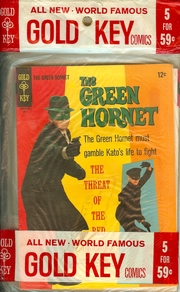
including Western and its Gold Key imprint. It is
not quite clear when exactly Western launched its Gold
Key comic packs, but available data points to 1967 (pictured below is a May 1967
Gold Key comic pack containing 5 comic books). As was the
case with all other comic book publishers, Western filled
its comic packs with regular newsstand copies and
typically sold them at gas stations and various
eateries. But a few years down the road Western/Gold Key
were increasingly feeling the squeeze that had lead to
the inception of comicpacks in the first place. Responding to dropping sale numbers,
Western's chairman and president Gerald J. Slade
instigated two major strategic decisions in 1971 to
reduce returns and increase sales (NNa, 1974). The first
measure referenced the fact that unsold
copies distributed through the newsstand channels could
be returned for a refund. At the suggestion of Slade and
in order to prolong their shelf life, all Gold Key comic
books dropped the conventional cover date (e.g.
"July") and only displayed a code (e.g.
"90272-305") as of February 1973. The code had
been used before and was actually generated by an
IBM system used to identify the comic (Thompson, 2011),
but conveniently obscured the date unless you had access
to the database.
|
| |
|
|
| The bottom line
for Western was: it worked, and
Gold Key subsequently registered
lower return rates (NNa, 1974). Slade's
second measure focussed on
emphasising direct-mail selling
to department, discount and toy
stores along with supermarkets.
Given Whitman's
long-standing experience in
direct marketing of children's
books and a wide range of games
and printed playthings and their
established sales network - with
no less than 200 dedicated
company salesmen selling Whitman
products to stores from Coast to
Coast (NNb, 1966) - Western had
everything needed ready in-house
to implement this strategy.
|
|
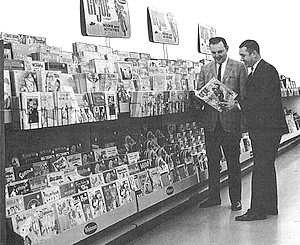
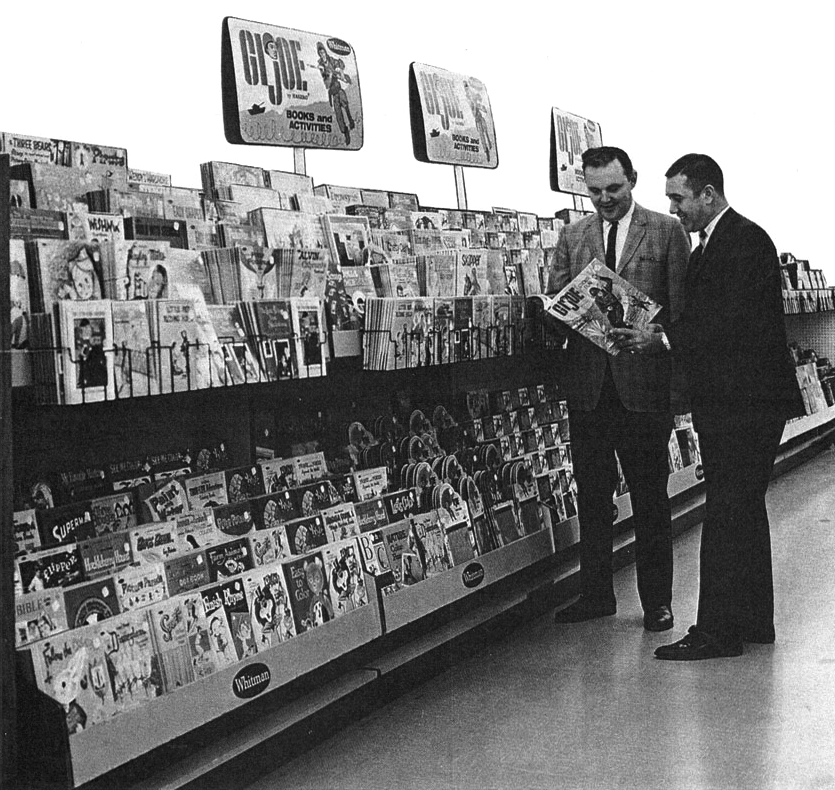
A classic Whitman display rack in
a store in Toledo OH, 1966
(Western Publishing corporate
magazine)
|
|
|
|
| |
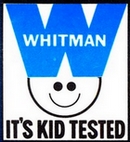
| Western had already registered a
number of trademarks for its Whitman imprint, all
displaying a stylised smiling face. A variant with the
added catchphrase "it's kid tested" had been in
use since April 1969, and it was upon this reputation and
the recognition factor of Whitman products (both with
parents and, perhaps even more importantly at that point
in time, shop managers) that Western was setting up its
direct marketing of comicpacks under the Whitman name. |
| |

|
|
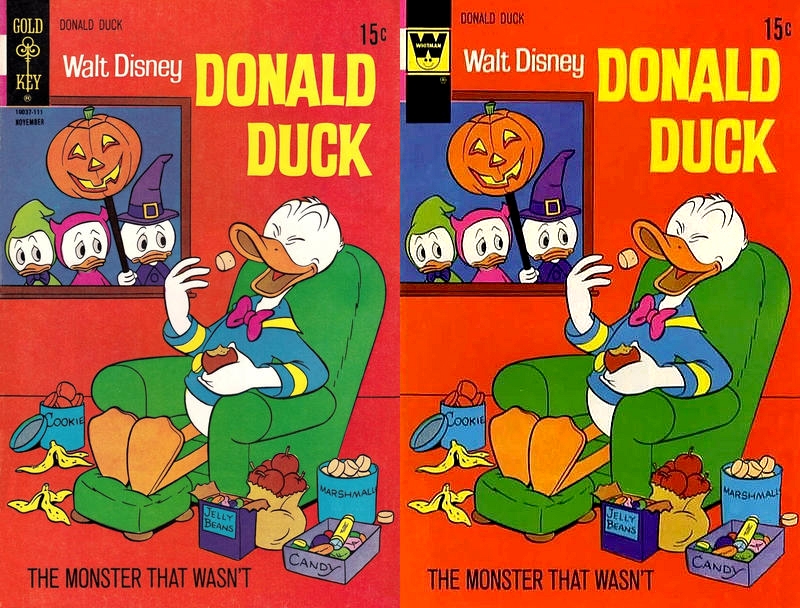
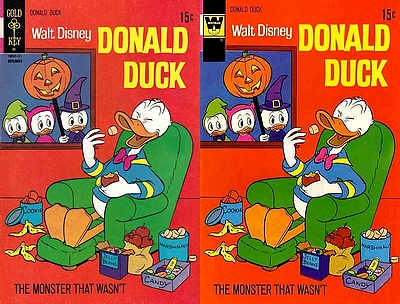
Western filed a trademark
registration for a Whitman
"face logo" (without
colour claim, although it would
mostly come to be used in a
yellow and black combination)
especially for comic books in
October 1971. Only one
month later, in November 1971,
three Gold Key comic books were
produced with both the standard
Gold Key logo (for the
newsstands) and the new Whitman
logo (for direct marketing in a
comicpack).
Leading
the way were well-established
titles featuring popular licensed
properties from Warner Brothers (Bugs
Bunny #139), Disney (Donald
Duck #140), and Walter Lantz
(Woody Woodpecker #120).
|
|
 |
|
|
|
| |
| Western was clearly introducing
the new Whitman comic books (which were absolutely
identical to the newsstand copies other than the logo)
within the well-established "kids and family
friendly entertainment" segment that Western in
general and Whitman specifically were already known and
respected for (and which also was the reason why neither
Dell nor Gold Key ever carried the Comics Code seal). |
| |
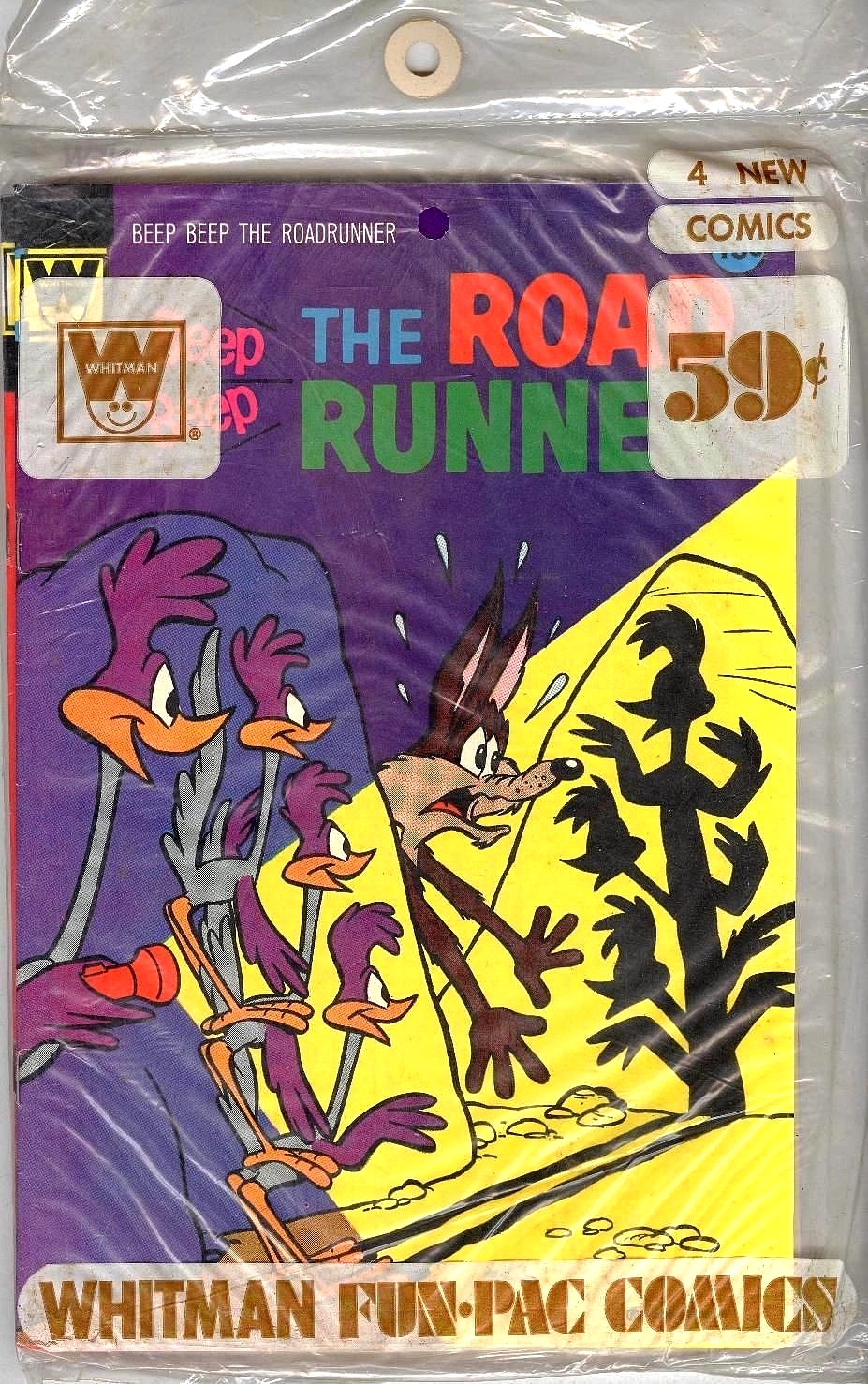
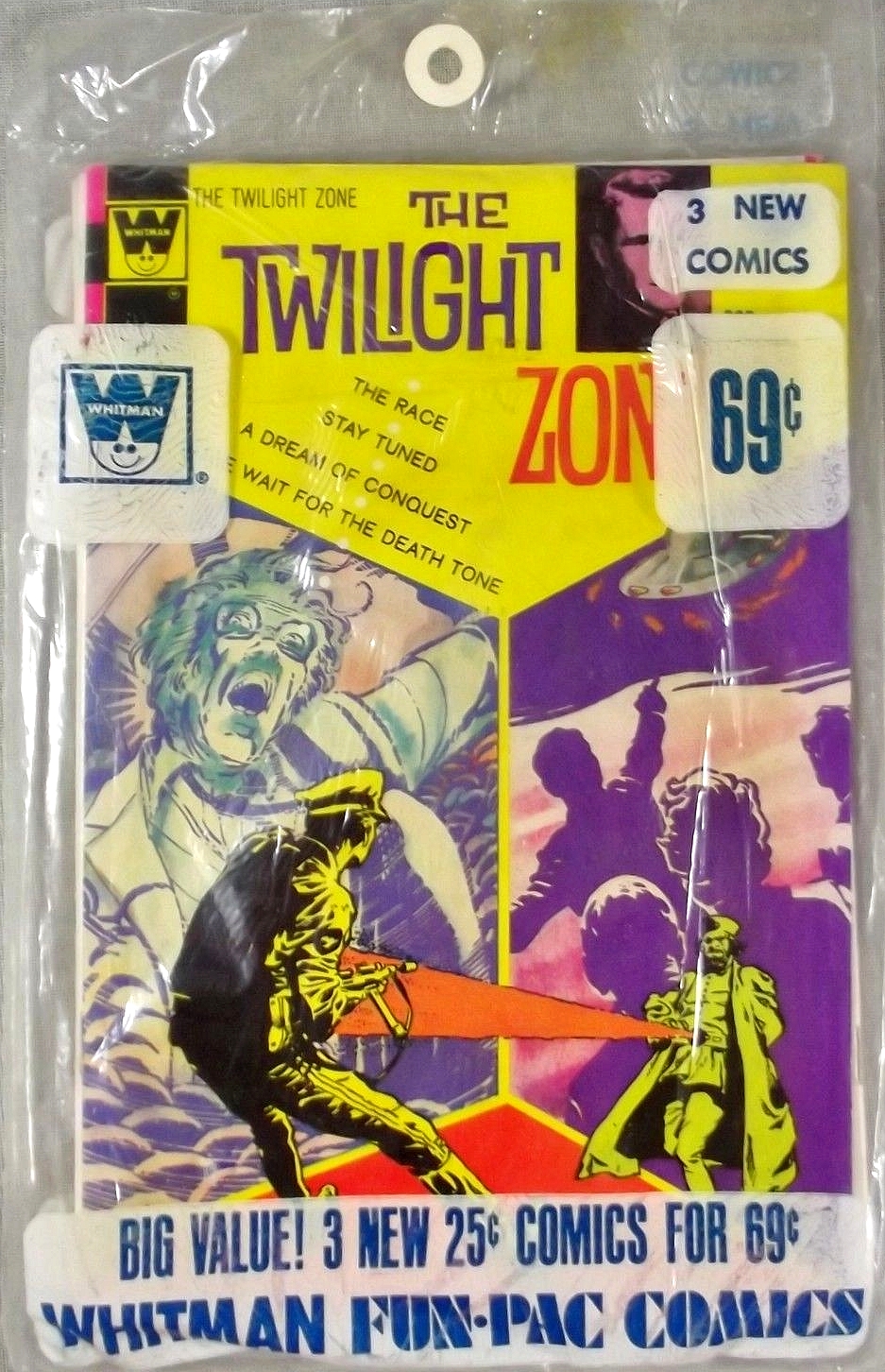
April 1973 Fun-Pac
|
|
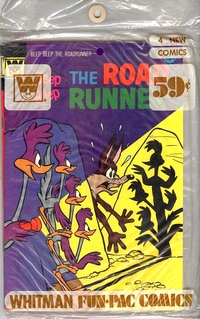
This initial batch was followed
with more familiar licensed (and a few original)
characters such as Mickey Mouse, Yosemite Sam,
Pink Panther, Scooby Doo, or Smokey Bear - all
squarely aimed at a younger audience and, more
importantly, their parents. The attempt here was
to blend in with Whitman's established selection
of books and games, and it worked according to
plan: the new direct distribution outlets had
Western's comic book sales going up (Halasz,
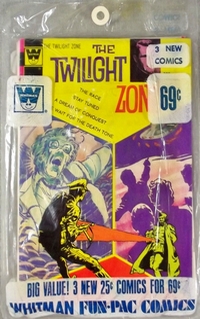
2025). It wasn't until
August 1973 that Western started to carefully
direct a few of their "Fun-Pacs" (which
originally came with four comics but were reduced
to carrying three issues by 1974) at a somewhat
older reader base. That month, the plastic bags
started carrying titles such as The Occult
Files Of Dr. Spektor, Ripley's Believe
It Or Not! and The Twilight Zone.
And once again, sales went
up (NNa, 1974). By 1976 direct marketing
accounted for about one-fourth of Western's
consumer product sales, which in turn accounted
for 70 percent of the company's total sales
(Halasz, 2025).
|
|
November
1974 Fun-Pac
|
|
| |
| As already pointed out, there
was a major difference in business conditions between
comic books packaged in a bag and distributed directly to
the end sales points, and those sold individually at
newsstands. Direct distribution came with a discount for
the seller, but unsold copies could not be returned for
credit - which was the established business model for
newsstand distribution. Apart from the fact that the
latter business model did little to nothing to
encourage actual sales, it was impossible to distinguish
the returnable newsstand copies from the non-returnable
packaged comic books, since comicpacks carried regular newsstand comic books.
Some unscrupulous vendors could therefore work
around the non-returnability policy of bagged comic books
with a fair amount of ease.
"A certain number of
distributors and retailers simply split the packs
open and returned the loose comics, making an
arbitrage profit." (Paul Levitz in Evanier,
2007)
With Western's introduction of the
Whitman logo for its packaged comic books, however, it
was now impossible to try and pass them for returnable
Gold Key newsstand issues.
|
| |
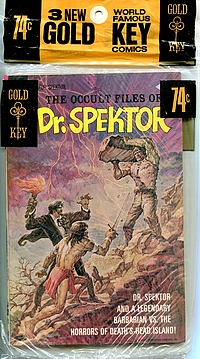
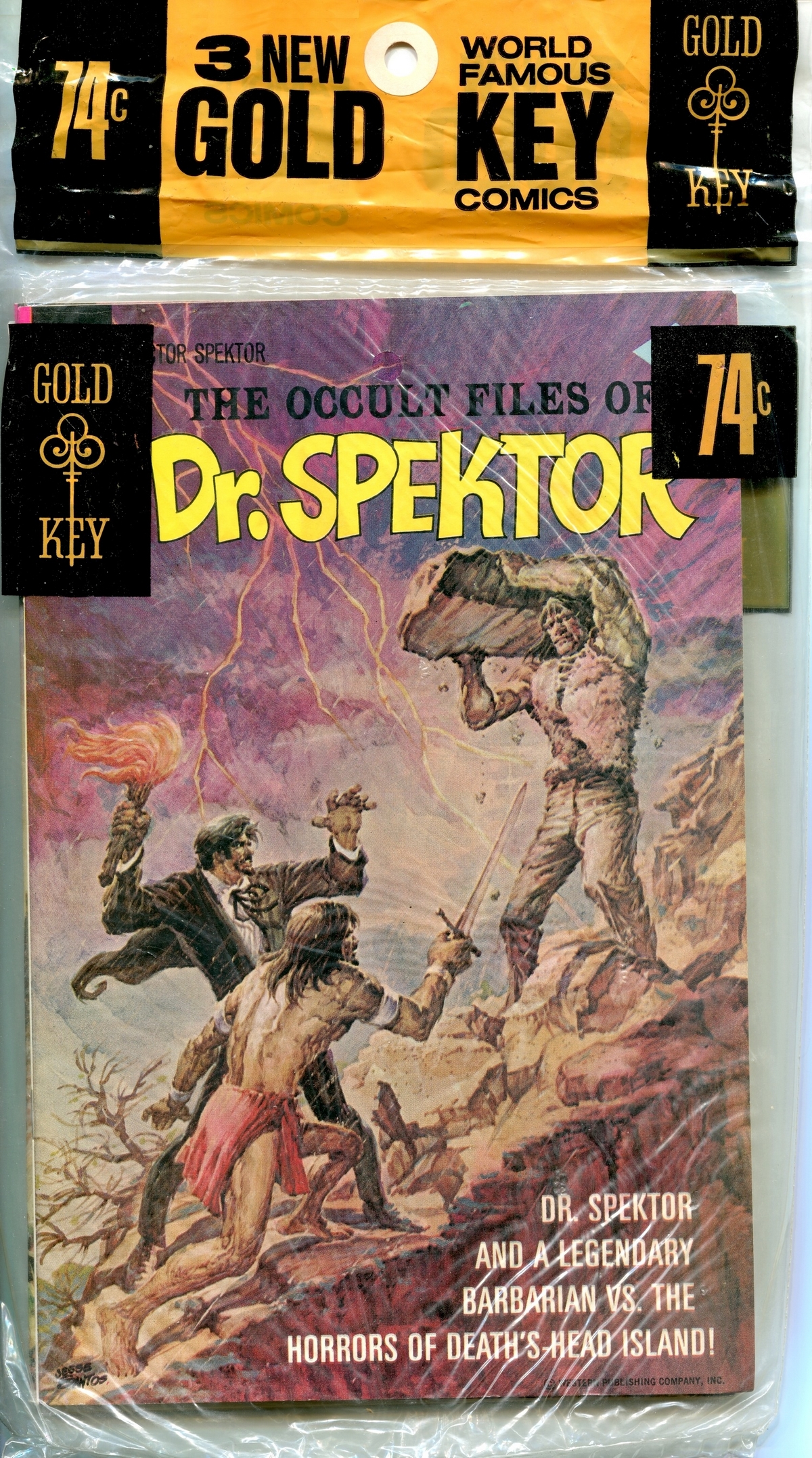
September 1975 Gold Key Pac
|
|
It would seem logical to assume
that Western introduced the distinctive Whitman
logo in order to put an end to such fraudulent
behaviour, but there is important evidence to
suggest that this was a nice little side-effect
at best, and that it really was all about keeping
distribution channels and book keeping neatly
separated - since Western continued to distribute
Gold Key comicpacks containing Gold Key newsstand
issues for many years after introducing the
Whitman comicpack logo. If
fighting fraud was the driver for having two
different logos, this situation clearly would not
have been allowed to continue. It would also
appear to be strange for neither DC nor Marvel
(or any other publisher who packaged their comics
in polybags) to copy, in some shape or form, the
idea of a distinctive marker to counteract
fraudulent returns.
In reality, the Gold Key
comicpacks and the Whitman comicpacks were
delivered to distinctly different retail sale
points, and Western had no intention of merging
or streamlining those - simply because the
Whitman brand and its long-established reputation
and sales points were too valuable to be diluted.
|
|
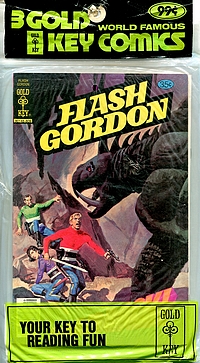
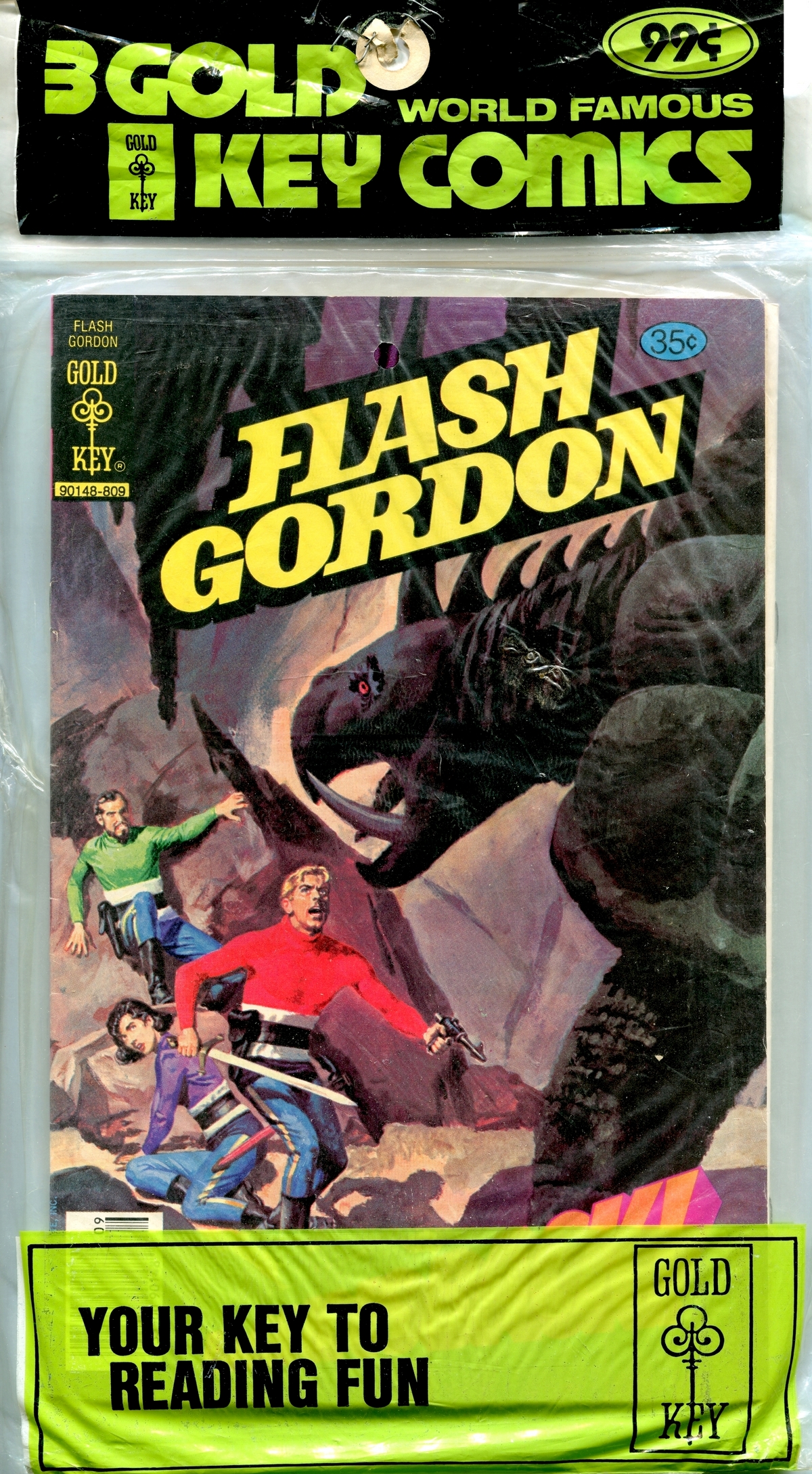
September
1978 Gold Key Pac
|
|
| |
| As far as the fraudulent retailers are concerned, it
seems that the comic book industry had simply accepted
the attrition their print runs were subjected to. And
since throughout all of
the 1970s anywhere between 50%-65% of the print run of
any given comic book was not sold (Shooter, 2011), a few
opened comic packs were probably not that big of a
problem in comparison. Western
would eventually discontinue their Gold Key line in 1980
but keep their Whitman line of bagged comic books up and
running until 1984.
|
| |
| |
"WITH GREAT DISTRIBUTION COMES GREAT
OPPORTUNITY":
WHITMAN AND MARVEL JOIN FORCES
|
| |
Opening up the Whitman distribution channels had
proven highly successful for Western (Halasz, 2025).
However, in a constantly shrinking comic book market
(Daniels, 1991), one of the few ways of ensuring the
future growth of the comicpack programme was expansion.
And so, sometime in 1976, Western approached the market
leader in comic books, Marvel, with a business proposal,
and the two struck a deal.
"Western has signed
an agreement with Marvel to distribute Marvel Comics
in Western's plastic bag series which is apparently
doing quite well. The two companies will not be mixed
in the bags. We believe that those Marvels to appear
in bags will have slightly different covers in that a
diamond will cover the space that currently houses
the cover date and Curtis company symbol. The cost of
three 30 cent comics will be 79 cents." (Comic
Reader #140, February 1977, pg 10).
|
 |
| |
Many questions surrounding the details of this
agreement remain unanswered due to a lack of first hand
information, but Jim Shooter stated in 2010 that the
venture and its set-up were developed specifically for
Western Publishing and its Whitman bagged edition program
(Miller, 2010). Whilst Shooter wasn't in a major
decision-making position at Marvel until January 1978
(when he became editor-in-chief), he would certainly have
known if the Whitman programme had instead been Marvel
getting into the direct market on its own and taking
Whitman along for the ride (as some argue was the case),
not the least due to his pronounced interest in the
matter.
"[Shooter was] the
best ally that the Direct Market retailers ever had
at any of the comics publishers. (...) What made Jim
Shooter so important to the development of the Direct
Market was that, unlike almost everyone else at
Marvel in 1979, Jim already knew about Phil Seuling's
Seagate Distributing. He not only knew what Phil was
doing, he had taken the time, completely of his own
accord, to track Phil's sales on each and every title
that Marvel printed. (...) The net result of his
analysis of Phil's business was that he believed
absolutely that the future of comics lay in retailing
through comics specialty shops." (Rozanski,
2004a)
The Comic Reader (widely
regarded as a reliable source) unambiguously
characterised the "diamond" logo as a unique
feature of issues destined for packaging into the Whitman
bags (of course once opened, comic books from Whitman
bags carrying the diamond could end up in lots of places,
which may account for some anecdotal individual
memories). It is also worth noting that Marvel's own
comicpack scheme (the Marvel
Multi-Mags) had been running for a good three years
by 1977, yet no change in the way of introducing a
distinctive variation on the covers had occurred neither
before nor after the Whitman distribution deal, as
Marvel's own comicpacks contained - and continued to do
so throughout the 1970s - regular newsstand editions.
There seems to be no first hand
information available on who came up with the design of
the diamond, or why it was used instead of the
established Whitman face, leaving those questions open to
conjecture. J. McClure (2010) assumes the lack of license
rights to be the reason, but without a first hand source
to back it up, this line of thought lacks evidential
weight - and leaves aside the fact that business deals
usually happen for specific reasons and in specific
contexts.
Marvel had lost $2 million by mid-1975 and was spiralling
towards bankruptcy (Daniels, 1991).
Its parent company Cadence Industries pulled the
emergency breaks and replaced Marvel's president Albert
Landau that same year with Jim Galton (Howe, 2012), a
former president of a paperback publishing company owned
by CBS. The new man in charge quickly realised that one
of Marvel's biggest problem was the newsstand
distribution model, and Galton wanted to move away from
this antiquated system and its shocking lack of true
accountability (Foerster, 2010).
|
| |
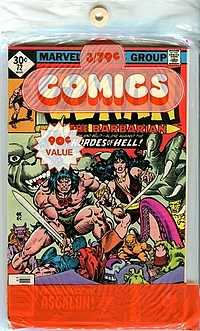
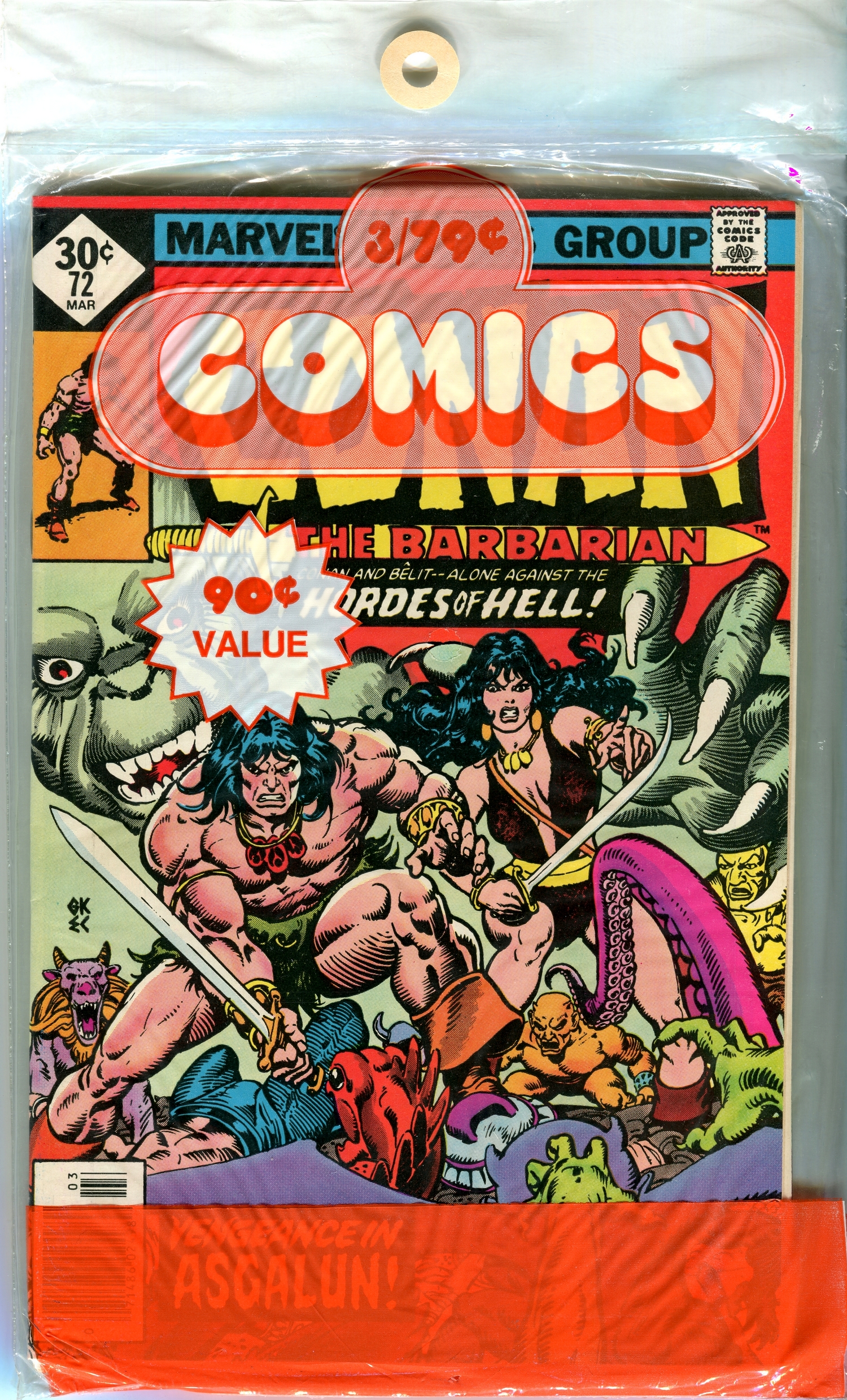
Marvel comics in Whitman bag
March 1977
|
|
Clearly this was an open door for
Western in 1976, and a deal struck between
Western and Marvel would be a win for both
parties (unfortunately the Comic Reader
doesn't tell us who initiated the idea). Western
could expand its range of comic books offered in
the Whitman bags, and Marvel could reach sales
points otherwise hard to reach without the
expertise and connections of Western's
distribution network. Licensing intellectual
properties had no place in this business
arrangement. The clout of
the Whitman brand would be another point in
favour for Marvel, but initially Western kept
efforts on their side to a minimum and simply
packaged the Marvel comic books in the same bags
that were in use at the time for their existing
comicpack programme (and which also happened to
be very low key, with no mentioning of Whitman at
all). Even the coloured segment at the bottom of
the bags (which conveniently hid the individual
UPC barcode on the covers of the outward facing
comic books) wasn't brought about by Western
distributing Marvel comics - it was a
modification put in place for the November
1975 Whitman packs (even though Gold Key
didn't actually introduce the barcode on its
comic book covers until June 1977).
|
|
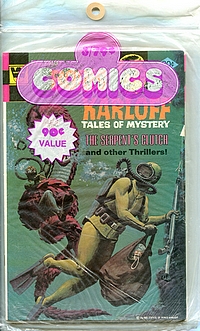
Gold
Key comics in Whitman bag
September
1976
|
|
| |
| The logic of having barcodes on Whitman comic book
issues at all seems somewhat elusive (since they were
only sold in sealed packs of three), but such is the
subject matter of comic packs - things didn't always
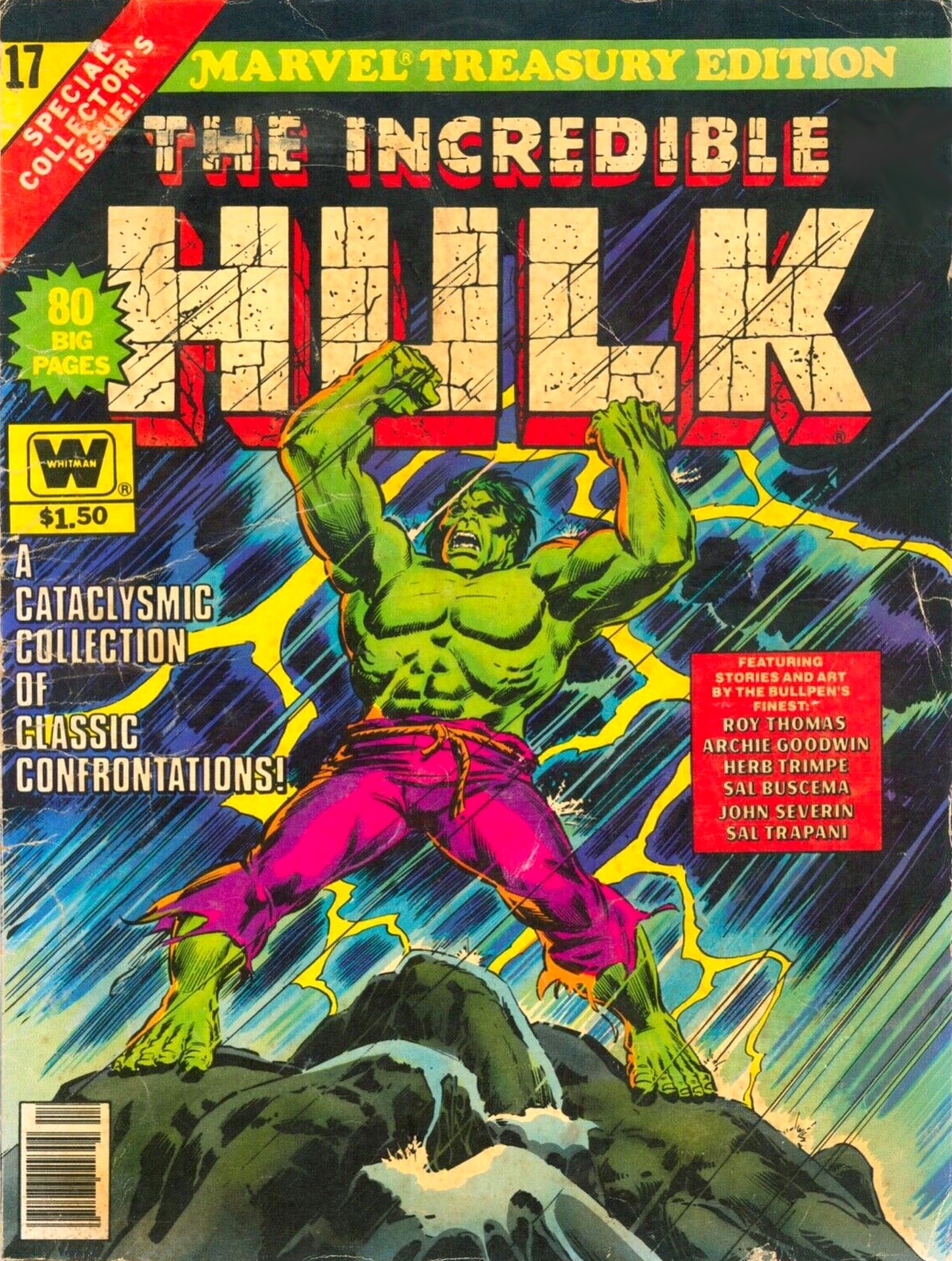
operate in ways that made perfect sense. Which in some
way also applies to the fact that a handful of oversized
Marvel comic books did actually feature a Whitman logo on
their cover (e.g.
Marvel Treasury Edition #17, April 1978),
although not using the "face" but simply a
"W" with the name Whitman spelled out - a
trademark originally registered by Western for playing
cards and jigsaw puzzles in 1972.
|
| |
| |
IT ALL STARTS WITH
CHANGES (UPON CHANGES)
|
| |
| The initial few months of the
Whitman-Marvel comicpack programme were characterised by
a very pronounced lack of continuity as a quick
succession of numerous changes took place. |
| |

|
|
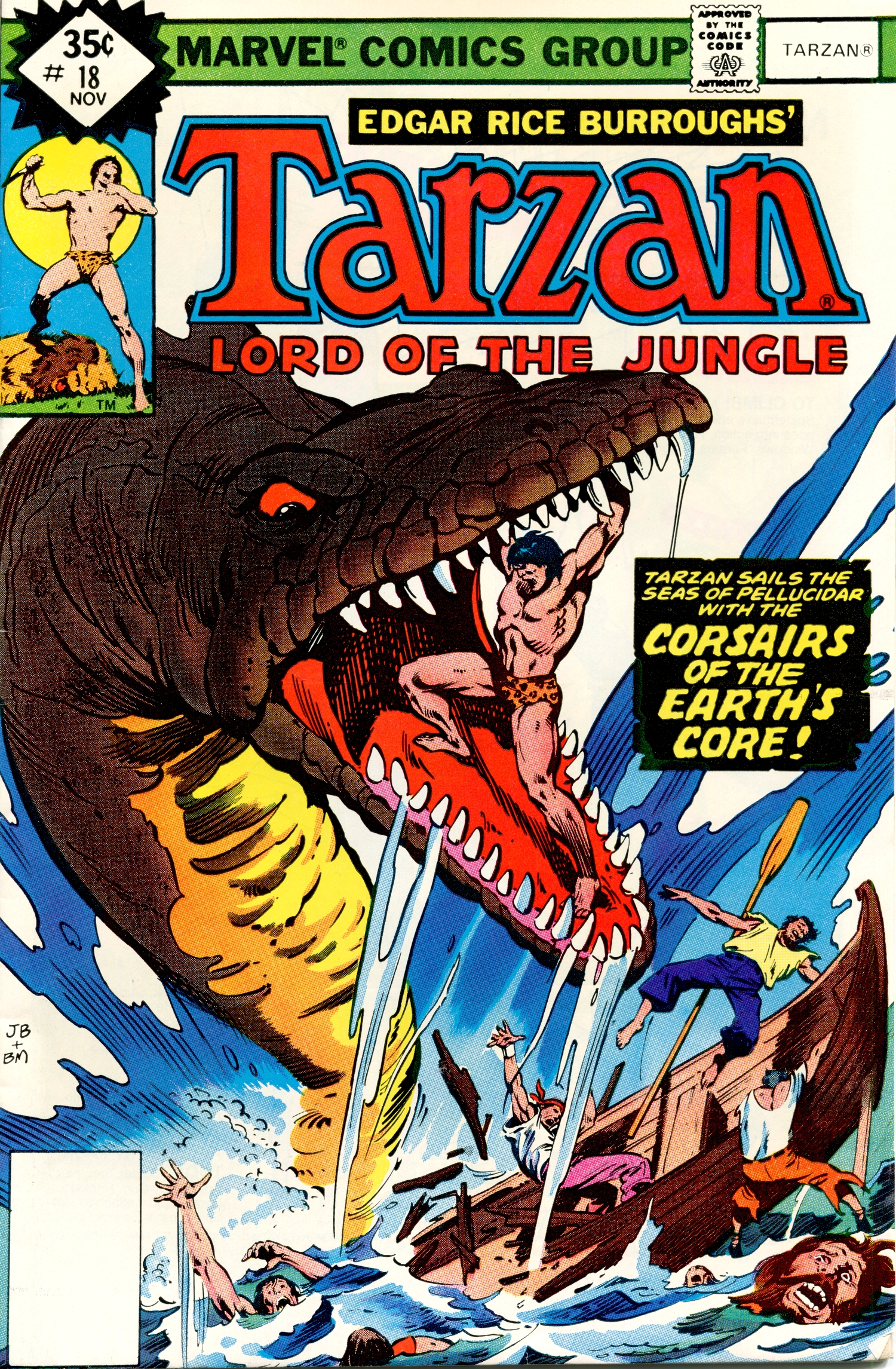
First off it was the diamond logo
itself that underwent a change: whereas it had
launched with an indication of price, issue
number and cover date, the indication of the
latter was dropped as of the June 1977 run of
Whitman comicpacks. The added space available was
used to have a larger indication of the issue
number whilst adding a hash (#) as well (as
illustrated here by the cover diamonds from Amazing Spider-Man #167 (April
1977) and Amazing Spider-Man #169 (June
1977) respectively). |
|

|
|
| |
| The next change didn't concern
the covers of the comic books but rather the plastic bags
that contained them. Publishers and distributors were
generally very conservative as far as the visuals of
their polybags were concerned (there was, after all, a
certain recognition factor involved), but an increase in
price would trigger a change by necessity - and as of
June 1977 Marvel was indeed testing the waters in a few
select cities for a rise from 30¢ to 35¢ (which would
become the standard price as of the November 1977 cover
date print run). |
| |
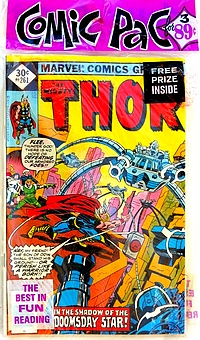
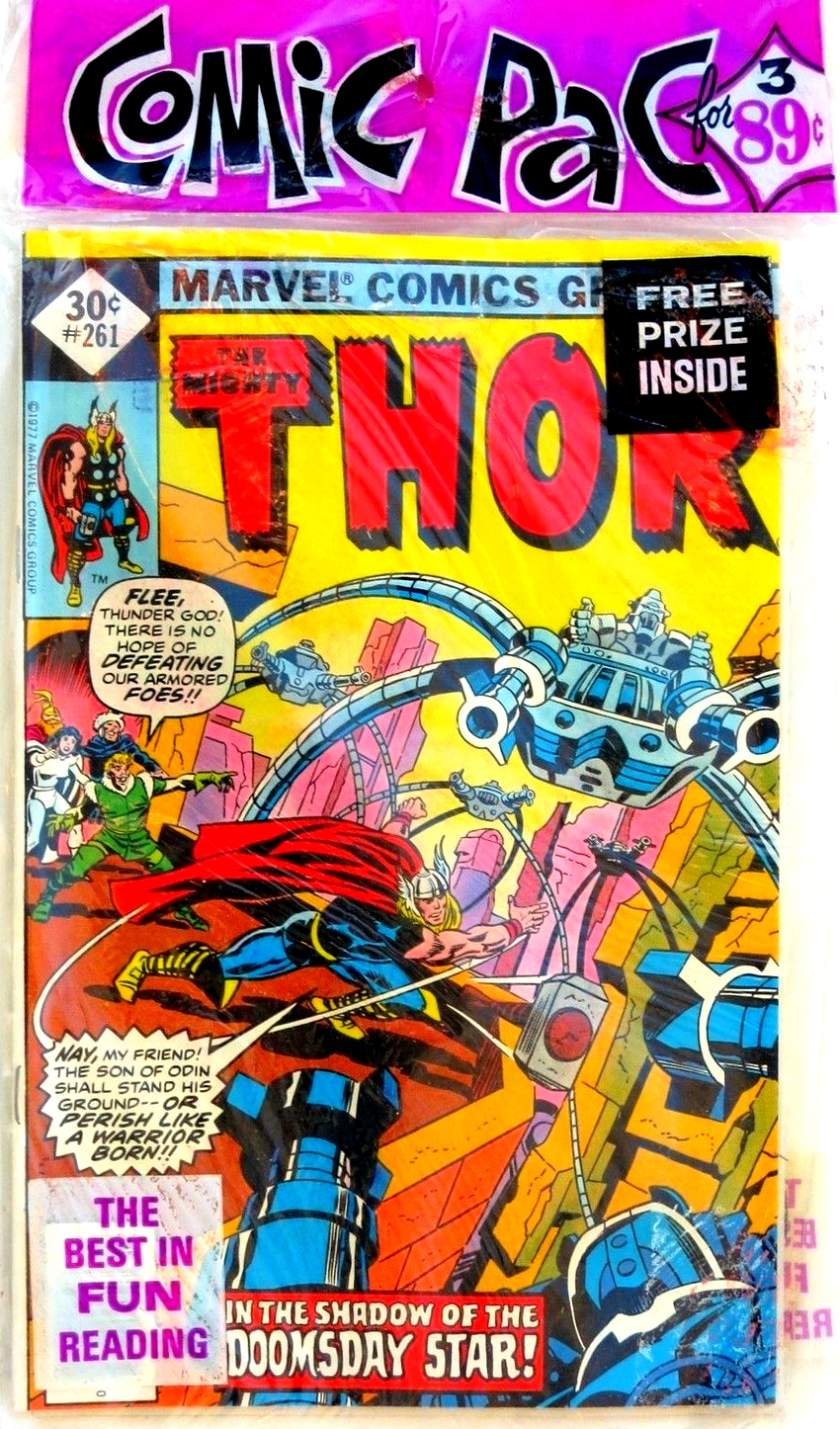
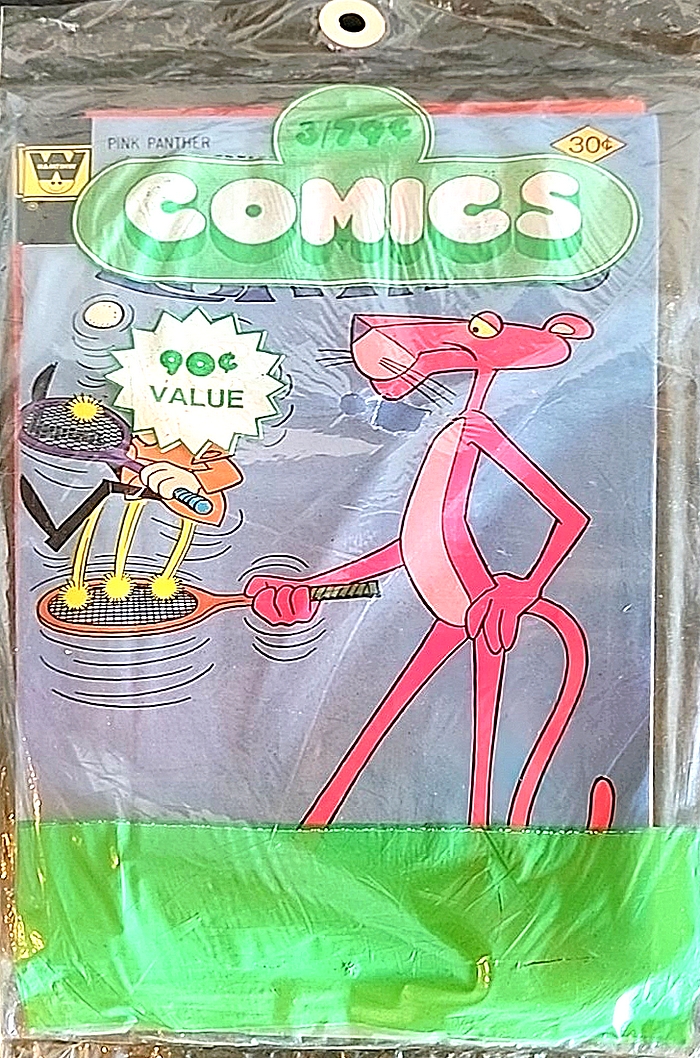
Whitman "CoMiC PaC"
July 1977
(3 for 89¢)
|
|
But although the price of the
comic books contained in the Whitman comicpacks
in July 1977 was still 30¢ each, Whitman raised
the price for a comicpack from 79¢ to 89¢
(maybe the discount of 11¢ had proven to eat
into profits too much), and that change ushered
in a new design in July 1977: the CoMiC PaC
(3 for 89). There
was still no explicit reference to Whitman on the
polybag, but it did feature two blurbs: "The
best fun in reading" and "Free
prize inside" (which turned out to be
either Korean or Indonesian banknotes worth next
to nothing). However, this polybag design (which
was used by Whitman across the board of its comic
book offerings) only lasted until November 1977,
when Marvel finally raised its cover prices -
triggering yet another polybag design, as three
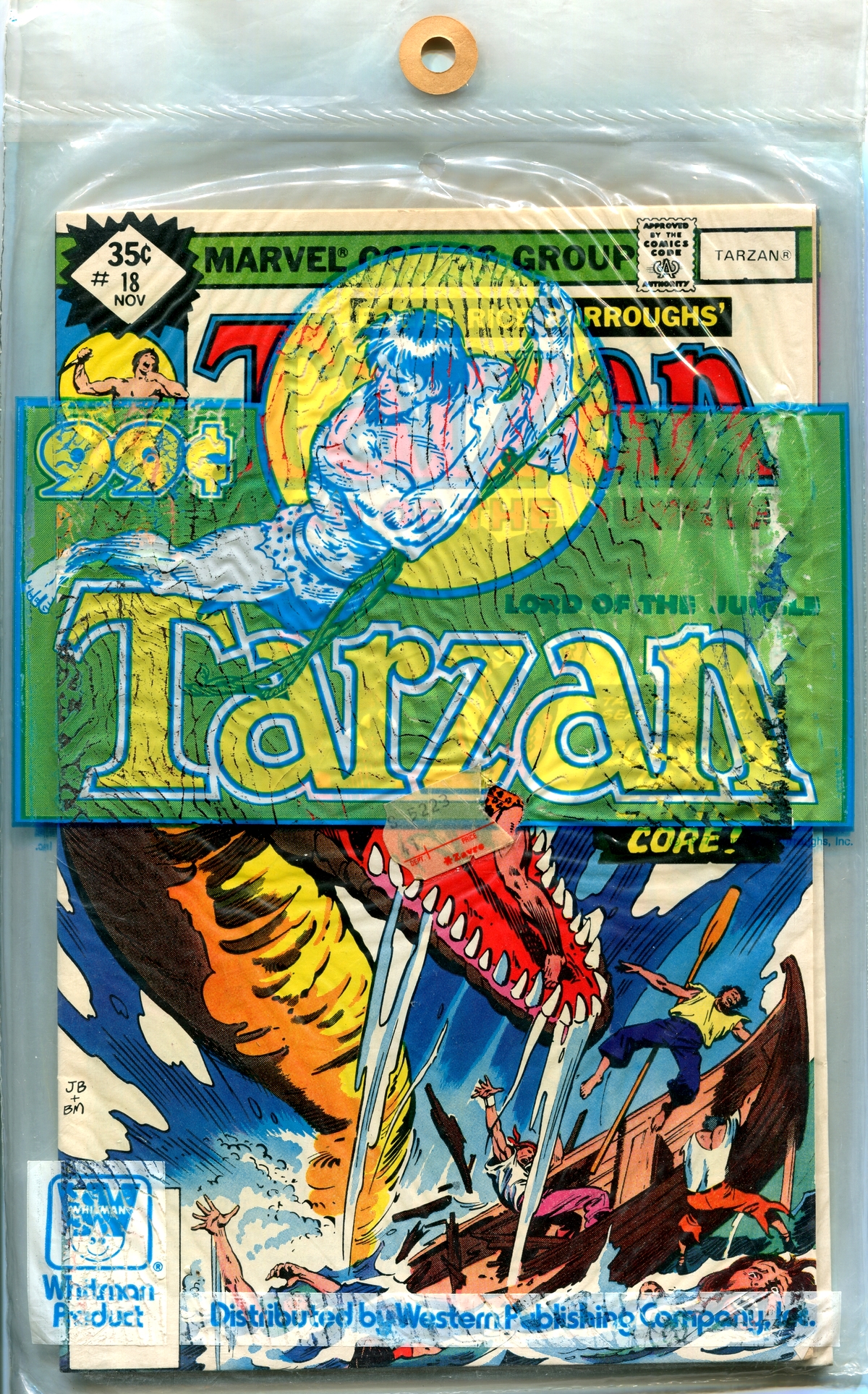
comic books now sold for 99¢.
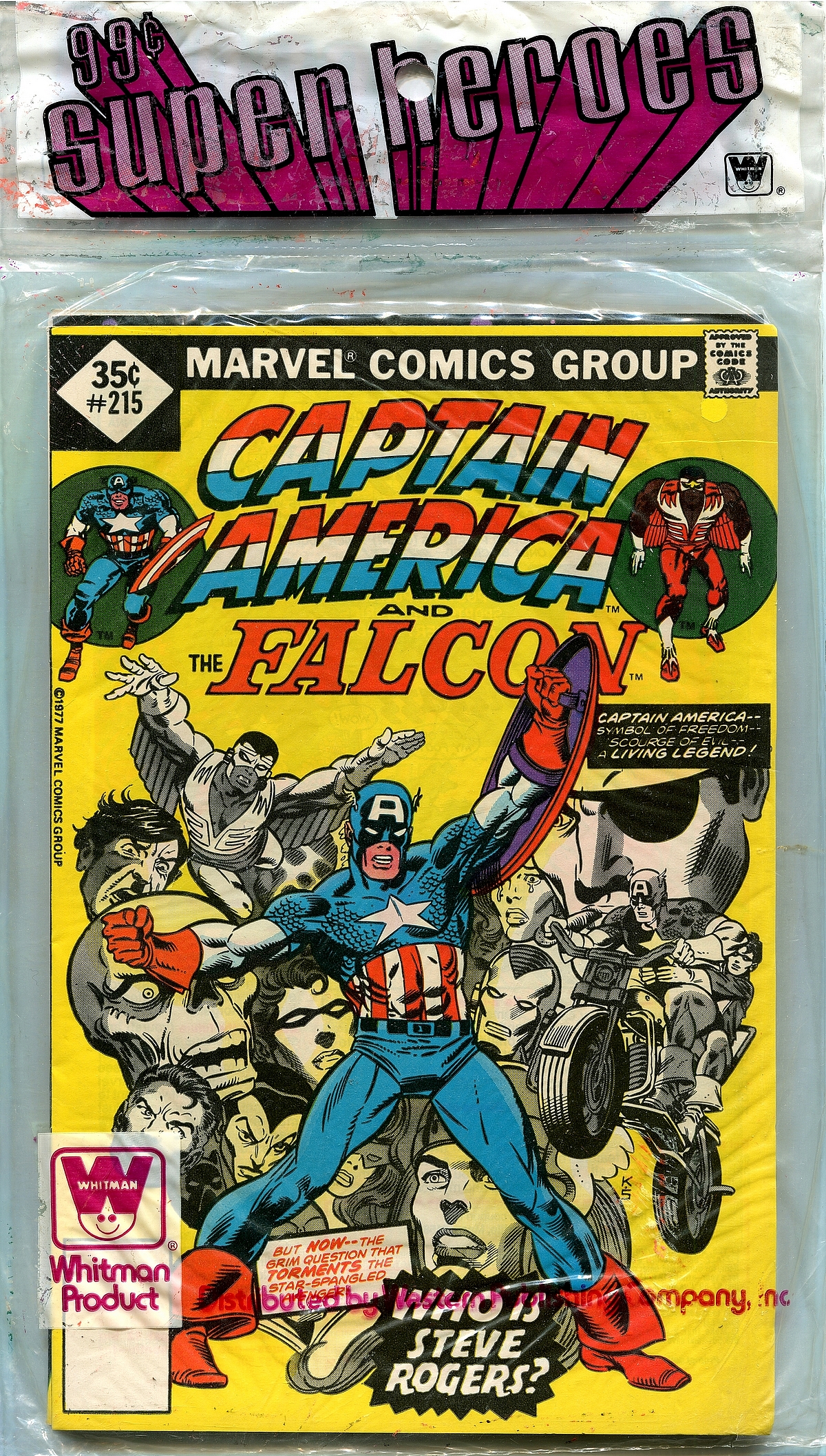
The third design in nine
months did, however, end up feeling more
appropriate, as the bag's hanger now featured the
header text "super heroes". It
was also the first to explicitly label the bag as
a Whitman product, with two "face"
logos and the taglines "Whitman
Product" and "Distributed by
Western Publishing Company Inc".
|
|
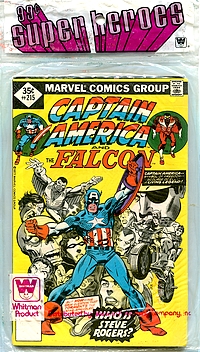
Whitman
"super heroes"
November 1977
(3 for 99¢)
|
|
| |
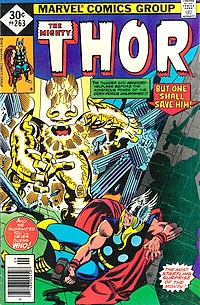
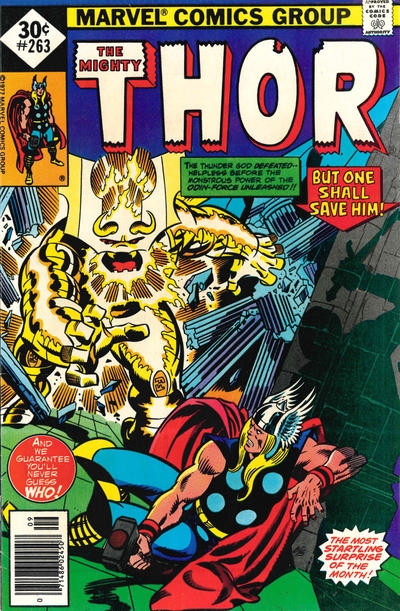
Thor #263
September 1977 (with barcode)
|
|
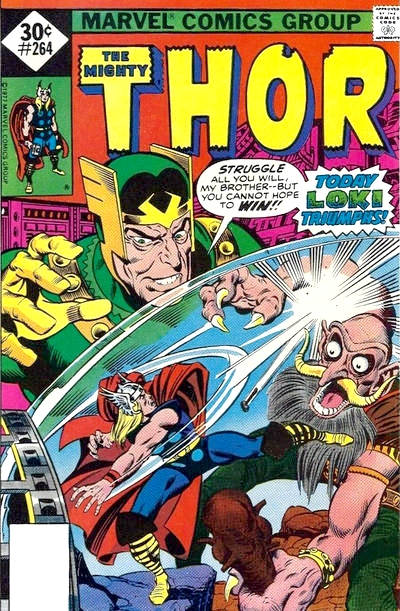
But even before the polybag
changed as of November 1977, another change had
worked its way onto the covers of the comic books
contained within the plastic bag the previous
month, in October 1977: the UPC barcode was
dropped, leaving an empty box where the newsstand
(and UK pence price variants) copies still
carried those zebra stripes. This of course did away with
the need to have a polybag design that covered
and obscured the barcode, in order to ensure that
cashiers didn't scan and ring up the price for a
single comic book (although in practical terms
this was very unlikely, since the salespoint
would not most likely not be selling individual
comic books and therefore not have that barcode
activated in its system).
During the first nine
months of its existence, the Whitman-Marvel
comicpack programme went through an amazing
number of changes. Marvel's rise in cover price
was, of course, nothing that Western could
influence, but all other tweaks did give the
impression that whoever was in charge at the
Whitman end was somewhat making things up as they
went along.
|
|
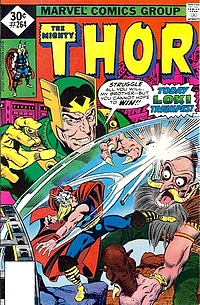
Thor
#264
October 1977 (no barcode)
|
|
| |
| Yet another change that occured
in the autumn of 1977 was, however, a decidedly strategic
one - and one that would pay off big time for both Marvel
and Whitman. |
| |
| |
THE
STAR WARS PHENOMENON
|
| |
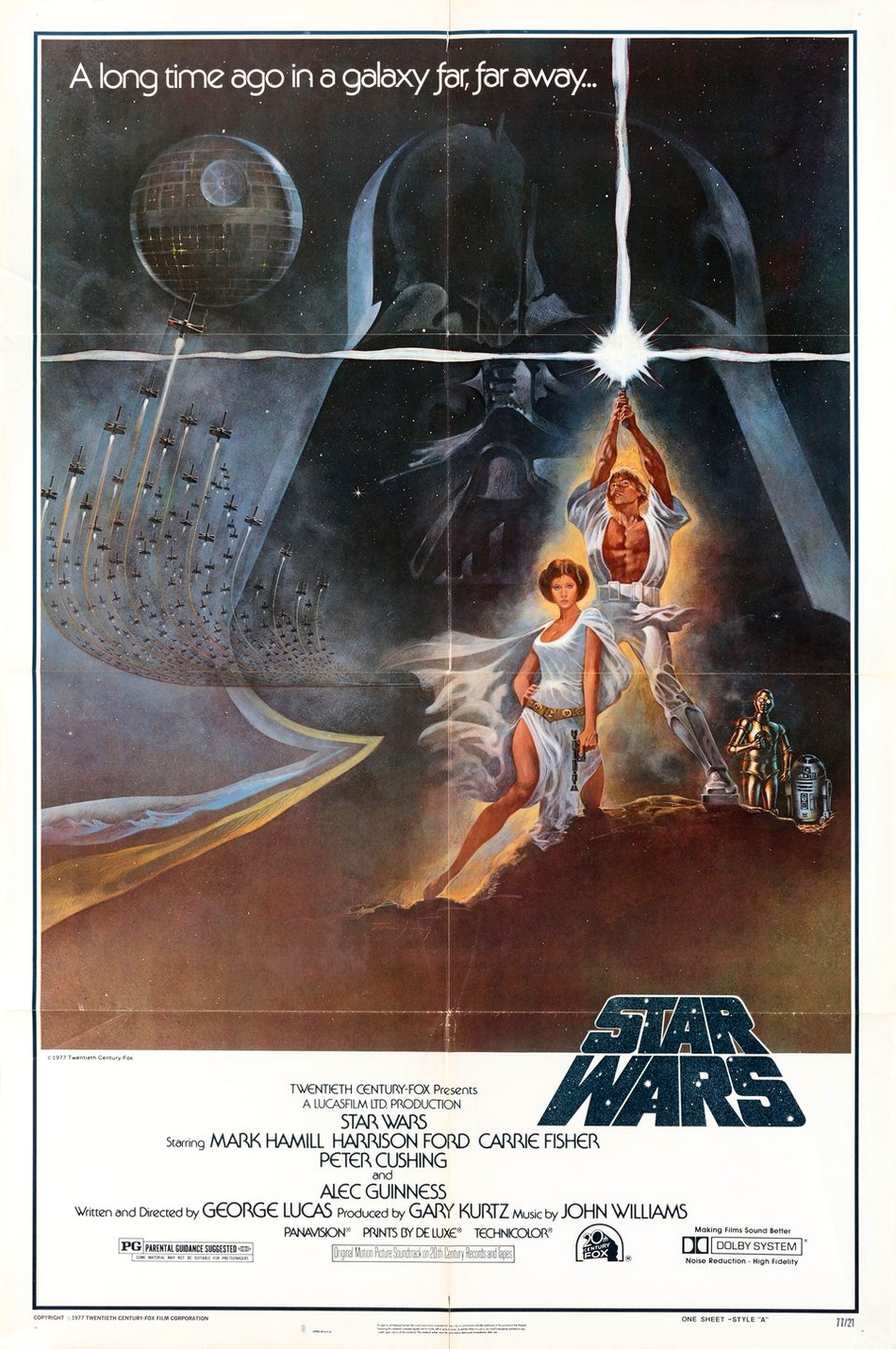
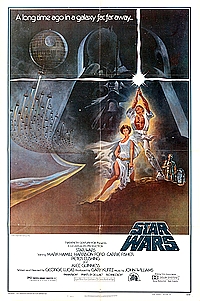
| On May 25th
1977, a movie called “Star Wars” premiered in
the US - and started what would become a worldwide
popular cultural phenomenon. |
| |
| And yet it hadn't been an easy
project for writer and director George Lucas;
every studio had turned down the pitch script,
with the sole exception of 20th Century Fox
(Shone, 2004). The studio was, however, expecting
the film to end up being of limited financial
success, which resulted in a relatively low
budget and production moved to the less expensive
venue of Elstree Studios in England, in order to
stretch the money available (Moore, 2022). Roy Thomas knew about the
movie and was in contact with George Lucas, and
just as Thomas had done a few years earlier for
Conan, suggested to higher powers at Marvel that
they should license Star Wars as a comic
book adaptation. But just as had been the case
with the movie, it wasn't an easy sell.
"There was a
lot of opposition to Star Wars. Even
Stan wasn’t keen on the idea. Even I
[Jim Shooter] wasn’t. I had no
prejudice against science fiction, but
wasting time on an adaptation of a movie with
a dumb title described as an “outer
space western?” (...) I was told (...)
that George Lucas himself came to
Marvel’s offices to meet with Stan and
help convince him that we should license Star
Wars (...) I don’t know how Roy
got it done (...) but Roy got the deal done
and we published Star Wars."
(Shooter, 2011b)
|
|
 |
|
| |
It would prove to be a pivotal decision, one that in
Jim Shooter's opinion saved Marvel from going out of
business (Shooter, 2011b). Star Wars #1, cover
dated July 1977, went on sale April 12th
1977 - more than a month prior to the premiere of the
film (Roy Thomas wrote his adaptation based on the
screenplay, as can be gleaned from the letters page in Star
Wars #4).
"The first two issues
of our six issue adaptation came out in advance of
the movie. Driven by the advance marketing for
the movie, sales were very good. Then about the
time the third issue shipped, the movie was
released. Sales made the jump to
hyperspace." (Shooter, 2001b)
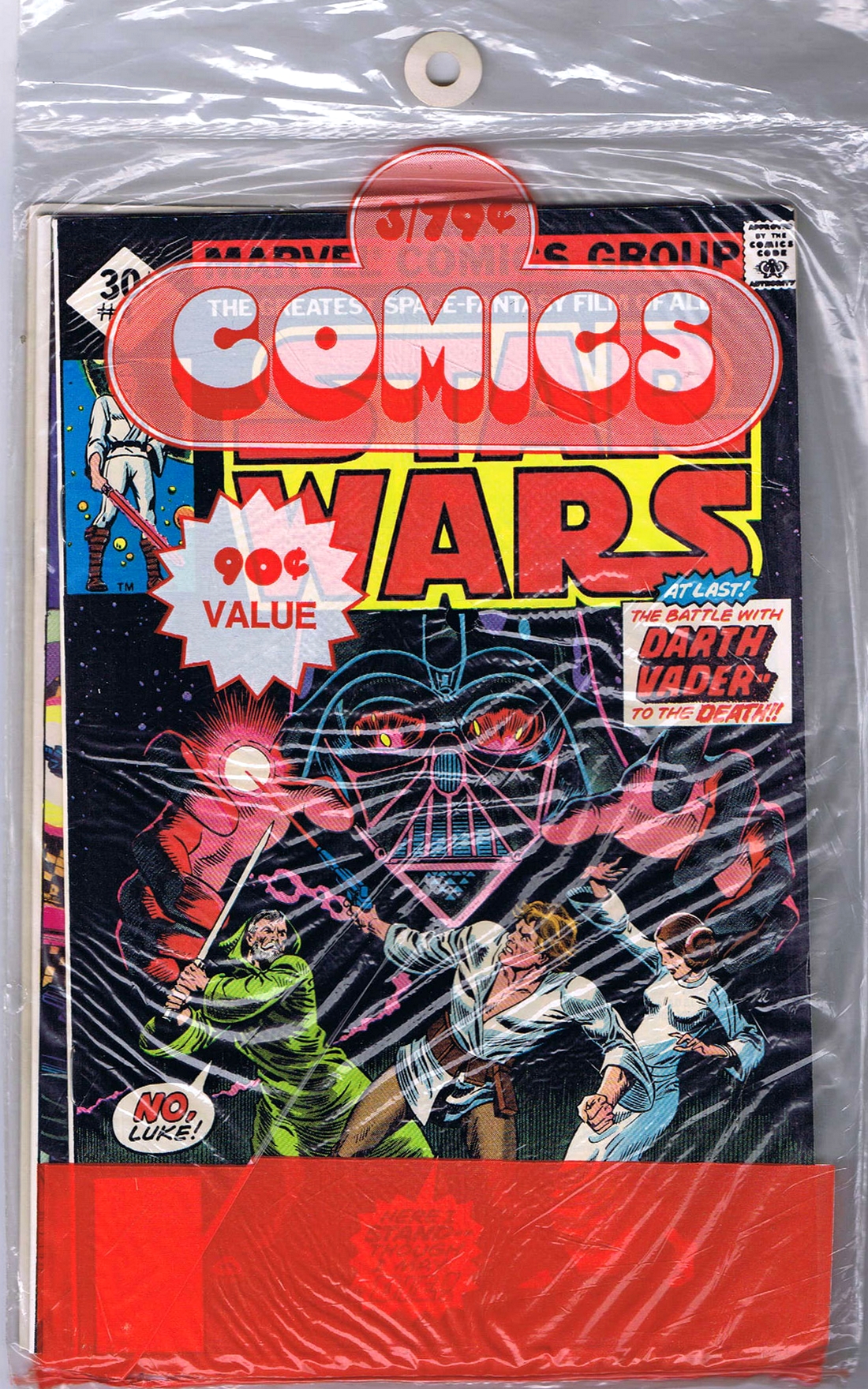
When Whitman became aware of the
landslide success of Star Wars and the comic
book adaptation, they initially simply packaged three
issues of Star Wars in a regular bag.
|
| |
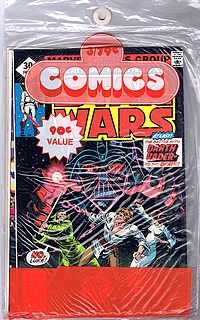
Whitman Star Wars Comicpack
|
|
The fact that they contained
issues #2, #3 and #4 somewhat defeated logic, but
as mentioned before, a distinct lack of common
sense was part of how comicpacks operated at
times. But then someone at Western/Whitman
started to put two and two together, and they
realised just what exactly they had on their
hands.
"When Star Wars was released in
May of 1977, there was an incredible shortage
of merchandising. In fact, the special
magazines put out by Starlog Group, and the
comics series produced by Marvel, were about
the only licensed products that were released
at the same time as the film (...) It was in
this desperate environment that comics
retailers were able to score in a big way."
(Rozanski, 2003)
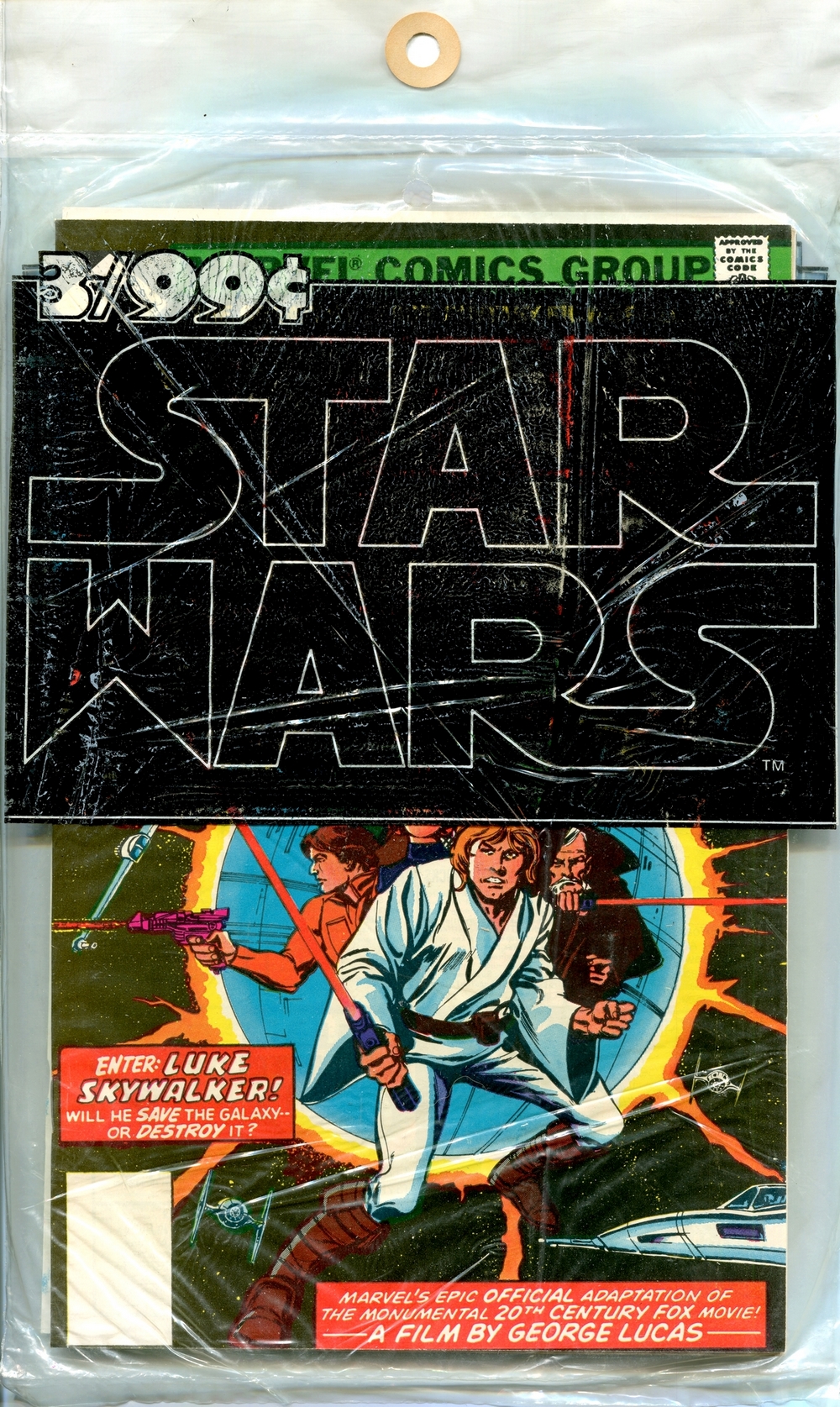
It was an opportunity not
to be missed, and Western was clever and
experienced enough to know exactly what to do.
The regular polybag was not fit for purpose here,
and was quickly replaced with bags that had the
Star Wars logo splashed prominently across half
of its surface - you simply couldn't miss it.
|
|
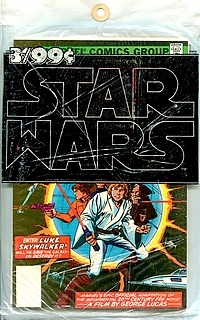
Whitman Star
Wars Themed Comicpack
|
|
| |
| The movie Star Wars had
become a cultural phenomenon and icon almost overnight.
It not only created an instant fanbase but became the
decade's blockbuster film, grossing an incredible $100
million in just three months. |
| |
20th
Century Fox's stock
soared from $6 to $25 per
share (pulling back the
studio from the brink of
bankruptcy) and generated
continuing revenues of
$1.2 million a day.
"Star
Wars the movie stayed in
theaters forever [and]
the comics sold and sold
and sold. We
reprinted the adaptation
in every possible
format. They all
sold and sold and
sold."
(Shooter, 2001b)
As
was the case for 20th
Century Fox, the comic
book adaptation turned
out to be a reprieve from
hard times and a blessing
for Marvel too, as Star
Wars #1 sold over a
million copies with
several reprints and
cover variants (Hoknes,
2018).
The
Whitman comicpack deal
with Marvel now turned
out to be a gold mine for
Western. Printing
capacities were freed up
in order to have more Star
Wars comic books
available (resulting in
no Marvel Whitman issues
other than Star Wars
in January to March 1978,
July 1978, and
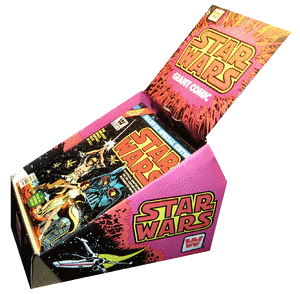
March/April 1979). In
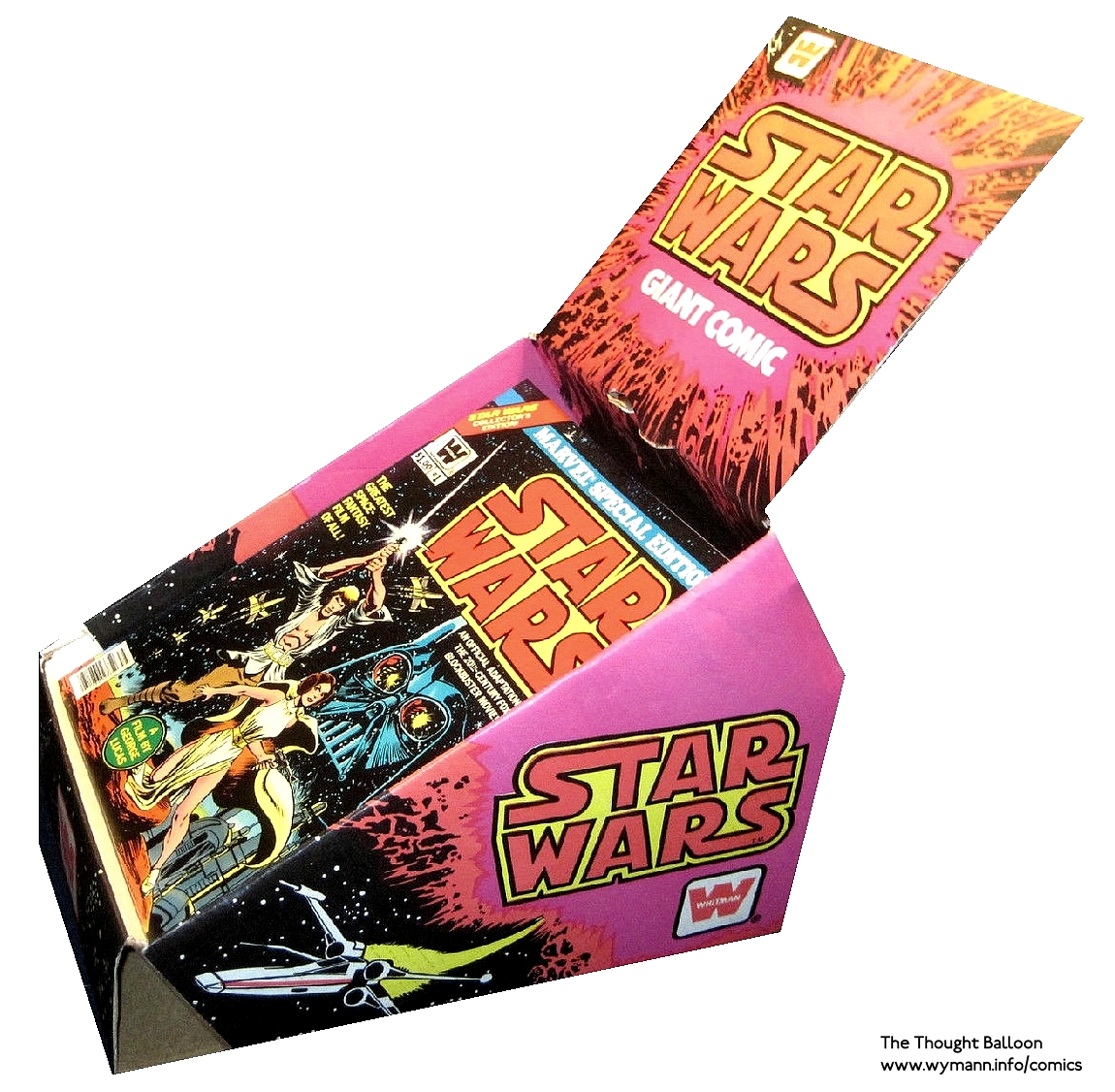
addition, Marvel put out Marvel
Special Edition Star Wars
#1 in July 1977, an
oversize
(10"x14")
collection of the first
three issues of the
regular Star Wars
comic book, which Western
also distributed as a
Whitman logo edition in
specially designed
containers.
|
|
 |
|
|
|
|
|
| |
| Marvel continued the Star Wars title after
the movie adaptation ended with issue #6, and the Whitman
Star Wars comicpacks with three consecutive
issues happily went along for several more iterations. On a side note it is worth noting
that the first six issues of Star Wars included
the only actual reprints Whitman distributed - otherwise,
copies contained in their comicpacks were never reprints
but rather printed at the same place and time together
with the regular newsstand copies.
|
| |
| |
|
| |
| Whilst the production and
distribution of "regular" comicpacks containing
three different Marvel titles continued, the success of
the Star Wars themed polybags inspired Whitman
to try the same thing based on specific Marvel
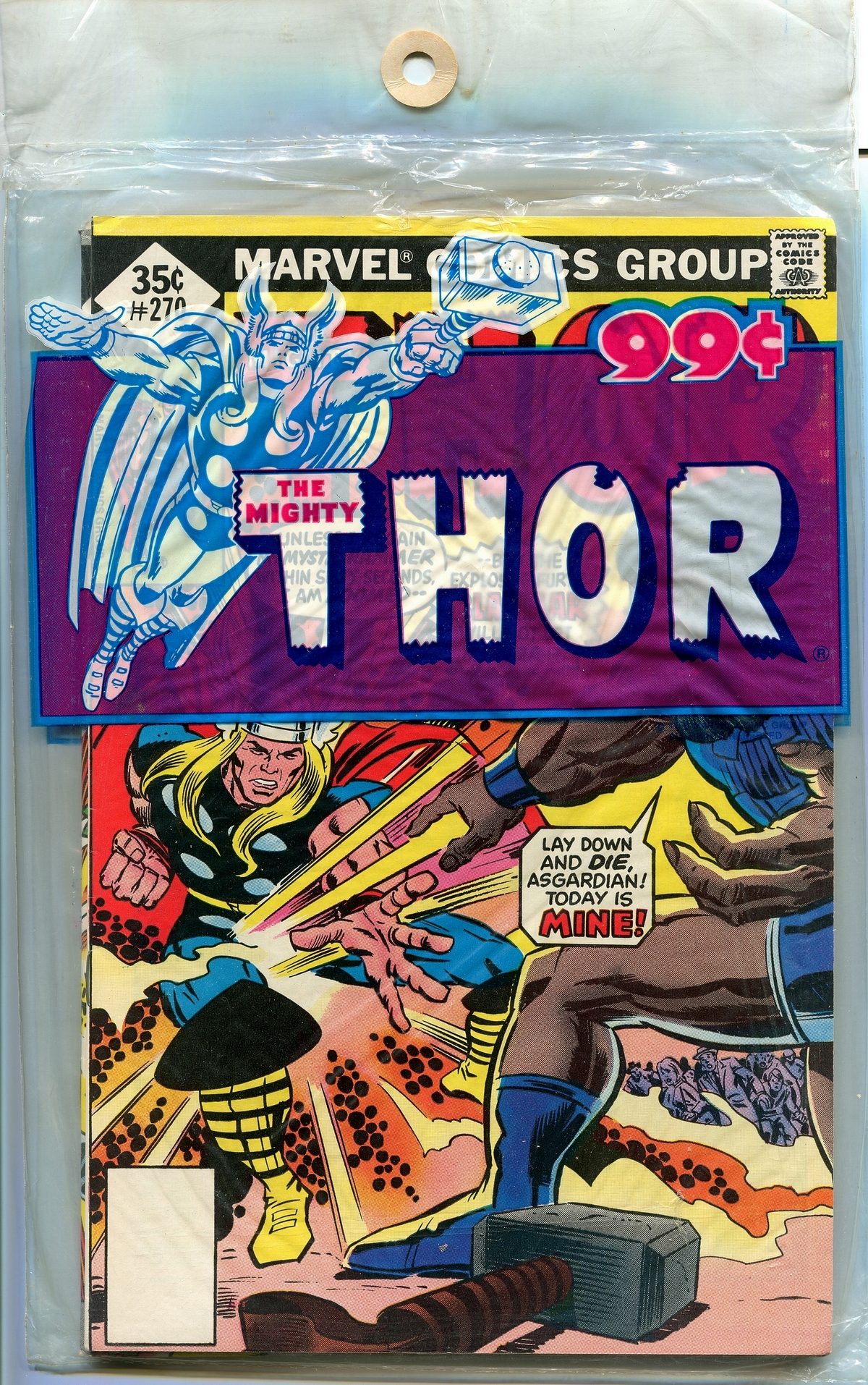
characters. The first confirmed such comicpack appeared
mid-1978, featuring Marvel's God of Thunder and
containing Thor #270 (April 1978), #271 (May
1978), and #272 (June 1978). |
| |
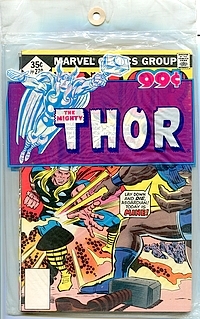
Whitman Thor Comicpack
|
|
As with the Star Wars
themed comicpacks, a bespoke bag design and logo
was introduced, which clearly also acted as
"billboard advertising". 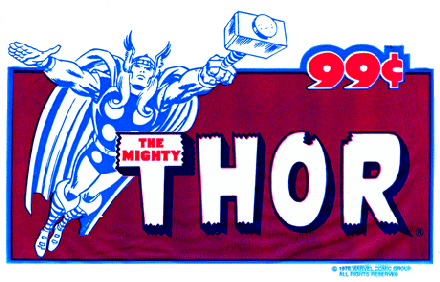
|
|
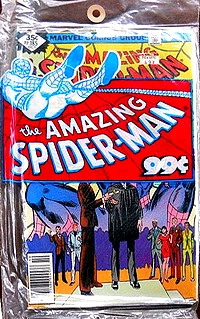
Whitman Spider-Man
Comicpack
|
|
| |
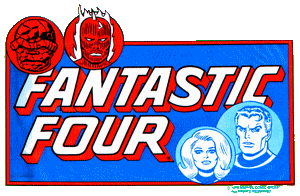
The initial Thor
themed comicpack was followed by at least two
more (containing issues #274-276,
August-September 1978, and issues #277-279,
October-December 1978). Other than Thor, Whitman
produced themed comicpacks for Spider-Man,
Captain
America, Hulk,
Conan
and the Fantastic Four in 1978 and 1979.
 |
|
Themed comicpacks
required a fair bit of advance planing,
since packaging three consecutive issues
of one title meant a waiting period of 60
days for a monthly title. This also meant
advance financing plus storage for two
issue runs before the third became
available and all three could be packaged
into one polybag - all of which explains
why the number of themed comicpacks
distributed by Whitman remained
relatively limited. They didn't, however,
limit them to classic Marvel characters.
|
Apart from releasing themed
comicpacks for Disney and other animated cartoon
characters in 1979, Whitman also issued several
themed comcipacks for characters and properties
that Marvel had licensed.
|
|
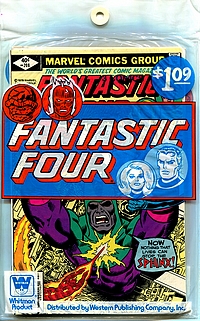
Whitman Fantastic
Four Comicpack
|
|
| |
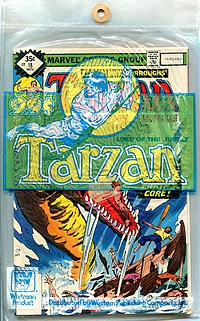
Whitman Tarzan Comicpack
|
|
The House of Ideas
was in an excellent position to do so after the
Star Wars triumph and fully embraced that policy
in the late 1970s with titles such as Tarzan,
Micronauts, and Battlestar Galactica
in appropriately labelled bags. DIRECT MARKET
EXPANSION - DIAMONDS ARE A PUBLISHER'S BEST
FRIEND
The
"Whitman diamond" appeared on Marvel
covers dated from February 1977 to April 1980,
with the exception of three gaps in printing:
January to March 1978, July 1978, and March/April
1979 (McClure, 2010), and the issues thus marked
were exclusively destined for packaging into the
Whitman comicpack bags (Miller, 2010).
During this
period of time, the "direct market"
(which would purchase comic books from the
publishers at a discount but on a non-returnable
basis) became an interesting alternative to the
classic newsstand distribution (with its returns
of unsold issues), not the least because sales
through the classic outlets (served by newsstand
distribution) were dropping and the number of
comic book shops was rising (Rozanski, 2004b).
|
|
| |
| And so Marvel put out the first direct market edition
(DME) copies, distributed exclusively to comic book
specialty stores, with the May 1979 cover date production
run. Whilst Marvel wasn't really
copying Western's direct market distribution business
model (since the comic books were sold to comic book
stores as batches of individual issues and not packaged
in comicpacks containing three different issues), the
House of Ideas didn't produce its own concept of how to
mark and distinguish non-returnable DME copies from
returnable newsstand copies and simply decided to copy
Western's diamond design to replace the Curtis
Circulation symbol.
|
| |
This was possibly facilitated
by the fact that Marvel DME single issue copies
and Whitman DME comicpack issues would co-exist
for almost a year, from May 1979 to April 1980,
and coming up with two different identifiers
hardly made economical sense.
However, a
slight redesign did take place as the cover
mastheads had dropped the "starburst" still
only 35¢ blurb a
month prior, since the cover price was set to go
up to 40¢ as of the May 1979 cover date
production run. This made it possible to decrease
the size of the character box and move it upwards
a bit, and since this change left less room for
the diamond, the design was squeezed slightly -
resulting in a "flat" diamond.
However, this
diamond redesign didn't offer enough space for
the issue number and the cover date month, so the
latter was simply dropped.
In addition
to the diamond marker, the direct market cover
needed the barcode invalidated, so Marvel
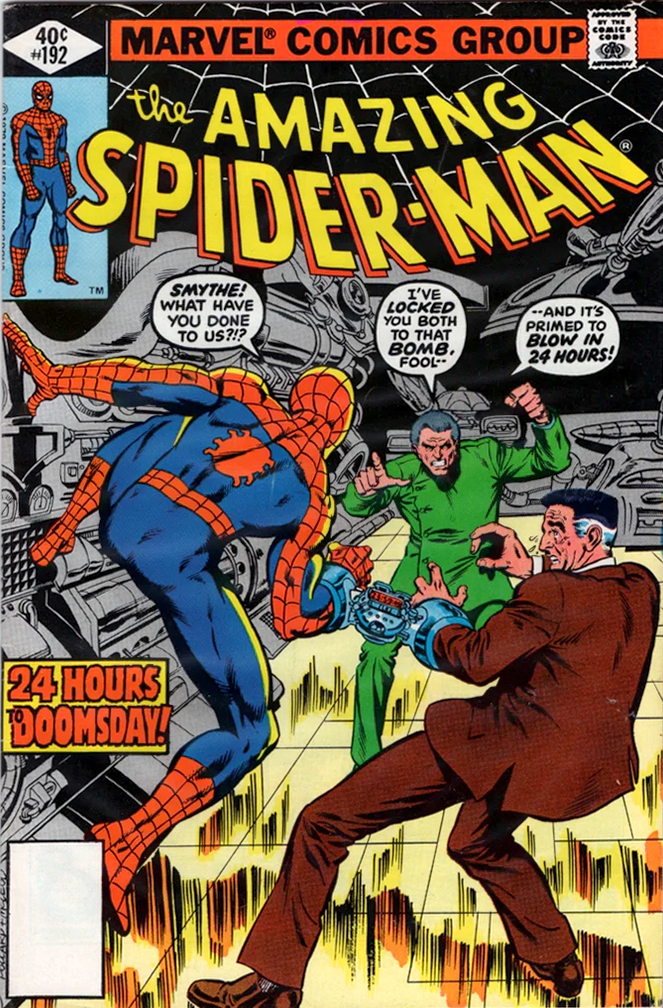
initially just took on another Whitman solution
and simply went with an empty white box. However,
someone at Marvel clearly didn't like the look of
that.
|
|
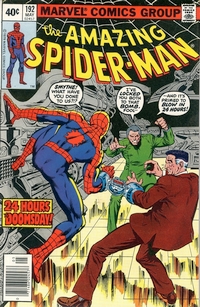
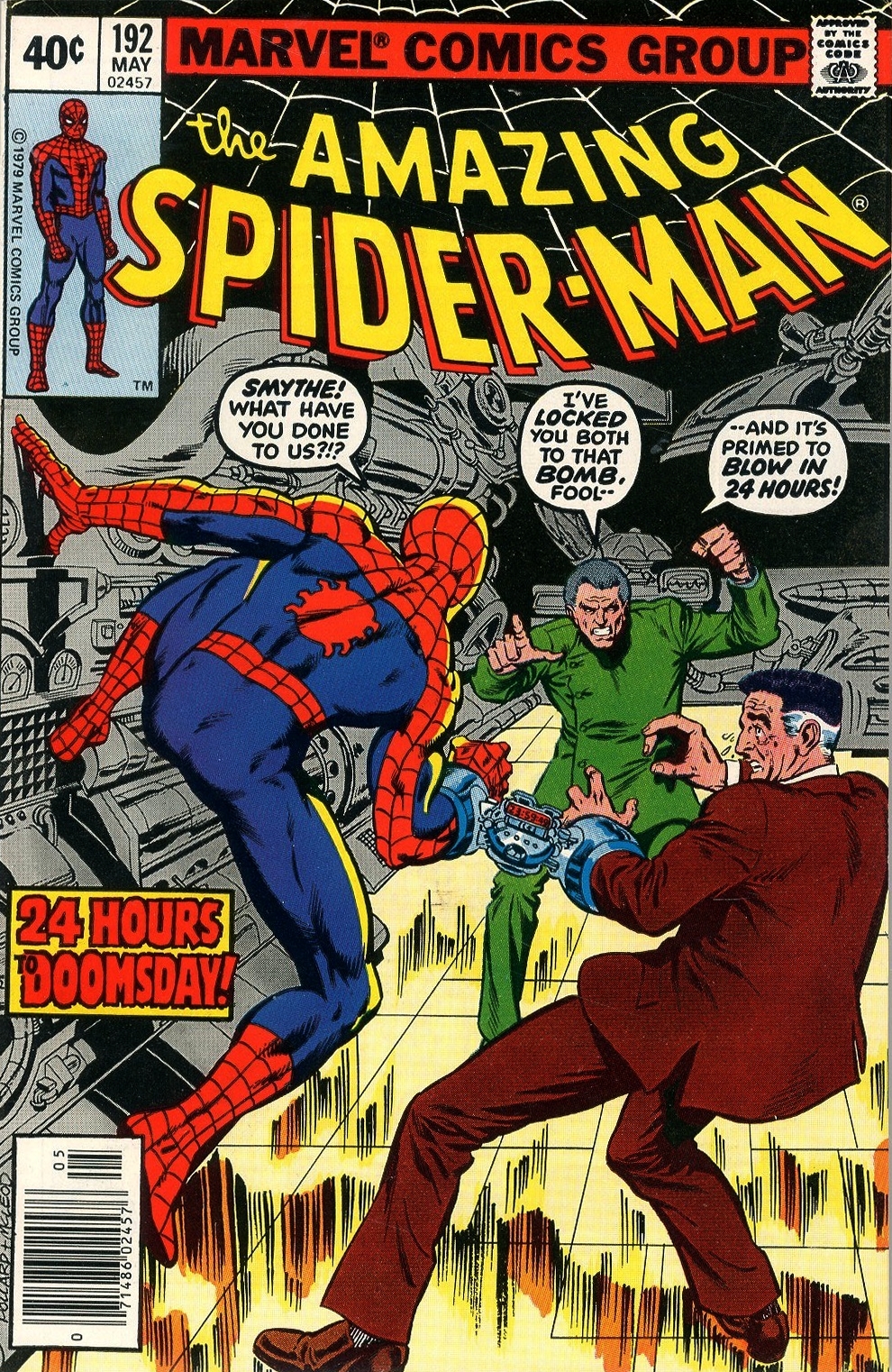
Amazing Spider-Man
#192
May 1979 (Newsstand)
|
|
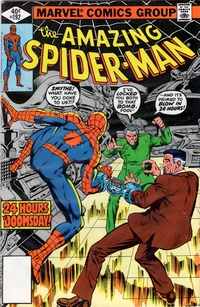
Amazing
Spider-Man #192
May 1979 (Direct Market)
|
|
| |
| Whether it was a simple case of horror
vacui or a feeling that the empty box could
give rise to the impression that there was a
printing error ("there is a box, there must
be something in it that's missing"), all
next month's titles regained the barcode but
featuring a diagonal line through it (since it
needed to be made unreadable). And since, again,
it didn't make any sense to have two separate
cover designs, Whitman followed suit and adopted
the barcode with diagonal line for its comicpacks
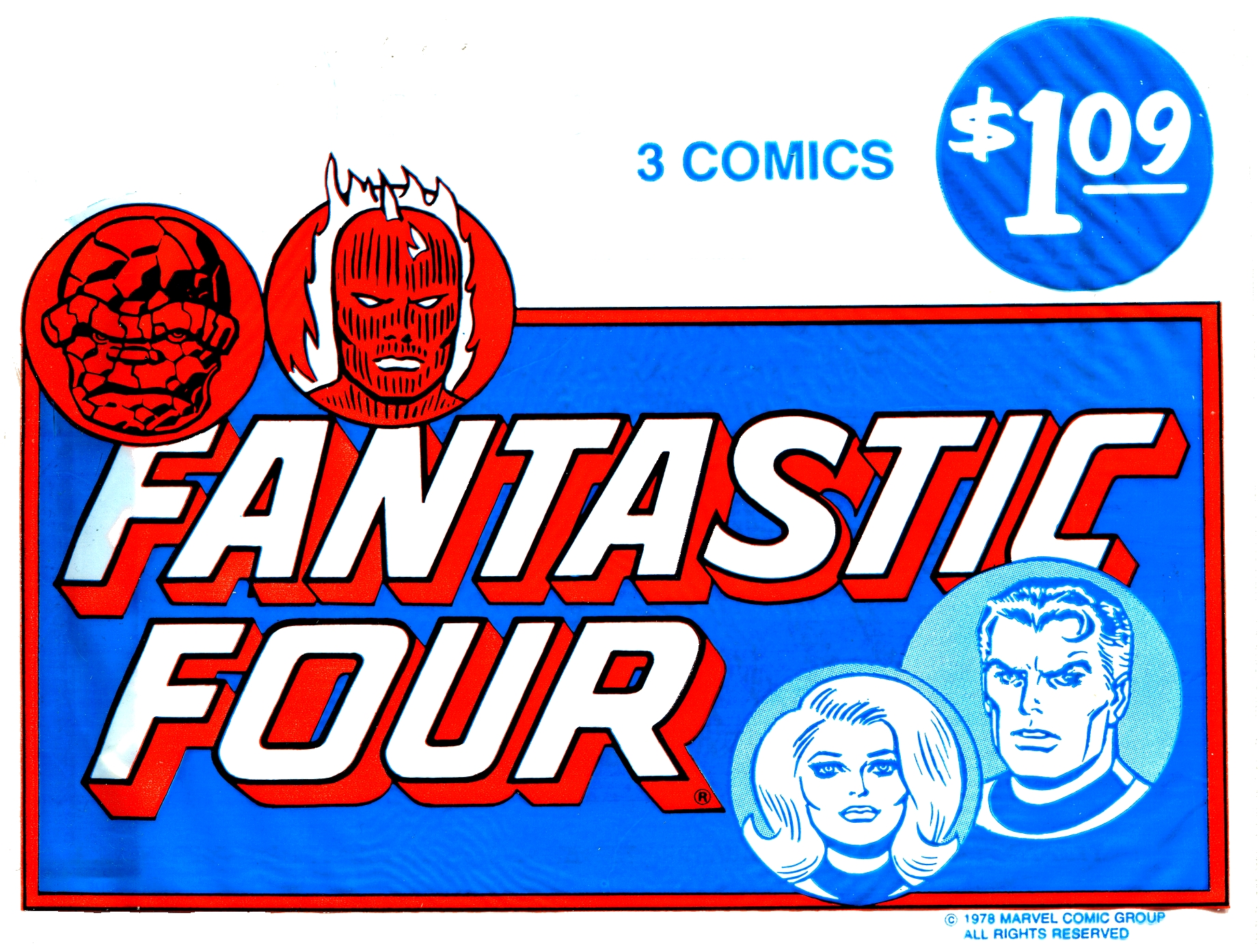
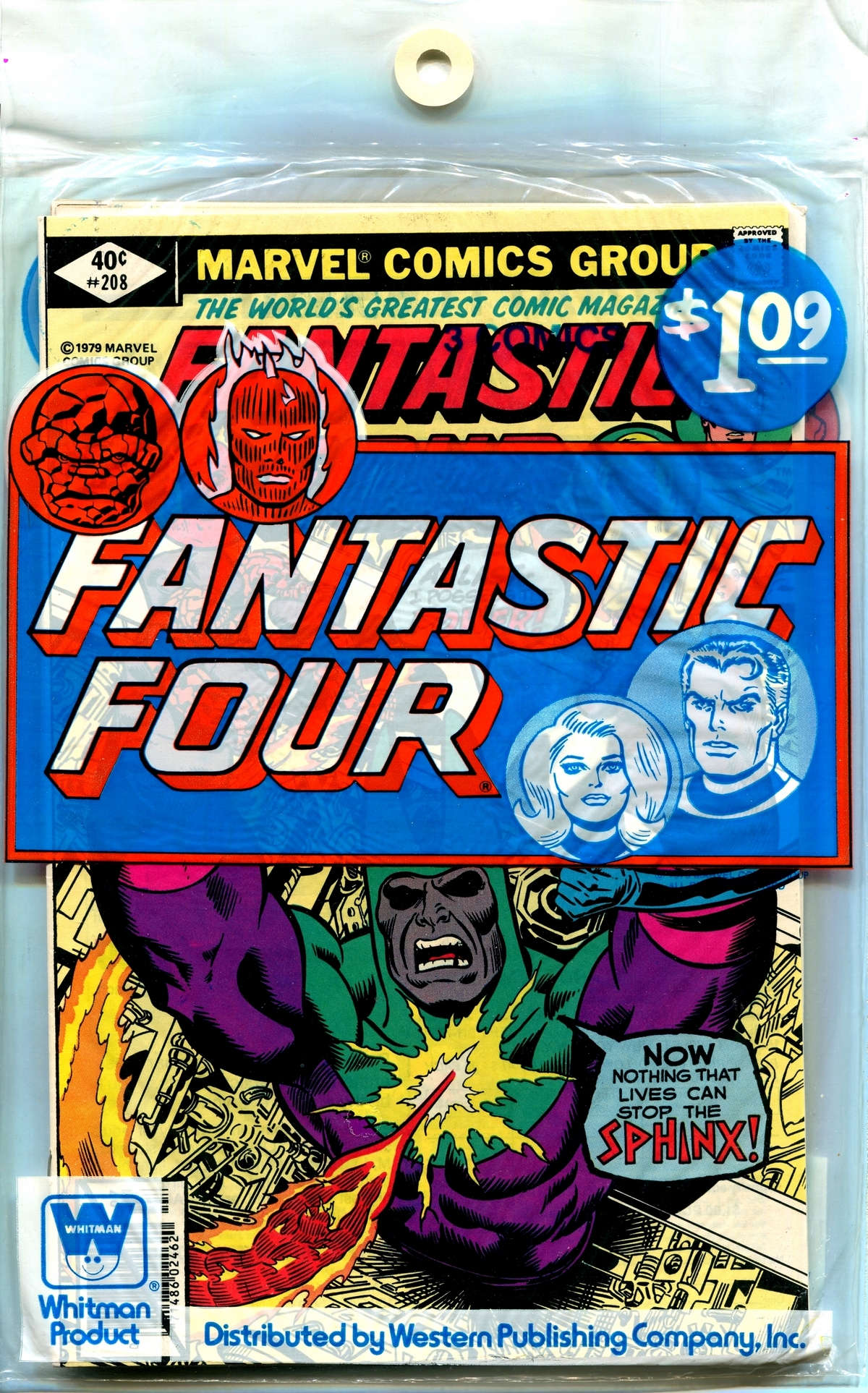
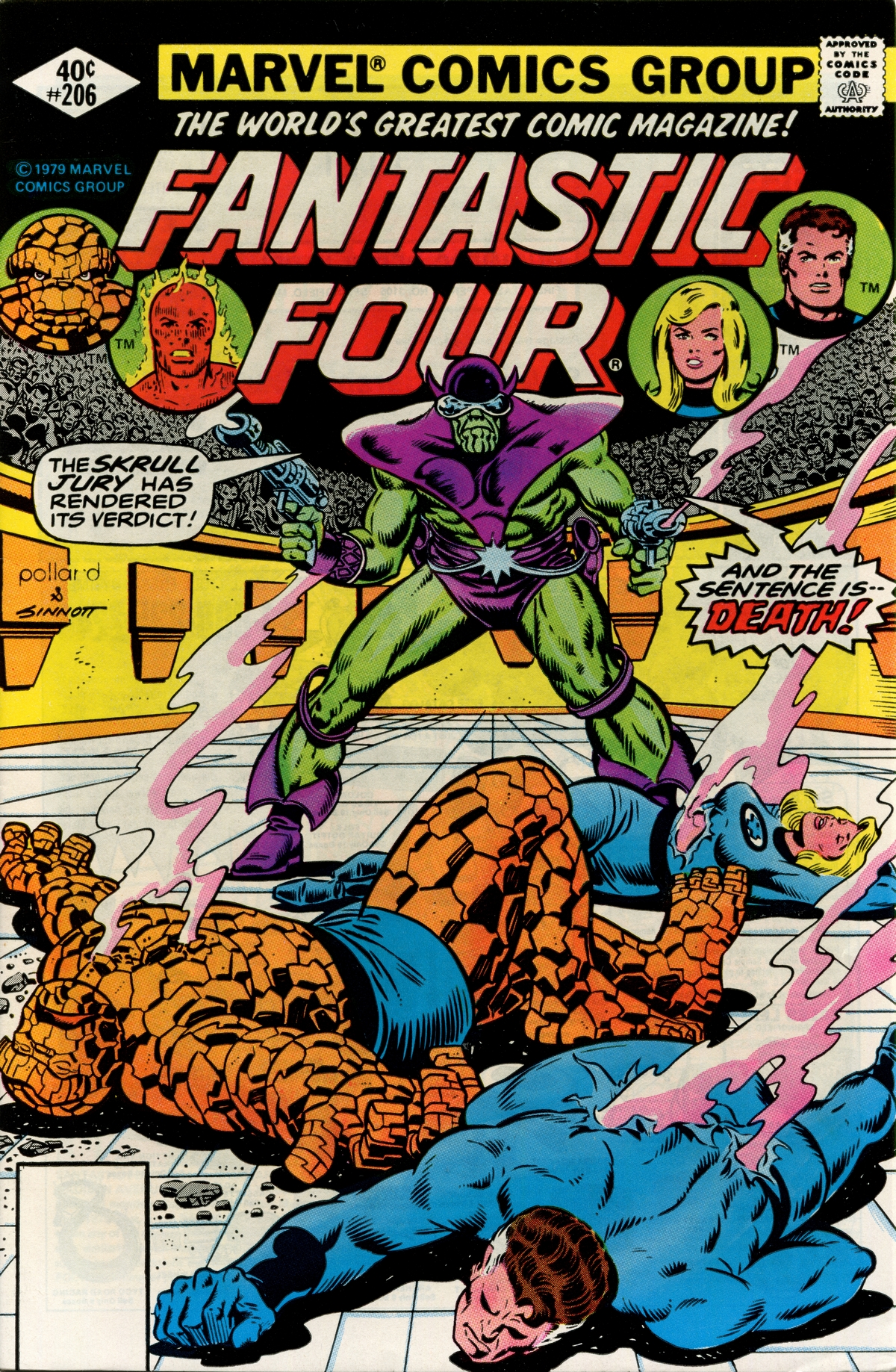
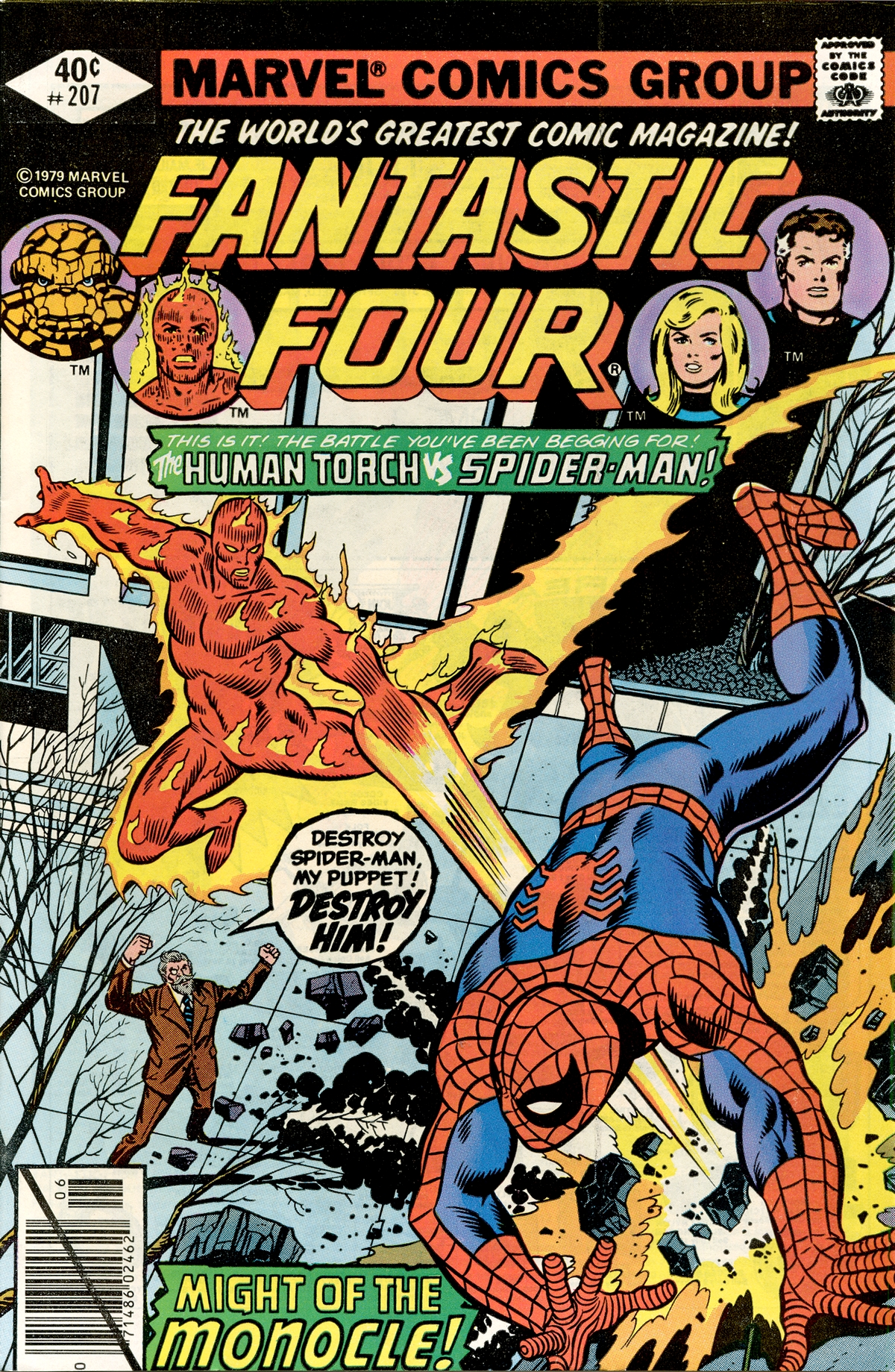
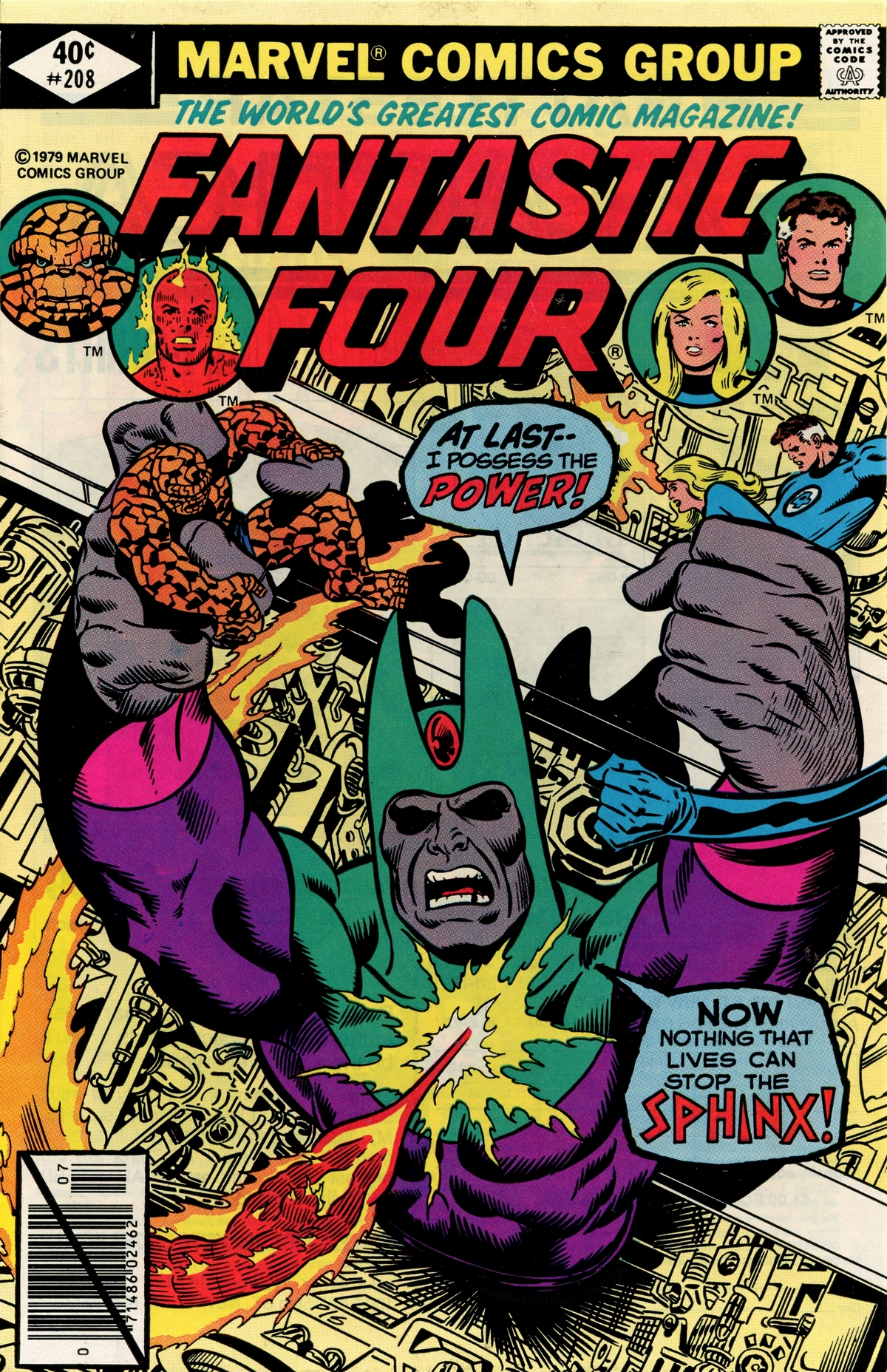
too. In some cases, this
meant that a Whitman comicpack could contain both
design variations, such as the themed Fantastic
Four pack that came with issues #206 (empty
barcode box), #207 (strike-through barcode), and
#287 (also strike-through barcode).
|
|
| |
Whitman Fantastic
Four Comicpack
(issues #206-208)
|
|
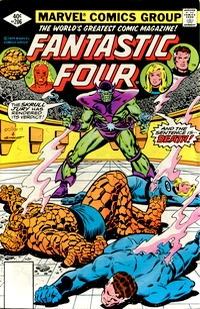
Fantastic Four
#206
(May 1979)
|
|
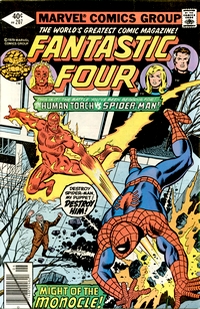
Fantastic Four
#207
(June 1979)
|
|
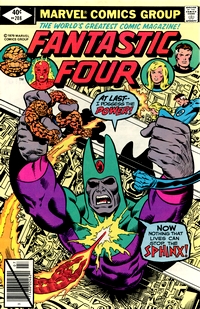
Fantastic Four
#208
(July 1979)
|
|
|
|
|
| |
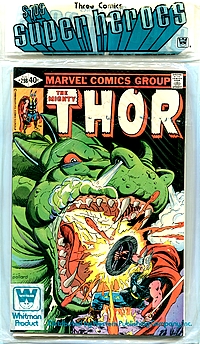
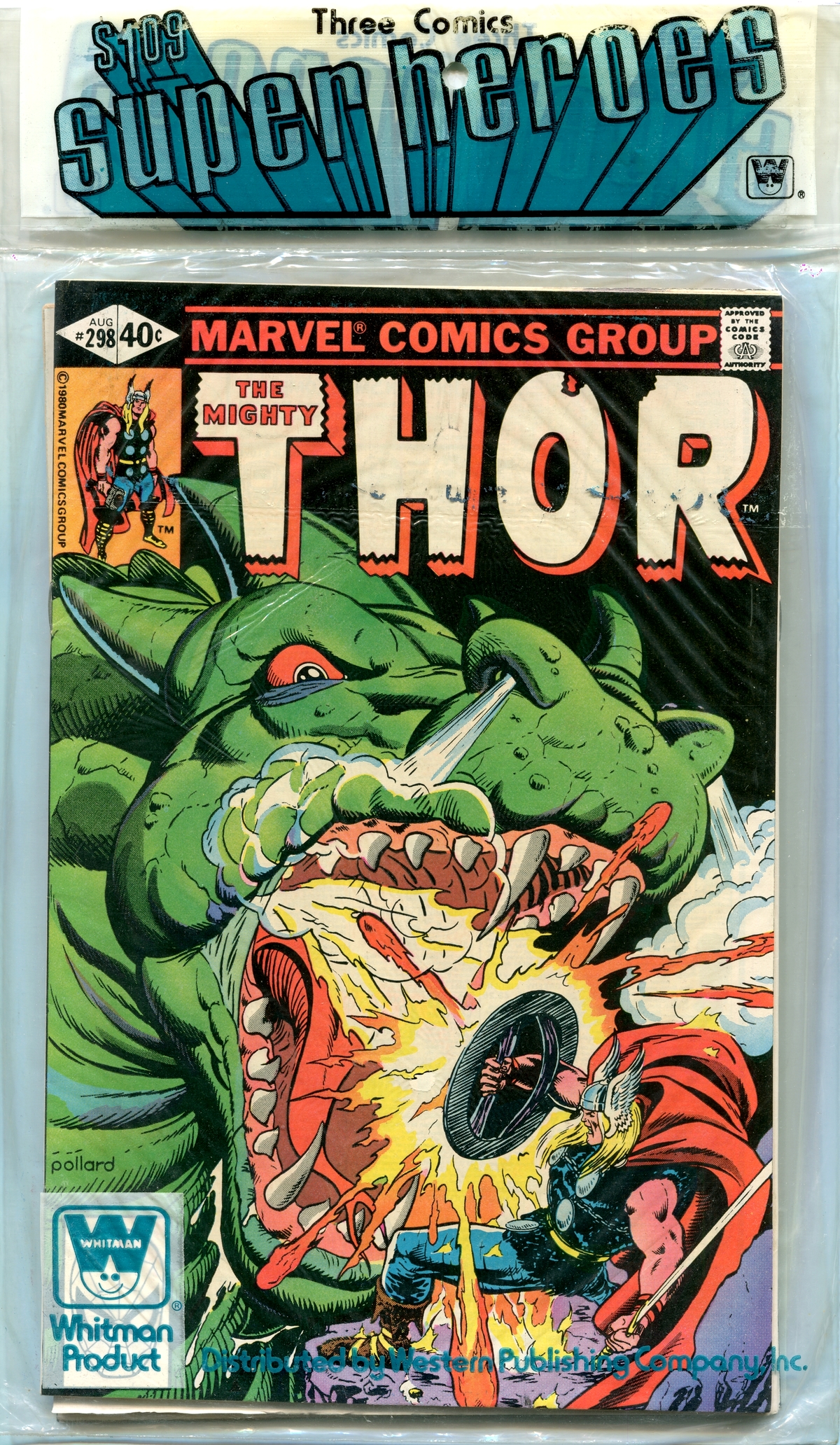
Whitman Super Heroes Comicpack
(August 1980)
|
|
Coinciding more or less with
Marvel's decision to systematically start
distributing comic books to the direct market,
Whitman's interest in Marvel titles began to
fade, and the flow of their comicpacks featuring
titles from the House of Ideas started to thin
out rapidly. The last
known example carried three issues from the
August 1980 cover date publication cycle (Thor
#298, Iron Man #137, and Captain
America #248), and incidentally used the
same polybag design that Whitman also used to
package its DC comicpacks at the time.
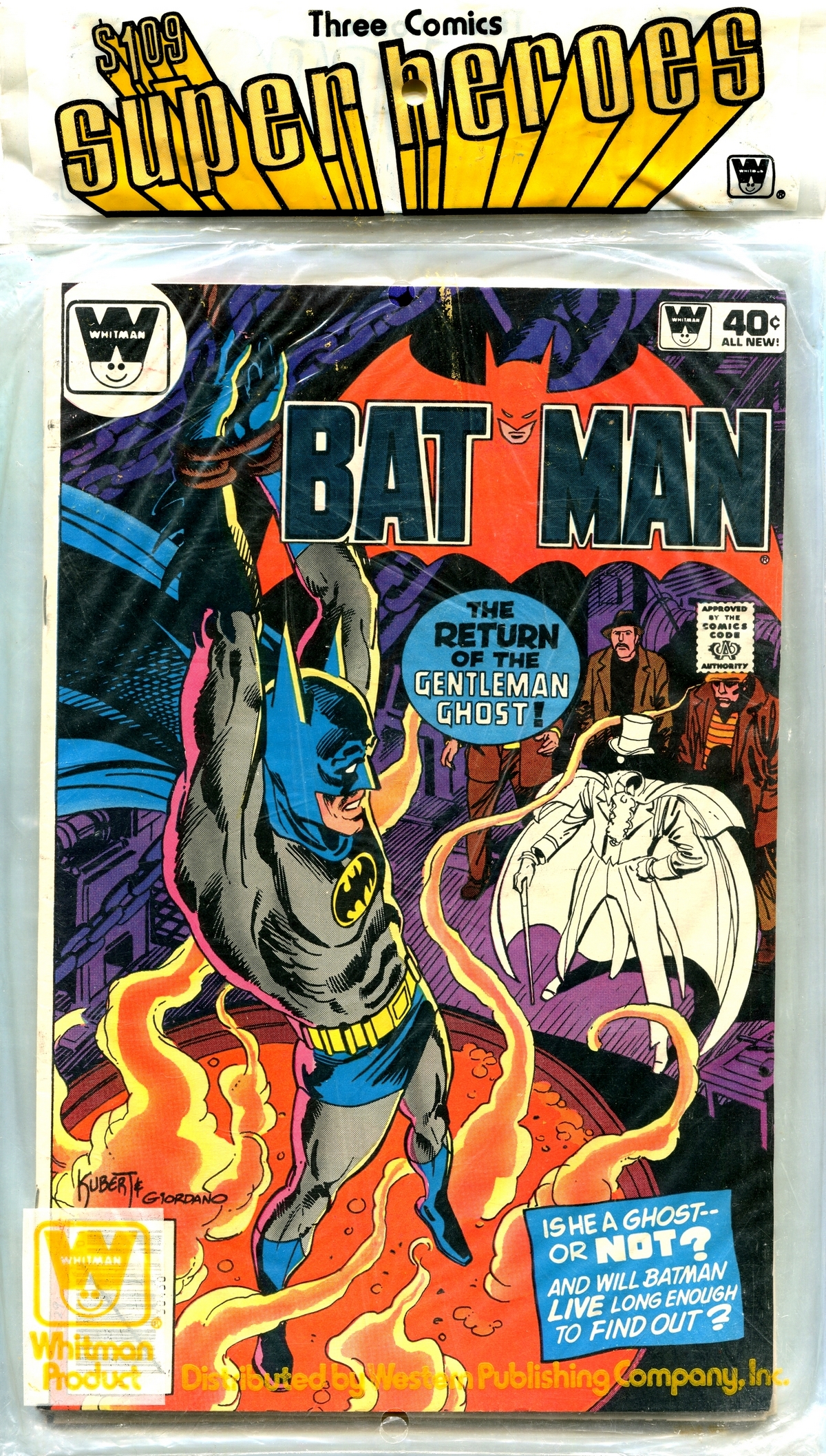
Whitman and DC had worked
together since March 1978, and that is where
Whitman shifted its focus to by late 1979.
"The
Western [comic packs] program was enormous -
even well into the '70s they were taking very
large numbers of DC titles for distribution
(I recall 50,000+ copies offhand)."
(Paul Levitz, in Evanier 2007)
Whitman's
collaboration with DC also left much more of a
mark than their business deal with Marvel ever
did.
|
|
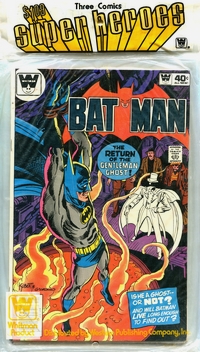
Whitman DC
Comicpack
(January 1980)
|
|
| |
| The point of leaving a mark can
be taken quite literally in this case, as issues carried
in Whitman's comicpacks lost their DC cover logo, which
was replaced by the familiar "Whitman face". |
| |
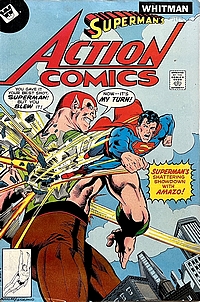
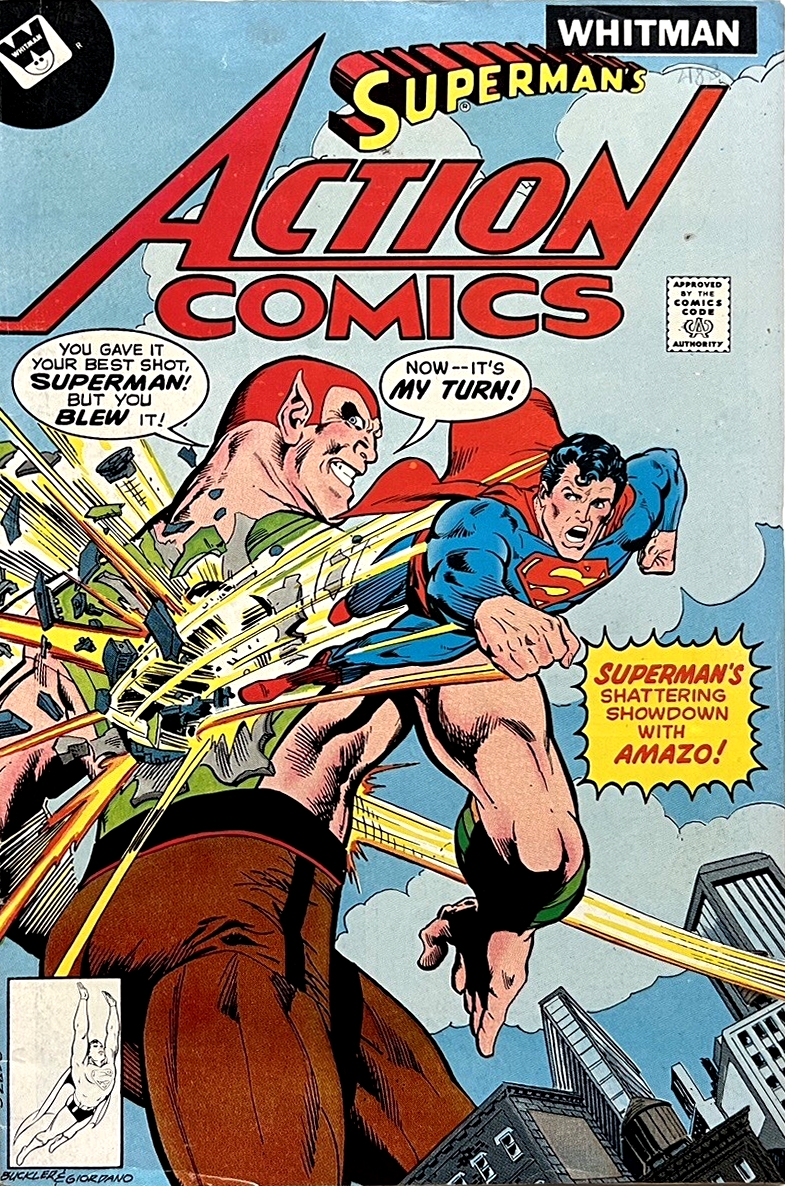
Action Comics
#483
(May 1978, Whitman)
|
|
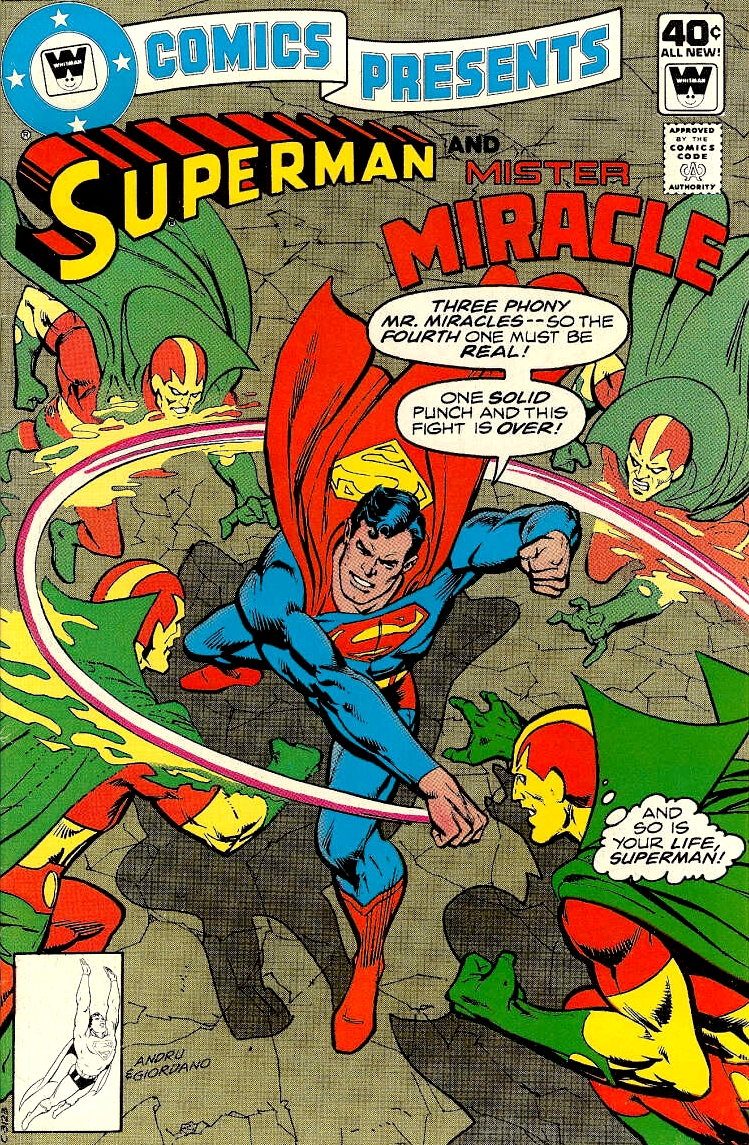
For the first few months of the
programme covers even had a WHITMAN
text box added. And since Whitman also followed a
policy of not showing issue numbers and dates on
the DC covers, this presented them with the
opportunity to even paste a second "face
logo" in their place. Whilst
all of this only affected the covers and left no
mark whatsoever on the content pages (where both
issue numbers and publication months could be
gleaned from the indicia), it did have rather
far-reaching consequences for Superman's team-up
title, DC Comics Presents, which to all
intents and purposes changed to Whitman
Comics Presents.
Clearly DC
was giving Western/Whitman far more rights to
their intellectual properties than Marvel did -
but that is a story for some other time.

|
|
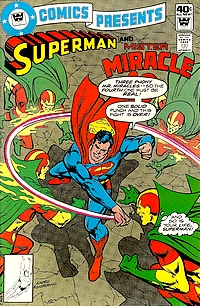
DC Comics Presents
#12
(August 1979, Whitman)
|
|
| |
| |
THE PRODUCTION PROCESS -
APPLYING THE DIAMOND
|
|
| |
One key aspect of the Marvel comic books distributed
by Western in its Whitman comicpack programme is the fact
that they were absolutely identical to the newsstand
copies - not the least because they were printed at the
same time, at the same place.
"The Whitman copies
were printed at the same time, as part of the same
run as the regular comics. Even the covers were part
of the same run, albeit with a press stop for
replating. But replating doesn't constitute a
reprinting. Long runs often have replatings in the
middle, and the cover presses had to be stopped to
replate for the Direct copies, too. They weren't
reprints." (Shooter, 2011b)
|
| |
| The "diamond
covers" needed for the Whitman comicpack
programme could be produced at an absolute
minimal extra work and cost. Comic books at the
time were all printed using the so-called
"four colour process" (CMYK for short)
which renders the variations in colours by
applying the so-called subtractive primaries
Cyan
(blue), Magenta
(purple) and Yellow. |
|
| |
| Mixing yellow and cyan produced
green colours, while yellow mixed with magenta
resulted in reds, and magenta with cyan in blues.
Mixing equal amounts of cyan, magenta and yellow
in sufficient density would produce black, but in
order to save ink and decrease drying times black
was used as the fourth colour pigment for the
so-called "key" (hence the letter K)
printing plate, which printed the artistic detail
of an image (Ferry, 1921). A
four-colour printing press therefore uses four
printing plates - one for each colour separation
- wrapped around a cylinder and inked with the
relevant colour. As paper passes through the
press, the cyan, magenta, yellow and black
separations are printed exactly one on top of the
other. This can produce a wide range of colours
by combining different tints of the four inks, as
colours are split into so-called "component
separations".
|
|

|
|
| |
| The system's terminology was
slightly modified for the production of comic books and
labelled YRB ("yellow-red-blue"), making the
colour labels somewhat less cryptic. The colour
separations used for comic books up until the 1980s were
fairly crude, using only tones of 0%, 25%, 50%, 75% and
100% in a coarse dot grid, and were done for both Marvel
and DC at the Chemical Color Plate Corporation in
Bridgeport (Connecticut). The process resulted in four
overlays (one each for CMYK) on Rubylith®
acetate, which then went to the camera for the so-called
shoot plates (a process which continued into the late
1990s before computer colouring took over). |
| |
|
| |
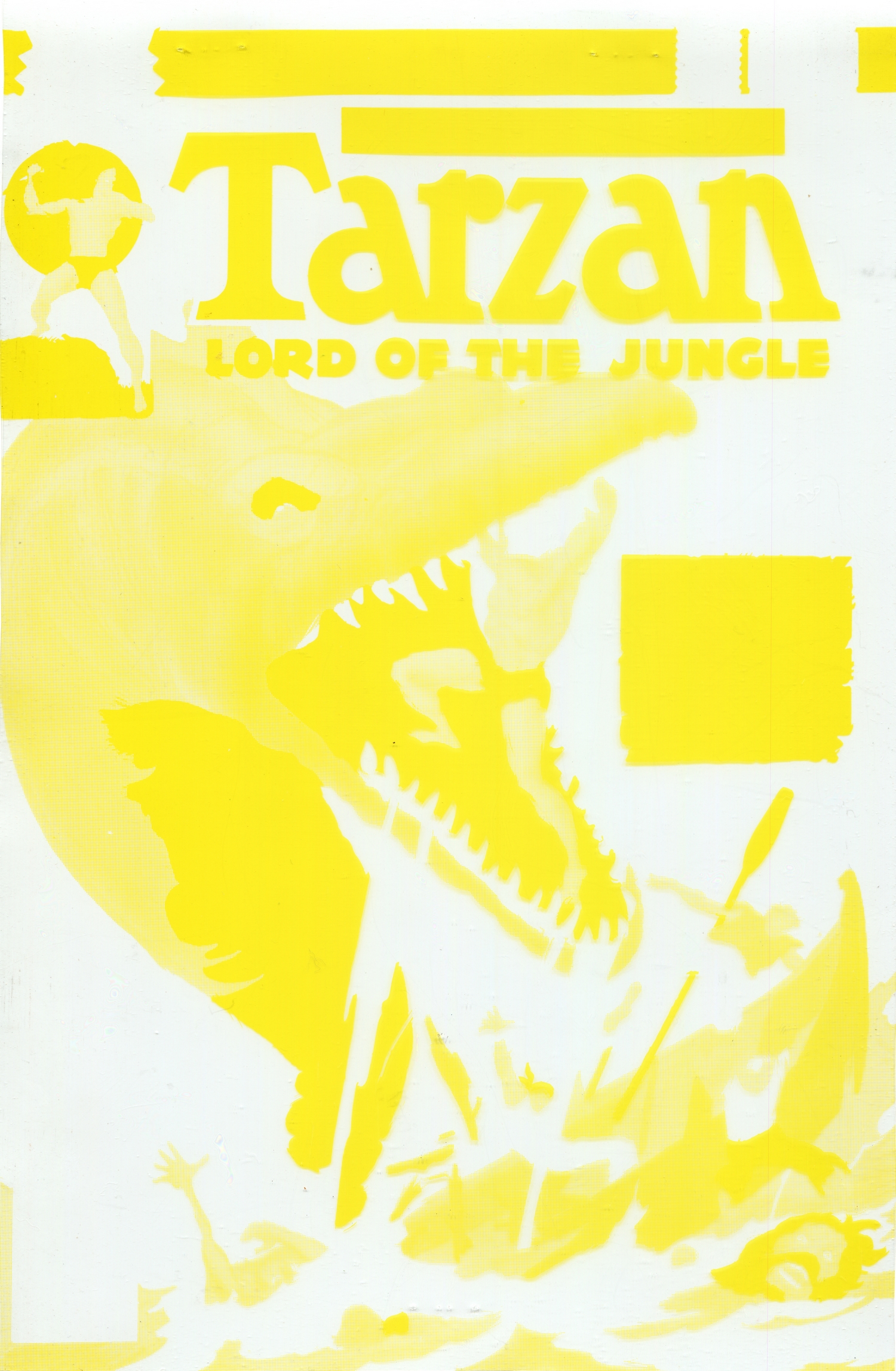
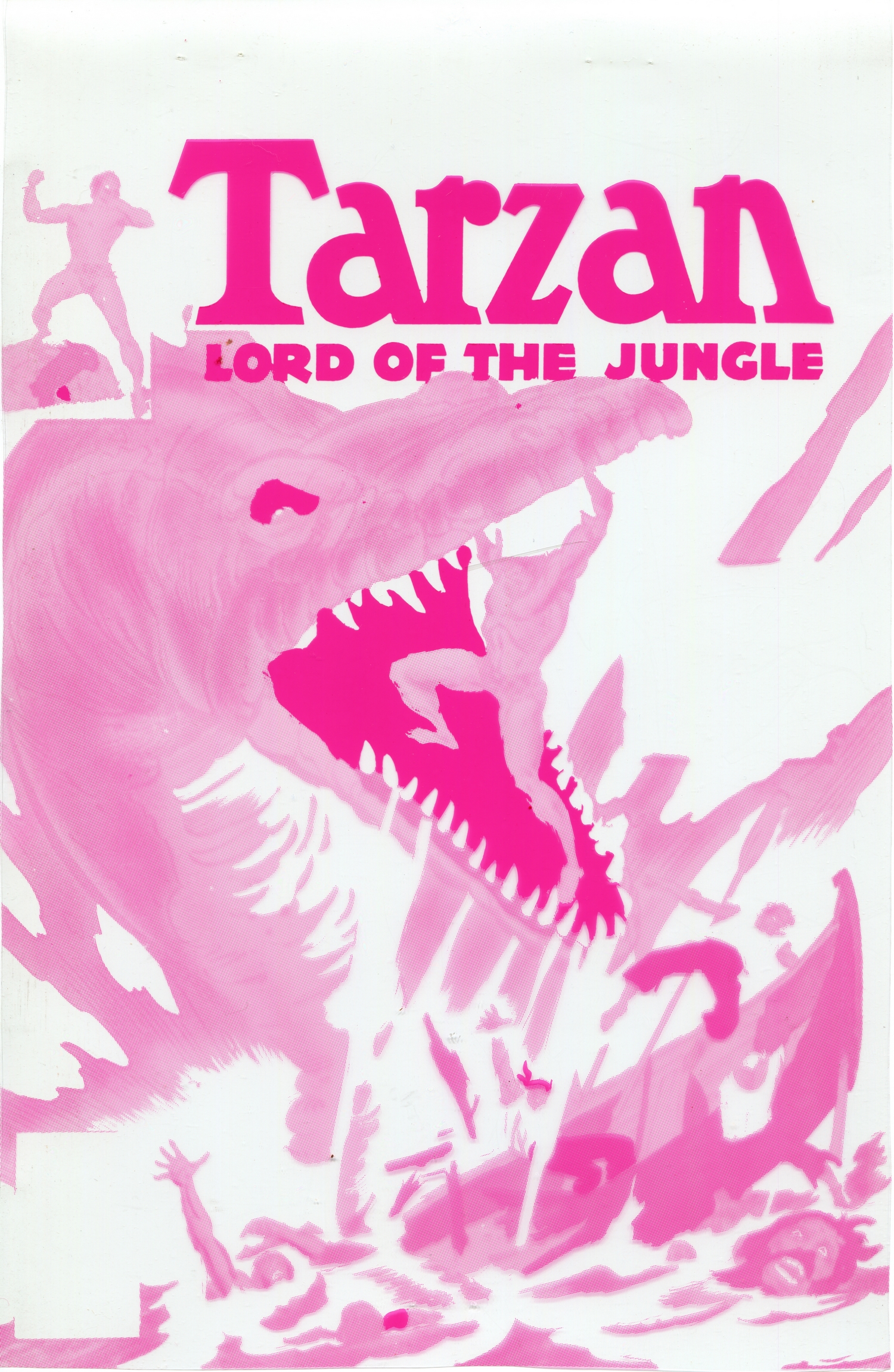
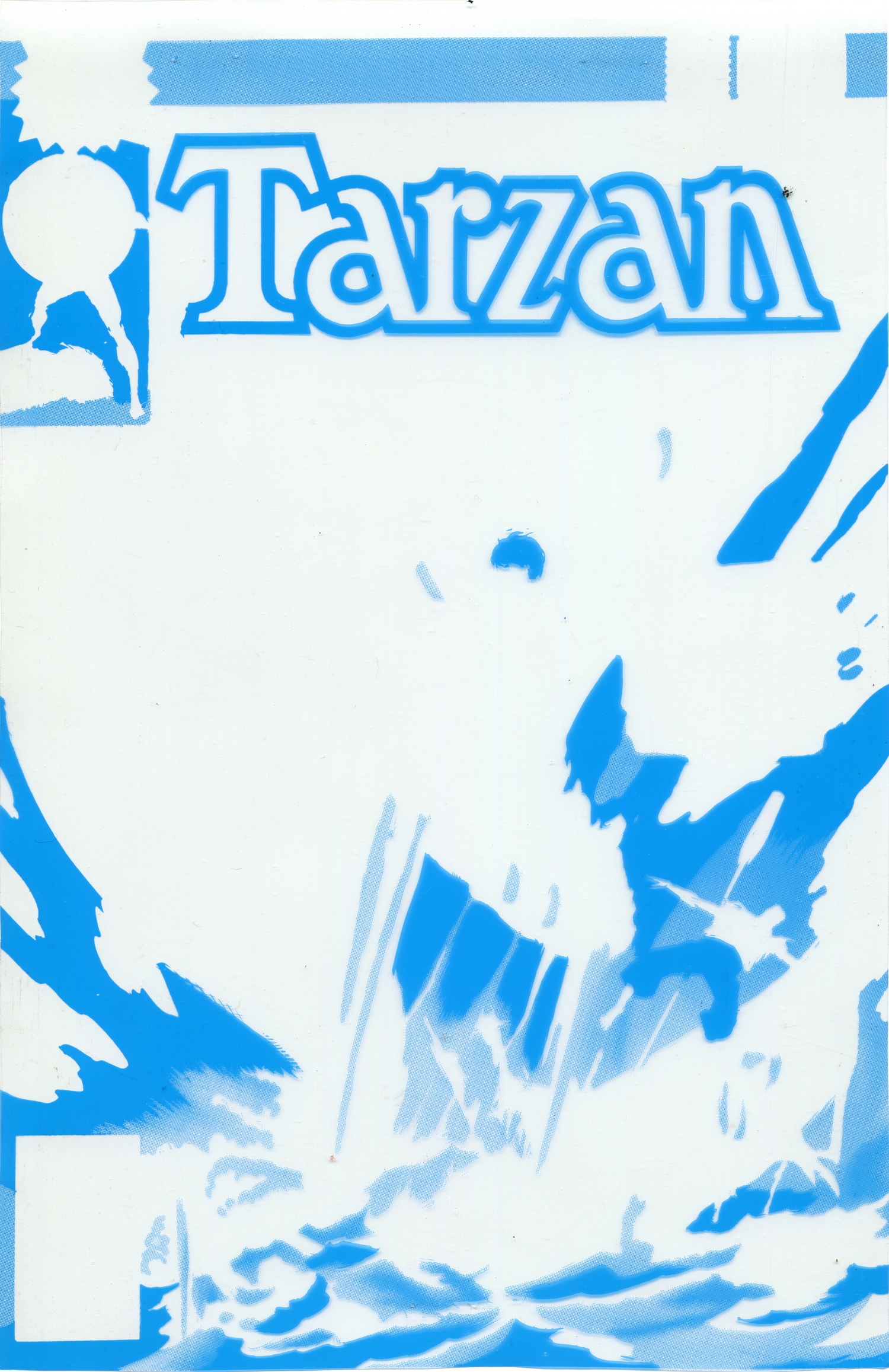
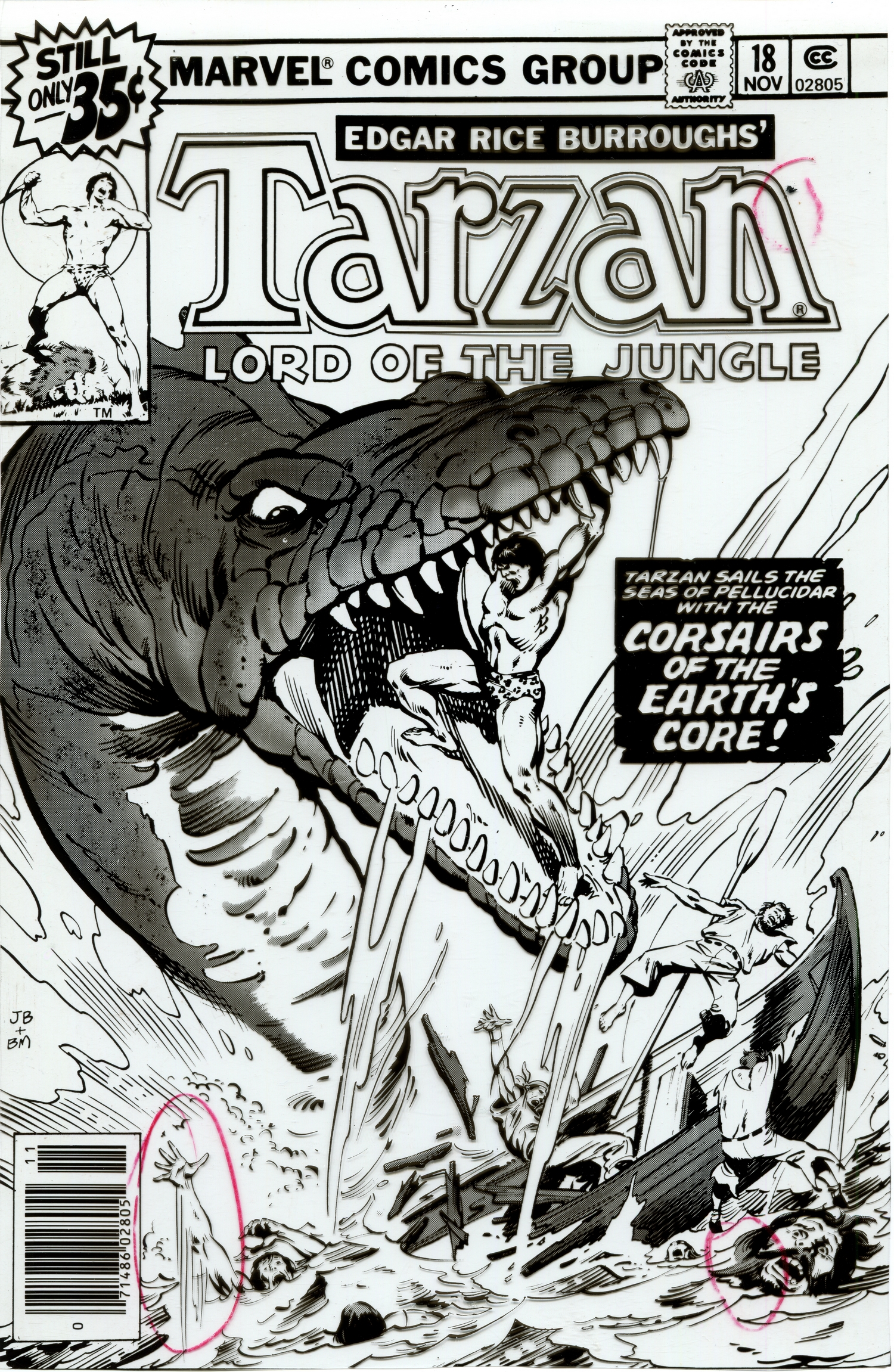
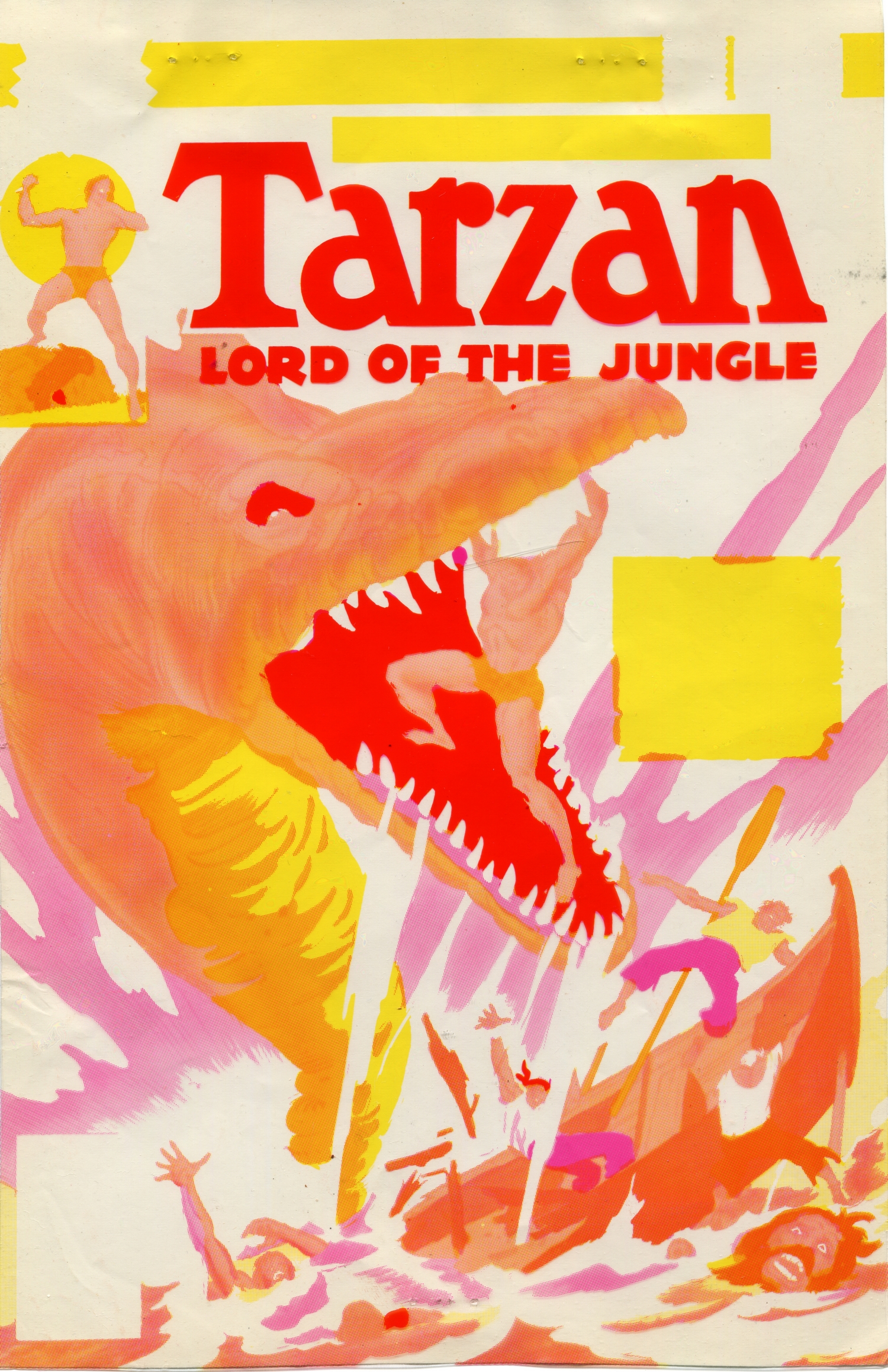
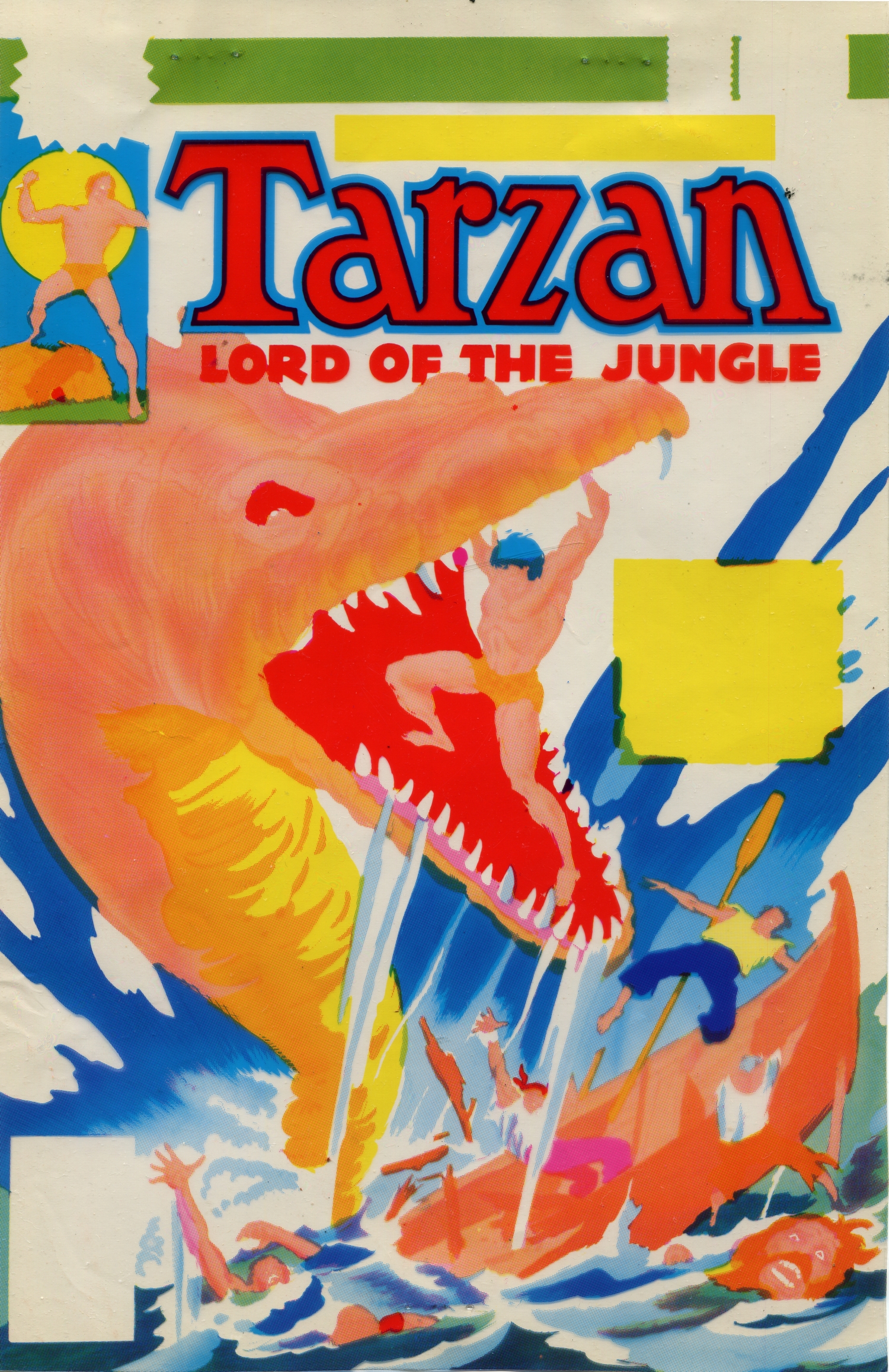
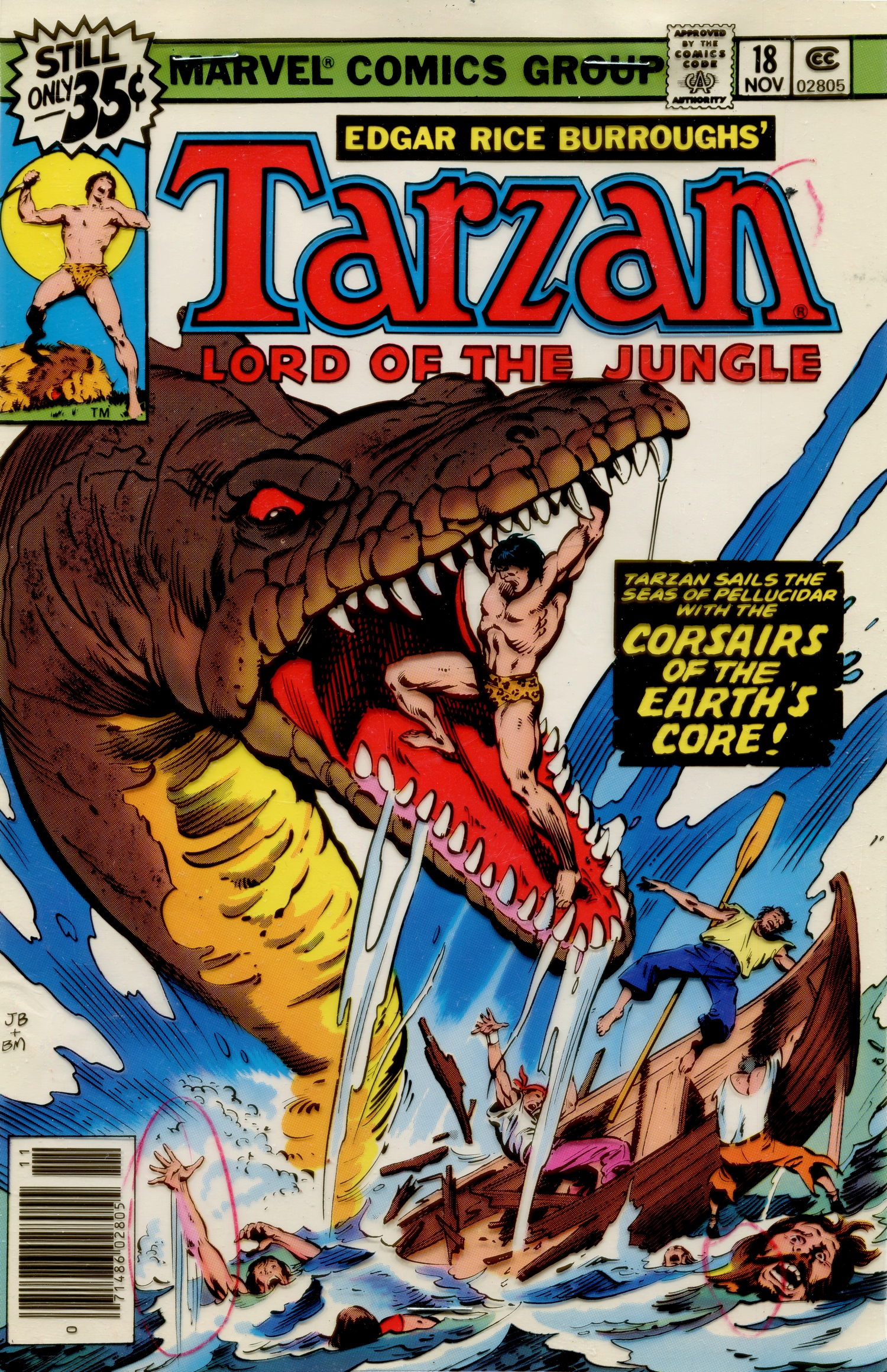
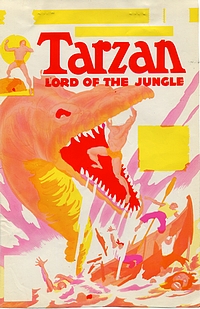
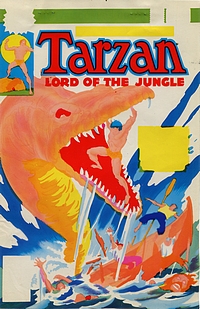
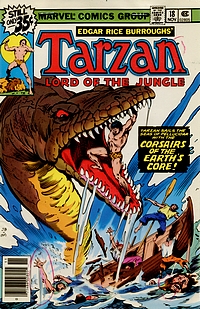
This process of building up a
multi-colour image from four components can be
seen from the acetate colour separations for the
cover of Tarzan #18 (January 1979):
The sequence
of the three colour ink layers for comic books
(YRBK) followed the practice used for newspapers
- which makes sense since they were both printed
on the same paper stock until the late 1980s).
|
=
|
|
=
|
|
=
|
|
|
| |
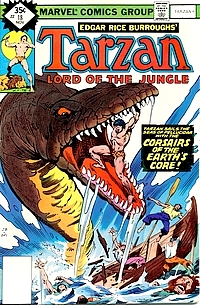
| The common sequence
in the printing industry, however, would often be
the reverse, KBRY (Pritchard, 2009). All that was needed now was a
second "K" plate with the diamond,
covered-up issue number and month box, and
blanked-out barcode.
This was done at the
Chemical Color Plate in Bridgeport, Connecticut,
who were contracted for the colour separation and
production of the shoot plates (i.e. negative
film) by numerous comic book publishers. Once
complete, the material was then shipped to World
Color in Sparta, Illinois, where the shoot plates
were used to produce large sheets of actual metal
printing plates to fit the printing machines
(Brown, 2017).
The printer at World Color
would thus run the first print run with one black
plate and then, when the required number of
covers had been printed, exchange the K
separation plate for the other cover version, and
simply continue printing. Stopping the printing
machine and changing plates was part of the
regular procedure anyway, so this change-over
wasn't really considered extra work.
"Both steel
and aluminum [printing] plates are used up
quickly and for most runs of comics, several
plates are made as a matter of course." (Brown,
2017)
|
|
Tarzan
#18 (January 1979)
|
|
| |
|
| |
| FURTHER
READING ON THE
THOUGHT BALLOON |
| |
| |
 |
|
"Comic
packs" not only sold
well for more than two
decades, they also offer
some interesting insight
into the comic book
industry's history from
the 1960s through to the
1990s. There's more on
their general history here. |
|
|
|
| |
|
| |
| BIBLIOGRAPHY |
| |
| BROWN Eliot
R. (2017) "Marvel
Behind The Scenes – Beyond The Behind*! Chemical
Color Plate", www.eliotrbrown.com, published online June 2017 DANIELS Les
(1991) Marvel: Five Fabulous Decades of the
World's Greatest Comics, Harry N. Abrams
EVANIER
Mark (2007) "More on Comicpacs", News From Me,
published online 2 May 2007
FERRY Ervin
Sidney (1921) General Physics and Its Application to
Industry and Everyday Life, John Wiley & Sons
FOERSTER
Jonathan (2010) "Marvel Comics' miracle man set
up business' success", in Naples Daily News, 30 May
2010
HALASZ
Robert (2025) "Western Publishing Group,
Inc. (International Directory of Company Histories),
Encyclopedia.com, published online 10 July 2025
HOKNES Terry
(2018) "Marvel
Comics Whitman Bag Variant Editions", terryhoknes.com
McCLURE
Jon Martin (2010) "A History of Publisher
Experimentation and Variant Comic Books", in Overstreet
Comic Book Price Guide, 40th Edition, Gemstone
Publishing
McCLURE Wendy
(2010) "A
Tale of two Whitmans", Albert Whitman Blog,
published online 20 December 2010
MILLER
John Jackson (2010), "Jim
Shooter on Marvel Whitmans, the direct market, and more", comichron.com, published online
19 April 2010
MOORE
John (2002) "How
Has the UK Shaped Star Wars?",
whynow.co.uk, published online 4 May 2022
NNa
(1974) "At Western: It's Fun, Games And
Profit", Milwaukee Sentinel, June 3, 1974
NNb
(1966) "Our Man in the Maumee Valley", The
Westerner #194, January 1966
PRITCHARD
Gordon (2009) "Ink
Sequence - 4/C process & beyond", The
Print Guide, available
on-line and accessed 1 June 2015
ROZANSKI Chuck (2003) "Evolution
of the Direct Market Part VI", milehighcomics.com,
published online December 2003
ROZANSKI Chuck (2004a) "Meeting
with Jim Shooter in May of 1979", milehighcomics.com,
published online February 2004
ROZANSKI Chuck (2004b) "The
International Association ofDirect Distributors",
milehighcomics.com, published online June 2004
SHONE Tom (2004) Blockbuster:
How Hollywood Learned to Stop Worrying and Love the
Summer, Simon & Schuster UK
SHOOTER
Jim (2011a) "Comic Book Distribution", JimShooter.com,
published online 15 November 2011
SHOOTER
Jim (2011b) "Roy Thomas saved Marvel", JimShooter.com,
published online 5 July 2011
THOMPSON
Maggie (2011) "And
I Quote: Matthew Murphy Discusses the Dell-Gold Key Split
in 1962", Official
Website of Maggie Thompson, published online 17
March 2011
WELLS John (2012)
American Comic Book Chronicles: The 1960s (1960-1964),
TwoMorrows Publishing
|
| |
| |
| |
The
illustrations presented here are copyright material.
Their reproduction for the review and research purposes
of this website is considered fair use
as set out by the Copyright Act of 1976, 17
U.S.C. par. 107.
(c) 2025-2026
uploaded to the web 25 April
2026
|
| |
| |
|