|
 |
|
AVENGERS,
DEFENDERS &
HULK
BACK TO BACK IN A
DECEMBER
1976 MARVEL MULTI-MAGS
|
|
|
|
| |
|
| |
 |
|
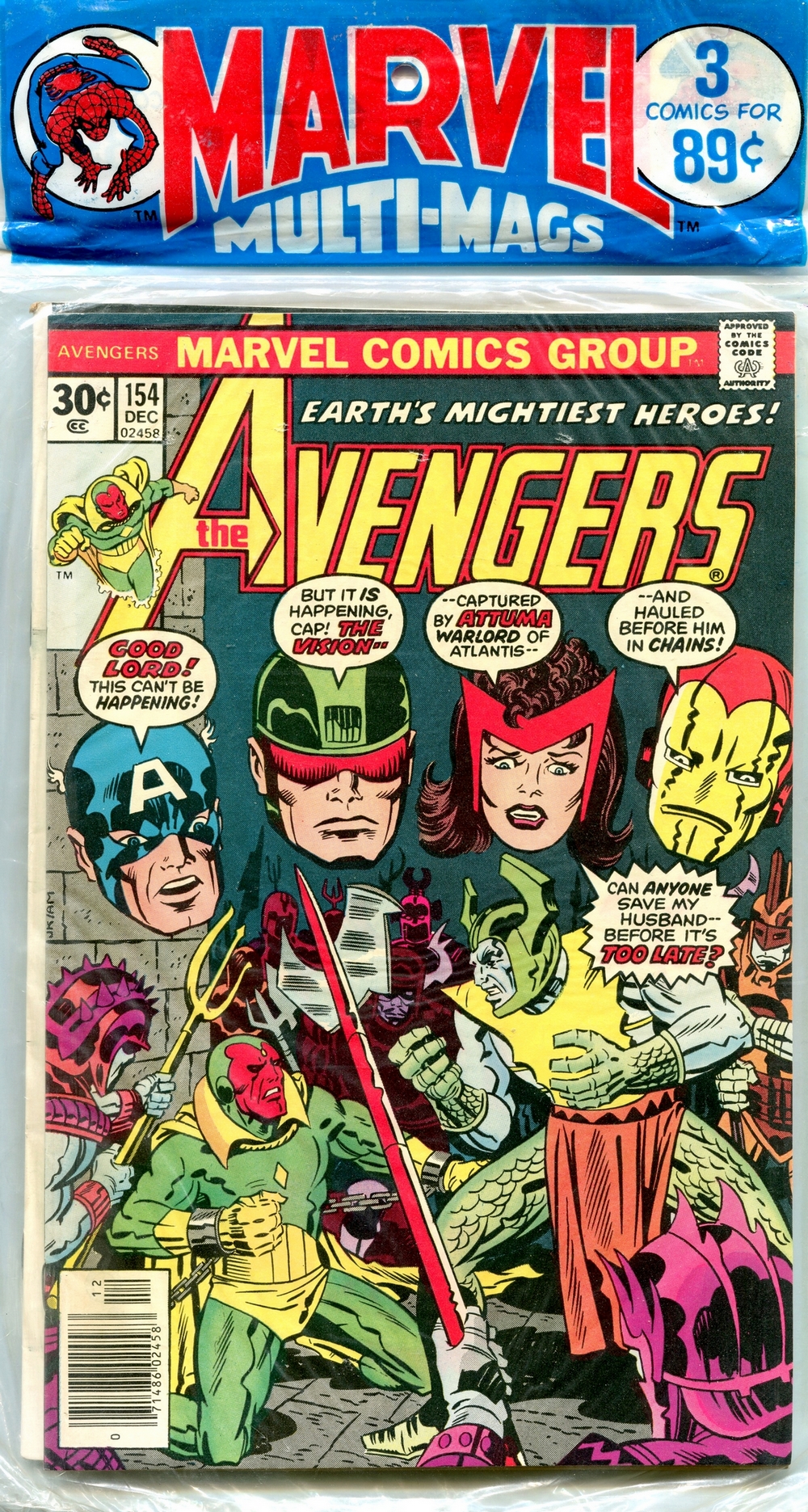
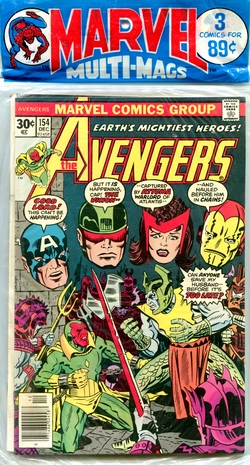
AVENGERS #154
DEFENDERS
#42
HULK
#206

In spite of the hugely successful
comeback of the superhero genre in the early
1960s, the comic book industry had a fundamental
problem: its traditional sales points were fading
away.
Small stores that had carried
comic books for decades were pushed out of
business by larger stores and supermarkets, and
newsagents started to view the low cover prices and
therefore tiny profit margins comics had to offer as a nuisance.
|
|
 |
|
| |
| Comic book
publishers needed to open up new sales opportunities and
tap into a new customer base. Slightly paradoxically, one
place these potential buyers could be found actually were
the ever expanding supermarkets and chain stores. But in
order to be able to sell comic books at these venues, the
product would have to be adjusted - such as packaging
several comic books together in a transparent plastic
bag. |

|
|
Pioneered
by DC Comics (who came up with the Comicpac concept in 1961), this
resulted in a higher price per unit on
sale, which made the whole business of
stocking them much more worthwhile for
the seller. At the same time the product
blended in with most other goods sold at
supermarkets, which were also
conveniently packaged. DC's
Comicpacs were a success - so
much so that other publishers quickly
started to copy the concept. Marvel
produced a series of Marvel
Multi-Mags in 1968/69, but only
fully embraced selling multiple
comic books packaged in a sealed plastic
bag at supermarkets, large grocery stores
or gas stations as of the early 1970s.
It didn't really
matter that buying these three comic
books in a comicpack for say 89¢ (rather
than from a newsagent for 90¢ in that case) clearly presented no
real bargain - it was the opportunity and
convenience to pick up a few comics at
the same time parents and adults did
their general shopping. Neatly packaged,
it almost became an entirely different
class of commodity.
|
|
|
| |
|
| |
| The comic books contained
in this specific MARVEL MULTI-MAGS
are all from the December 1976 cover date run,
which meant that they were actually on sale at
newsagents in September 1976. In reality, there
could be quite a delay in terms of actual
availability of MARVEL MULTI-MAGS
at some sales points, resulting in some
Multi-Mags on display containing "semi-recent
books (typically about nine months old)"
(Brevoort, 2007). Considering the packaging and
distribution process, this doesn't really seem
too surprising. |
|
| |
| No titles had
permanent slots in the MARVEL MULTI-MAGS, but issues of the Avengers
and Hulk would show up in a reliably
regular way. But even with these fairly regular
titles there was never any guarantee of an
uninterrupted flow of consecutive issues - and
therefore a distinct possibility of missing out
on a part of the storyline, since the continuity
of the Marvel Universe of the 1970s was such that
plots and storylines usually evolved over more
than one issue. This didn't exactly make
the MULTI-MAGS an ideal way of getting
your Marvel comic book fix. On the other hand, this was a
common fate of the average comic book reader in
the 1970s, whether their comic books came
packaged in a plastic bag or as single issues
from a display or spinner rack. Back in those
days, an uninterrupted supply of specific titles
was, quite simply, not guaranteed. Not worrying
too much about possible gaps in storylines wasn't
really a big thing - besides, you would usually
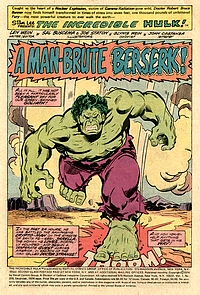
get a recap of "what happened so far"
on the first page.
So
all in all it simply was a part of being a comic
book fan in the 1970s - as were the monthly
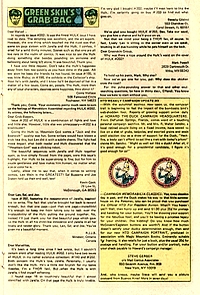
Bullpen Bulletins (which were the responsibility
of the editor-in-chief) and the in-house
advertising.
|
|
| |
 |
|
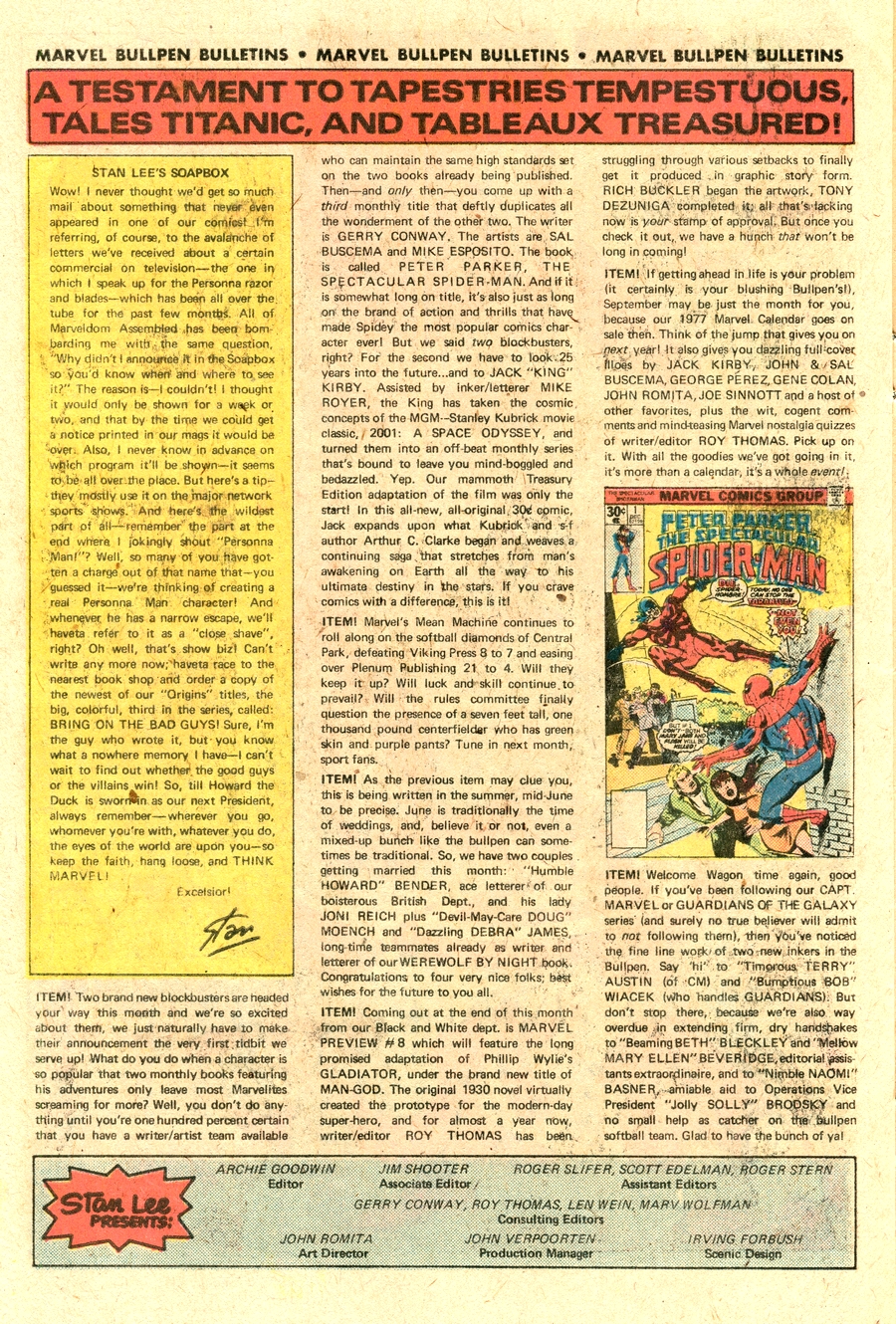
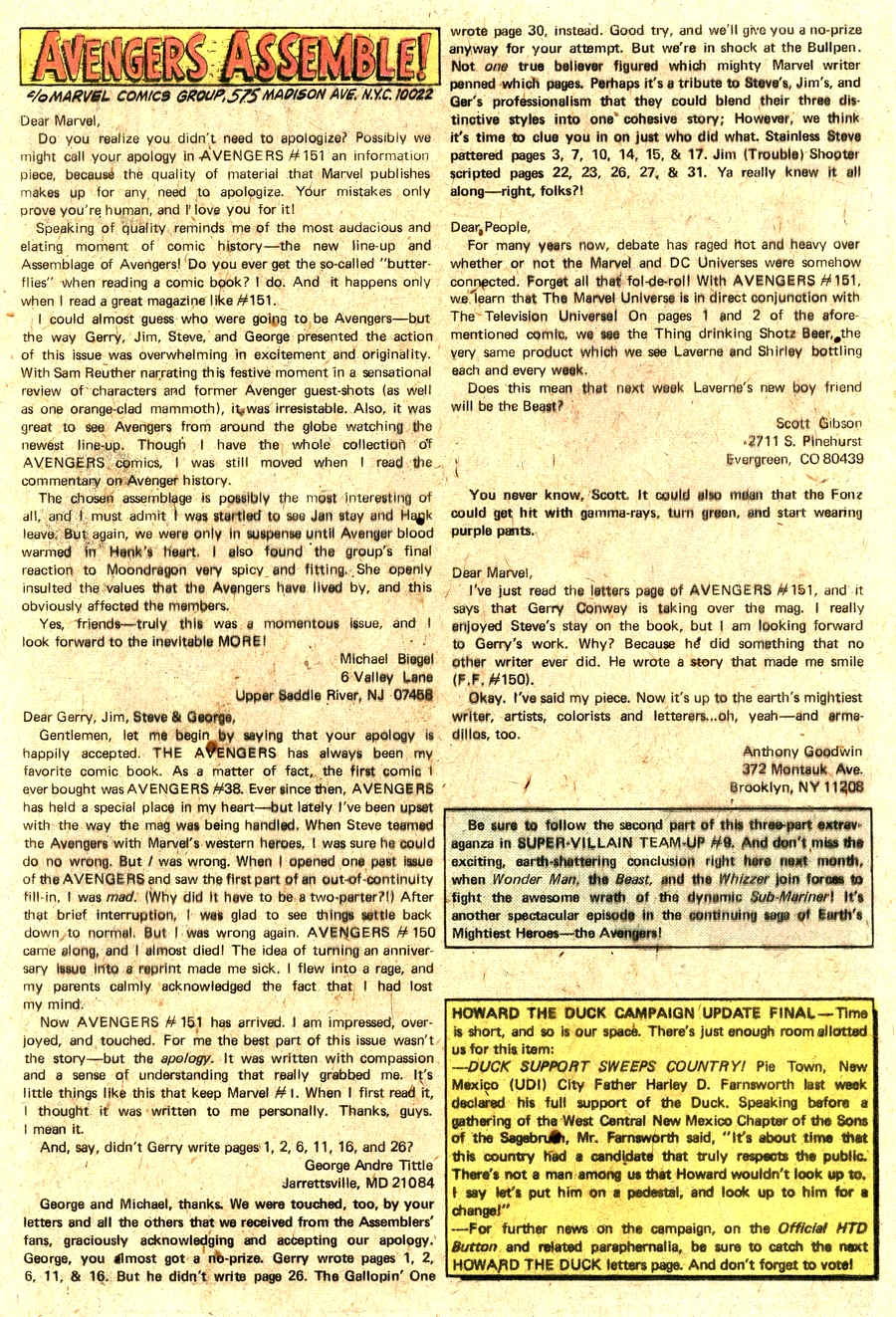
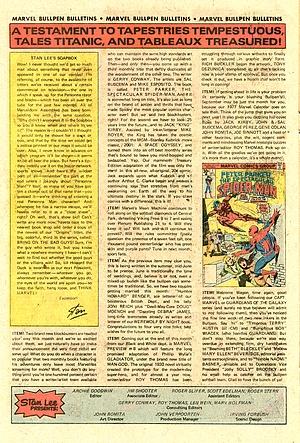
| In December 1976, the
Bullpen Bulletin was still making its way
through the alliterative alphabet with
its title, this time featuring the letter
T - which resulted in the typically
nonsensical "A Testament To
Tapestries Tempestuous, Tales Titanic,
And Tableaux Treasured!". The punchline item of
the Stan Lee's Soapbox column
was his appearance in a TV commercial for
razor blades, and only "Smilin'
Stan" could make it sound like the
starring role in a Hollywood blockbuster.
What little space remained was used to
blow another personal trumpet ("sure,
I'm the guy who wrote it"),
namely the sequel to the massively
successful Origins of Marvel Comics:
Bring On The Bad Guys.
Possibly more
pertinent information could be glanced
from the actual Bullpen Bulletins' various ITEM! bullet
points.
|
|
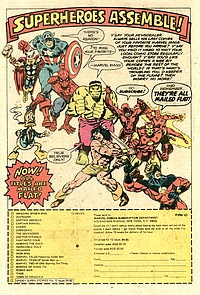
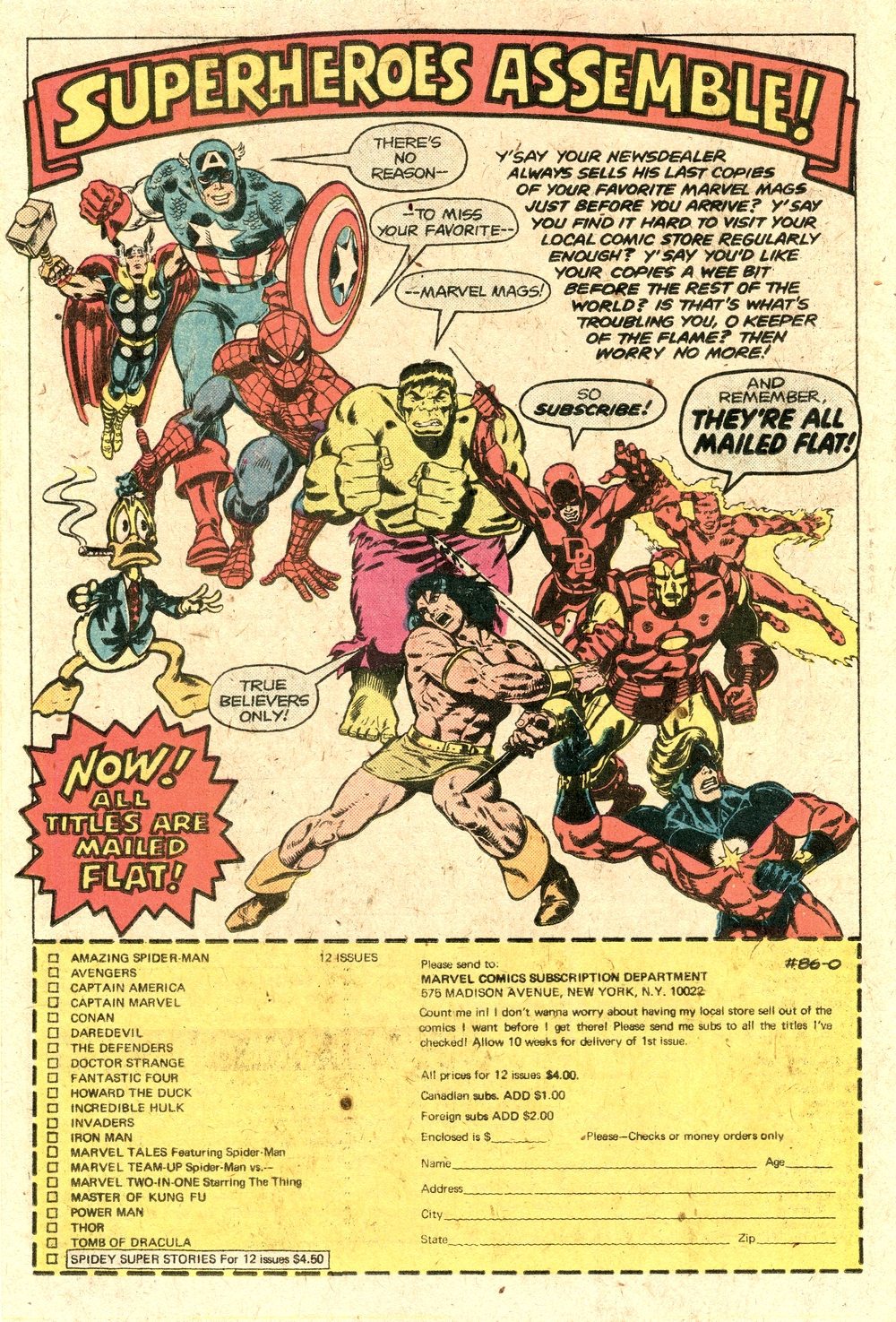
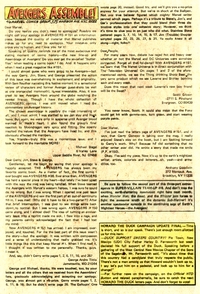
In-house ad from Avengers #154
|
The main
story here undoubtedly was the launch of Peter
Parker, Spectacular Spider-Man, handing
Marvel's best-selling superhero his third monthly
title.
|
|
| |
| This "blockbuster
launch" clearly overshadowed the
simultaneous debut of Jack Kirby's 2001: A
Space Odyssey. Preceded by a Treasury
Edition format adaptation of the movie (which had
been part of the agreement of Kirby's return to
Marvel), the idea was for Kirby to continue to
explore the concepts of 2001 in this new
monthly title. However, it would only last for 10
issues, whereas Spectacular Spider-Man
clocked up an impressive 264 issues before
cancellation in November 1998. There weren't
too many in-house ads that month, but the
subscription plug for various Marvel titles
always was an attention grabber.
|
|
| |
|
| |
|
|
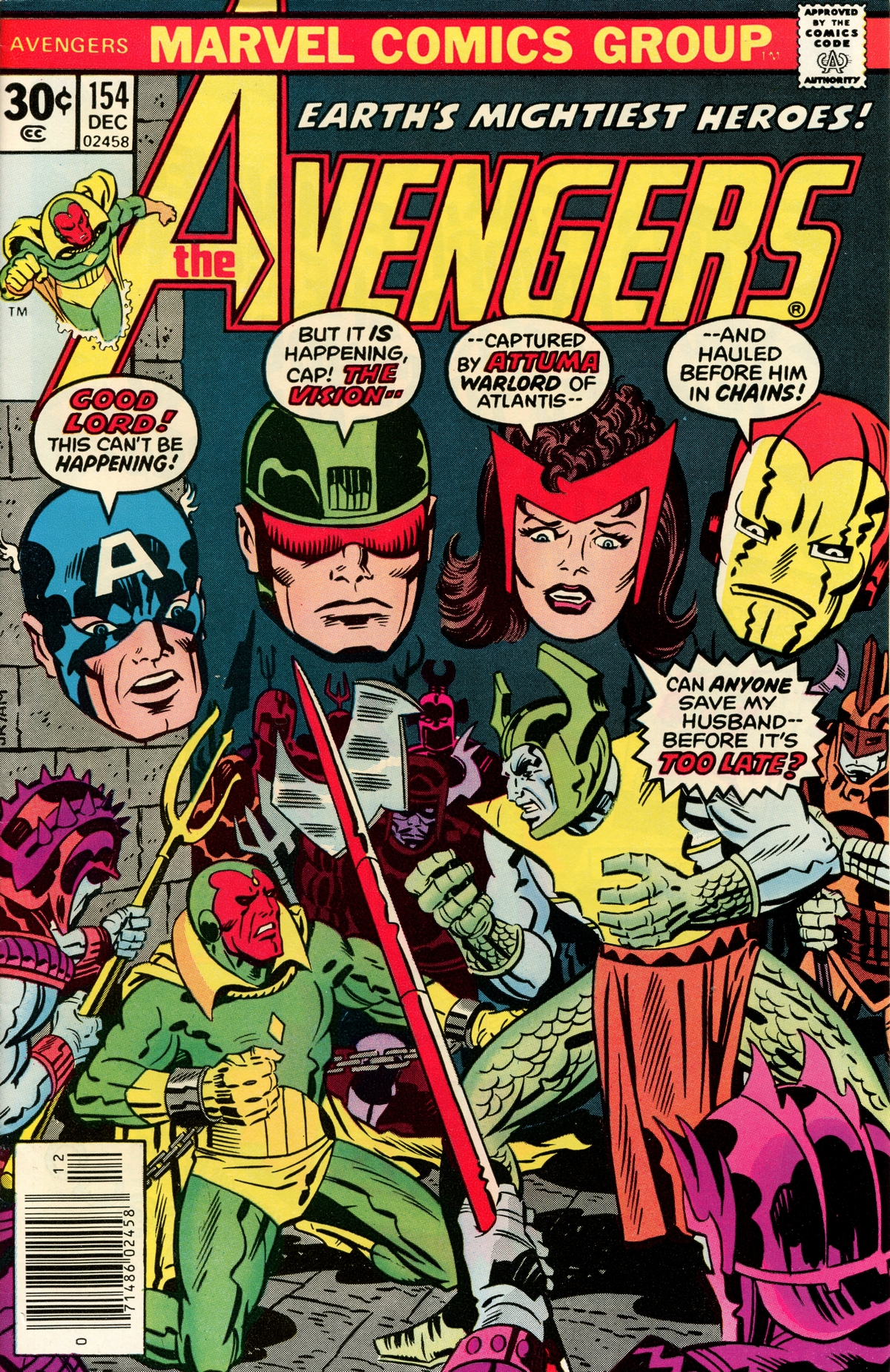
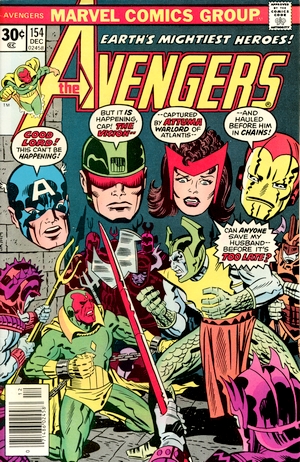
AVENGERS
#154
December 1976
(monthly)
On Sale: 21 September 1976
Editor
- Gerry Conway
Cover - Al Milgrom, Jack Kirby (pencils)
& Al Milgrom (inks)
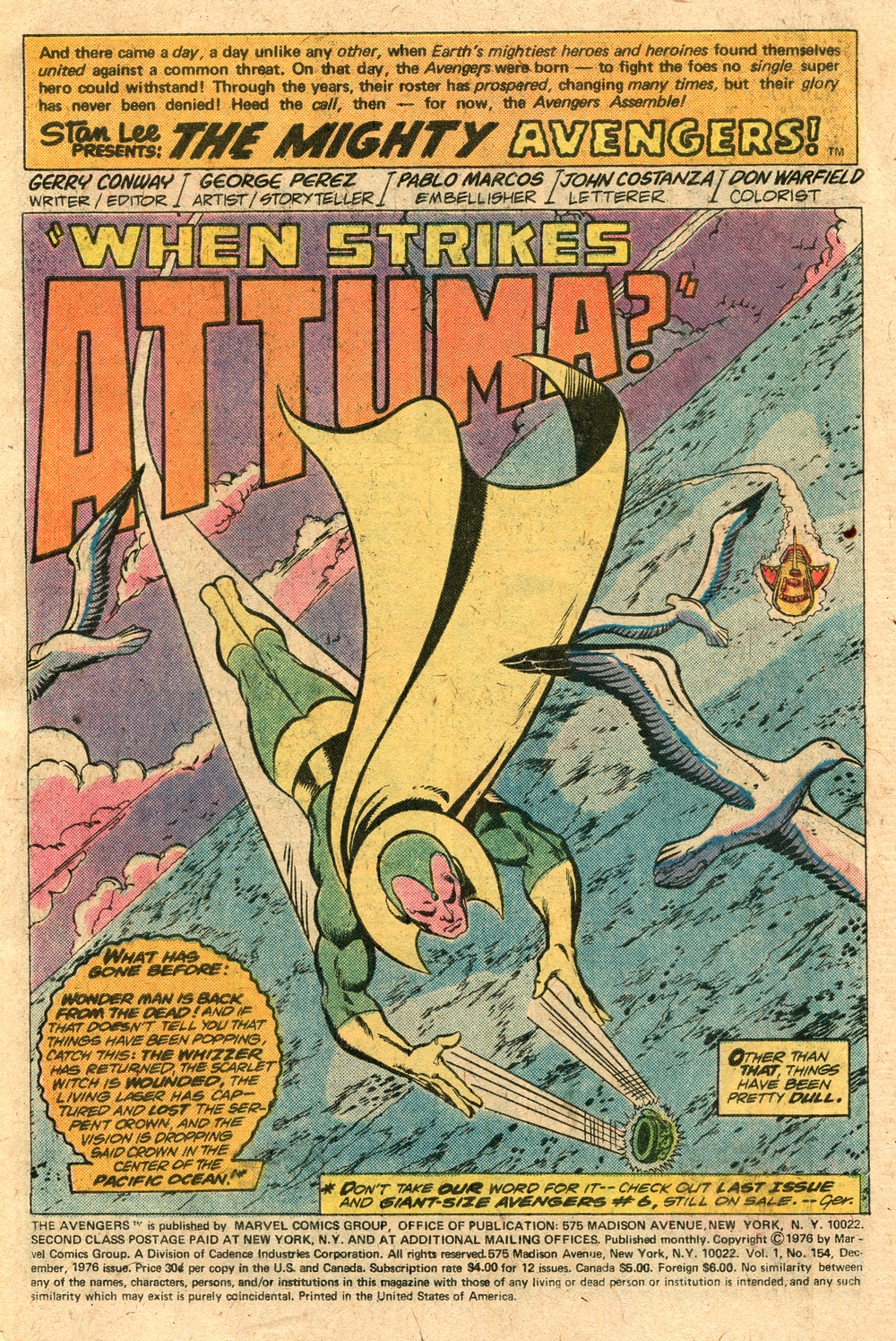
"When Strikes
Attuma?" (17
pages)
Story -
Gerry Conway
Pencils - George Perez
Inks - Pablo Marcost
Lettering - Gaspar Saladino (pg1), John
Costanza
Colouring - Don Warfield
STORY
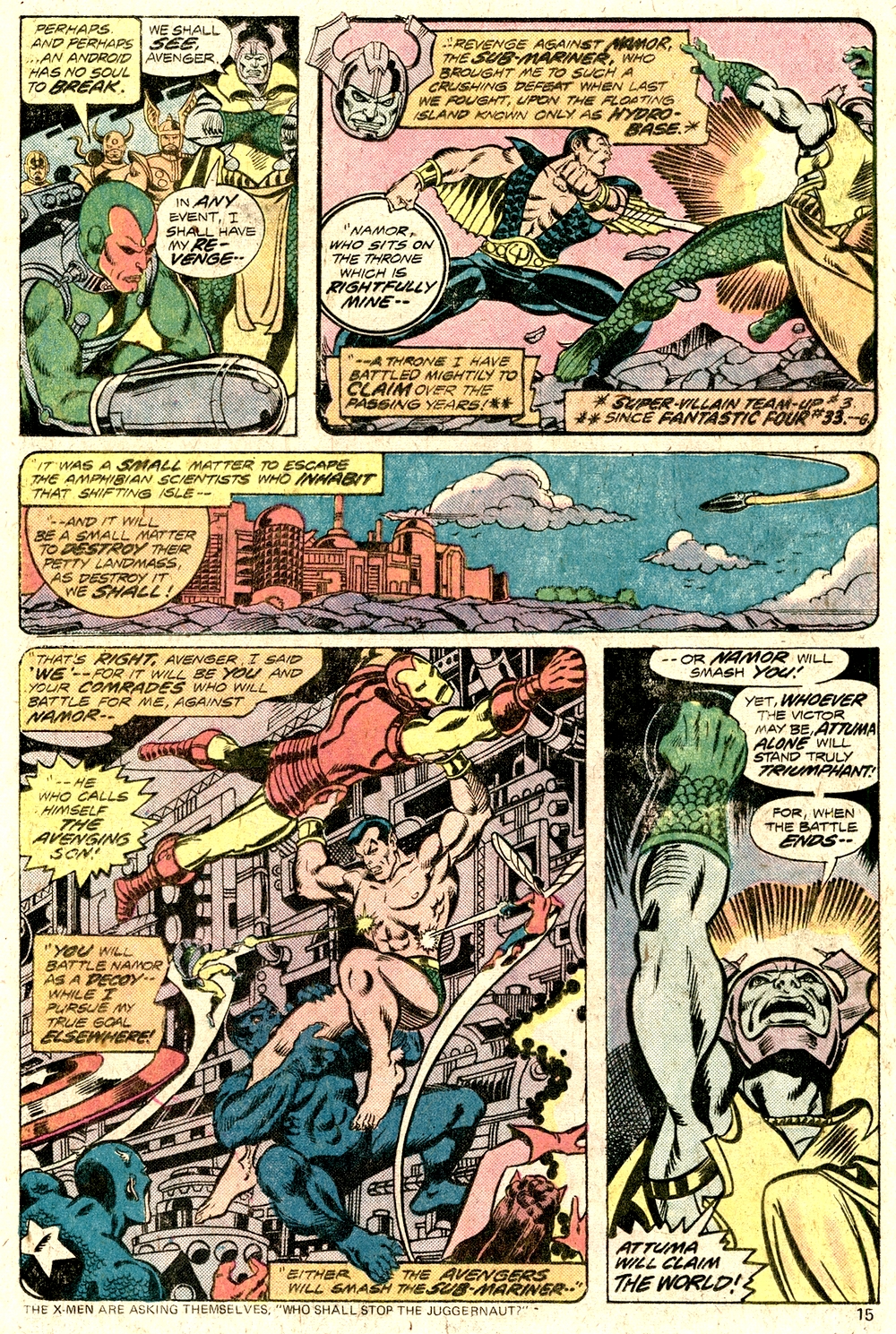
OVERVIEW - Attuma
captures most of the Avengers by using
Tyrak the Treacherous to pose as Triton
from the Inhumans.
Part 1 of a
four-part story that crosses over into Super-Villain
Team-Up #9 (December 1976) for part
2, continues in Avengers #155
(January 1977), and concludes in Avengers
#156 (February 1977)
|
|
|
| |
| Gerry
Conway was the writer for Avengers issues
#151–157
(September 1976 to March 1977), so this issue is squarely
midway in that run. |
| |
| Pencillers
and inkers would rotate frequently at that time,
since Marvel was really overextending itself and
trying to shuffle their creative staff as best as
possible across the board of far too many titles
(which is also why this period saw frequent
reprints in the wake of what Stan Lee called the
"Dreaded Deadline Doom"). Something
else that Marvel would do a lot in the 1970s was
to have one segment of a multi-part storyline in
title A appear in title B before being continued
and concluded in title A again.
The growing number of characters in the Marvel
Universe made that fairly easy, and in the case
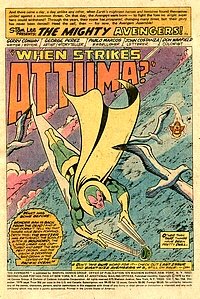
of the storyline that starts out in Avengers
#154 it is Attuma, long-standing nemesis of
Namor, who facilitates a detour by way of Super
Villain Team-Up #9 since this title starred
Dr Doom and the Sub-Mariner (who had lost his own
title in 1974).
|
|
 |
|
 |
|
| |
| There could be many reasons for
doing this. In some cases it made sense due to the main
characters involved (such as the Dracula crossover story
with Doctor Strange in Tomb of
Dracula #44 and Doctor Strange #14, both
May 1976), but it is fairly evident that
in most cases it served as an attempt to boost sales of
one or both titles. In this case, Super Villain
Team-Up could certainly do with an extra shot in the
arm. Such crossovers invariably
entailed an elevated number of editorial pointers to
events featured in previous issues or other titles. Some
editors were fonder of these than others, but it
certainly was a nifty way of showing readers the history
and breadth of the Marvel universe.
|
 |
|
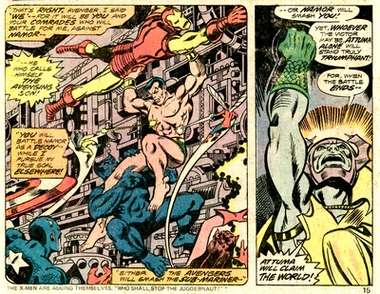
The story
put together by Gerry Conway follows a standard
crossover plot, where "good guys" (the
Avengers and Namor in this case) are tricked by a
"bad guy" (this time it's Attuma) to do
his evil biddings for him by fighting each other.
The story will never be considered a classic
Avengers tale, but it is slick enough to generate
interest and provide a good read - which was all
that Conway, who did seven issues and an annual
and knew he wasn't going to stay on the title,
wanted to achieve.
"I
think I was just vamping to some extent, just
trying to (...) do stories that would keep
some interest going until we could decide who
would be the best team on the book."
(Conway in Russ, 2018)
George Pérez (who in
the 1970s was often credited without the accent
on the letter e) had first been assigned to the
title in 1975 and provides consistent quality
artwork.
|
|
| |
| Pérez, who would go on to become a fan favourite
both at Marvel and DC due to his detailed artwork and his
knack of handling complex crowd scenes extremely well,
had a special bond with the Avengers. |
"When I went to Marvel [in 1974]
that was the book I wanted to do but of
course I was a young punk, they’re not
gonna give me The Avengers right away (...) I
was doing very minor-league [features] (...)
and George Tuska, the artist who was working
on The Avengers, was going on vacation. Bill
[Mantlo] knew (...) how much I wanted to do
The Avengers. He called me up and said
“George, will you be willing to do one
issue, a fill-in issue of The Avengers?”
I said “Yeah!” without hesitation,
even though I was already drawing one and a
half books. (But at my prime I was doing
three and a half books a month. I was young
and stupid.) But The Avengers I wasn’t
going to turn down. I did it, and when George
Tuska came back from vacation, he heard I had
a great time and said “He wants to do
it? Let him!" George, like a lot of
artists, didn’t want to do team books.
So, I got the book because George Tuska
didn’t want to take it back. They liked
what I did, Steve Englehart, the writer,
liked what I did in my one issue. The fact
that I was fearless. I wanted as many
characters as you could throw in there."
(Pérez in Greenfield, 2019)
|
|

George
Pérez
(1954-2022)
|
|
| |
| Although the crossover formula
often had an ulterior motive on Marvel's behalf
("let's push a title that's not selling too well by
having a crossover with one that does"), the results
would mostly be enjoyable simply because readers would
either be exposed to a character they didn't know or get
to see a character they hadn't seen in a while.
What certainly helped to keep reader's
potential annoyance at a story bouncing around different
titles in check was the fact that back in the the
1970s, Marvel would certainly hope you would go out and
buy that other title, but they never truly required you
to do so. There would always be an explanatory editorial
exposition filling you in on what had been going on in
the "other title" - not the least since there
was no guarantee of your news agent actually stocking it.
Readers who got their comic books in Marvel Multi-Mags
would certainly be out of luck with Super Villain
Team-Up: definitely a fringe title, only one issue
is known to have been packaged into a (Whitman) Marvel
comicpack (Super Villain Team-Up #12, June
1977).
|
| |
 |
|
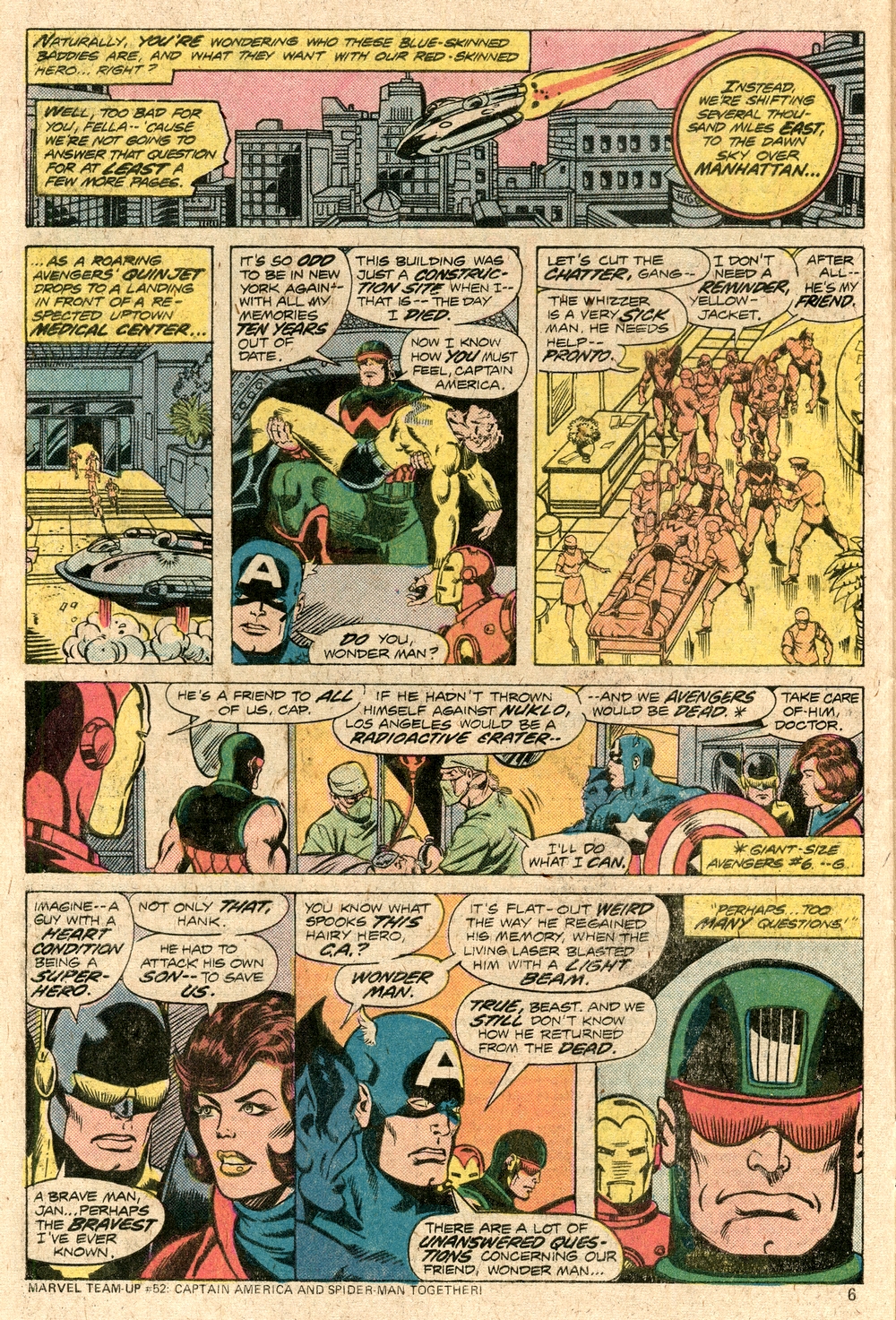
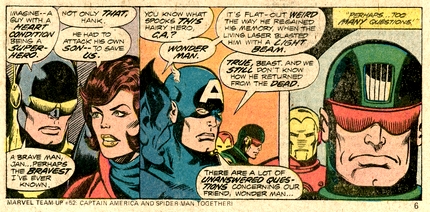
But it
wasn't just missed deadlines and a subsequent
proliferation of reprints at Marvel in the
mid-1970s - there was also at times a noticeable
drop in quality control. Page 6 of Avengers #154
is an example, where the bottom row of panel
displays not one but two goof-ups: first there is
no dividing gutter between the first and second
panel, and then the colourist got Iron Man's
helmet wrong by depicting it in all-over yellow.
Either nobody noticed,
or (more likely) there simply wasn't enough time
to fix it.
|
|
| |
 |
| |
|
| |
|
|
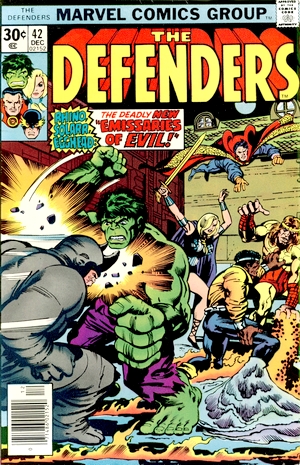
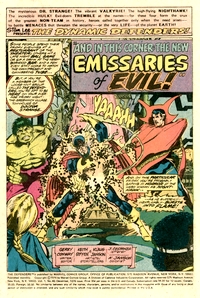
DEFENDERS #42
December
1976
(monthly)
On Sale: 21
September 1976
Editor - Gerry
Conway
Cover - Jack Kirby, John Romita
(alterations) & Klasu Janson
(inks)
"And
In This Corner: The New
Emissaries Of Evil!" (17
pages)
Story
- Gerry Conway
Pencils - Keith Giffen (layouts),
Klaus Janson (finished art)
Inks - Klaus Janson
Lettering -
John
Costanza
Colouring - Klaus Janson
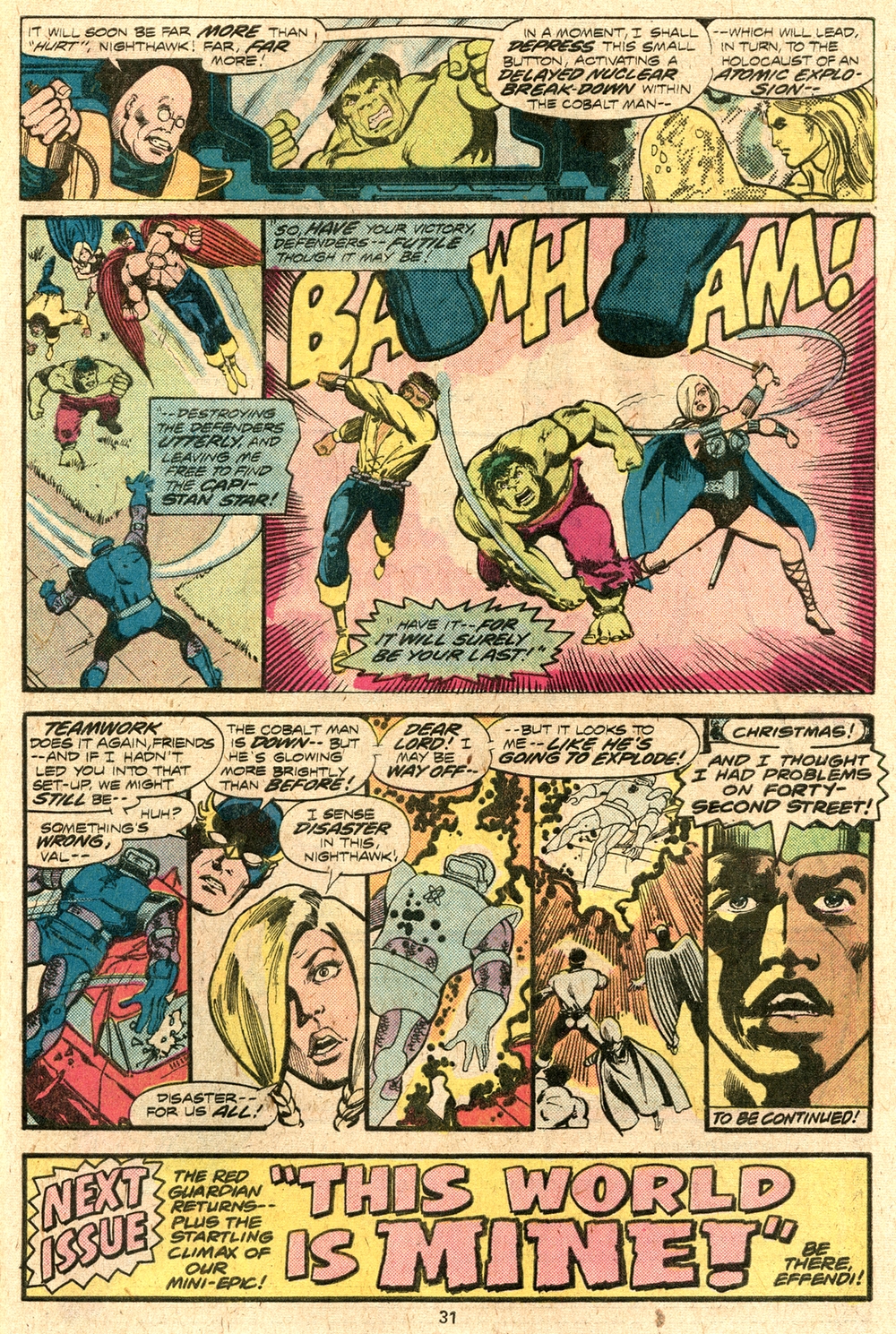
STORY
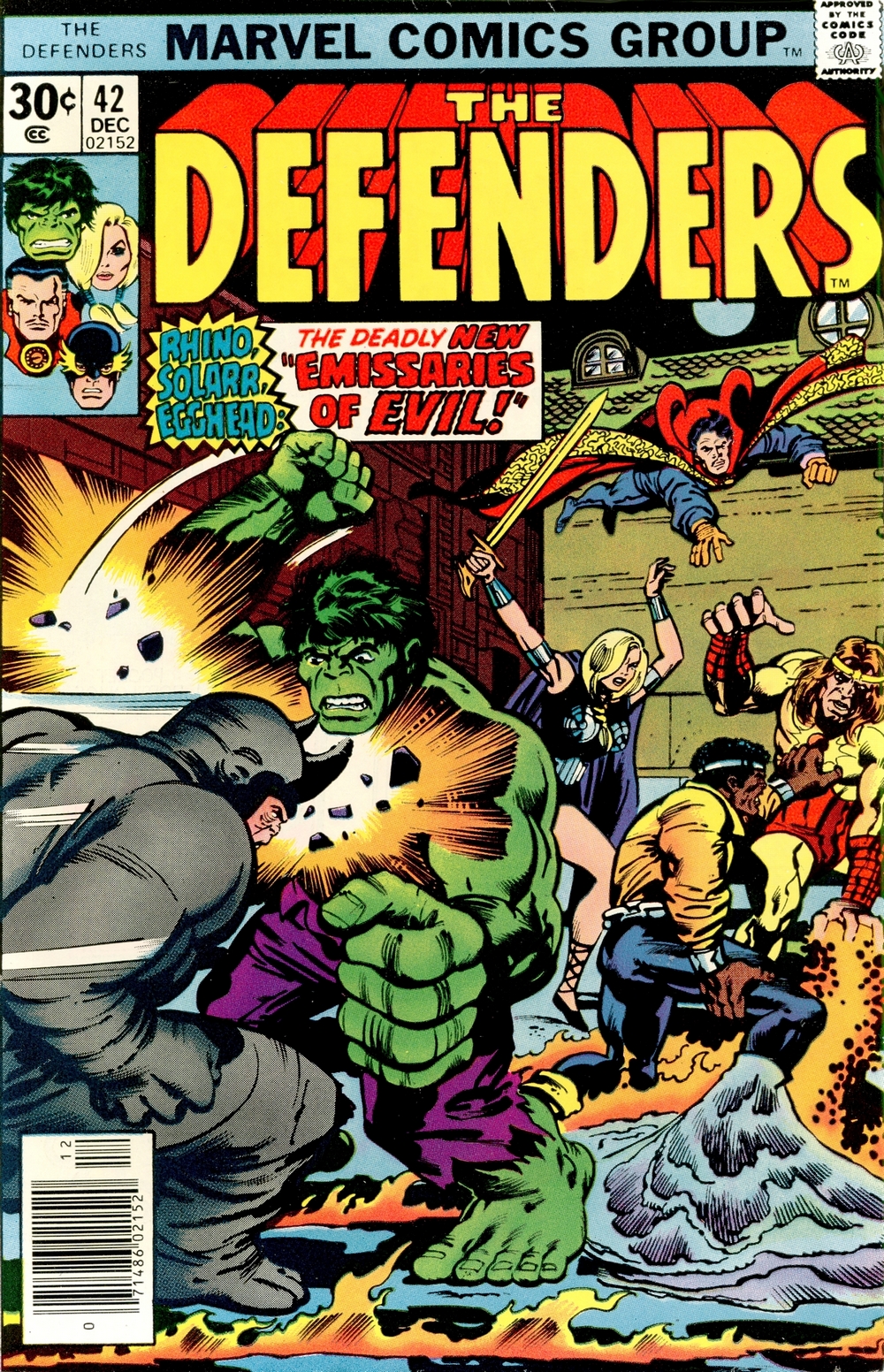
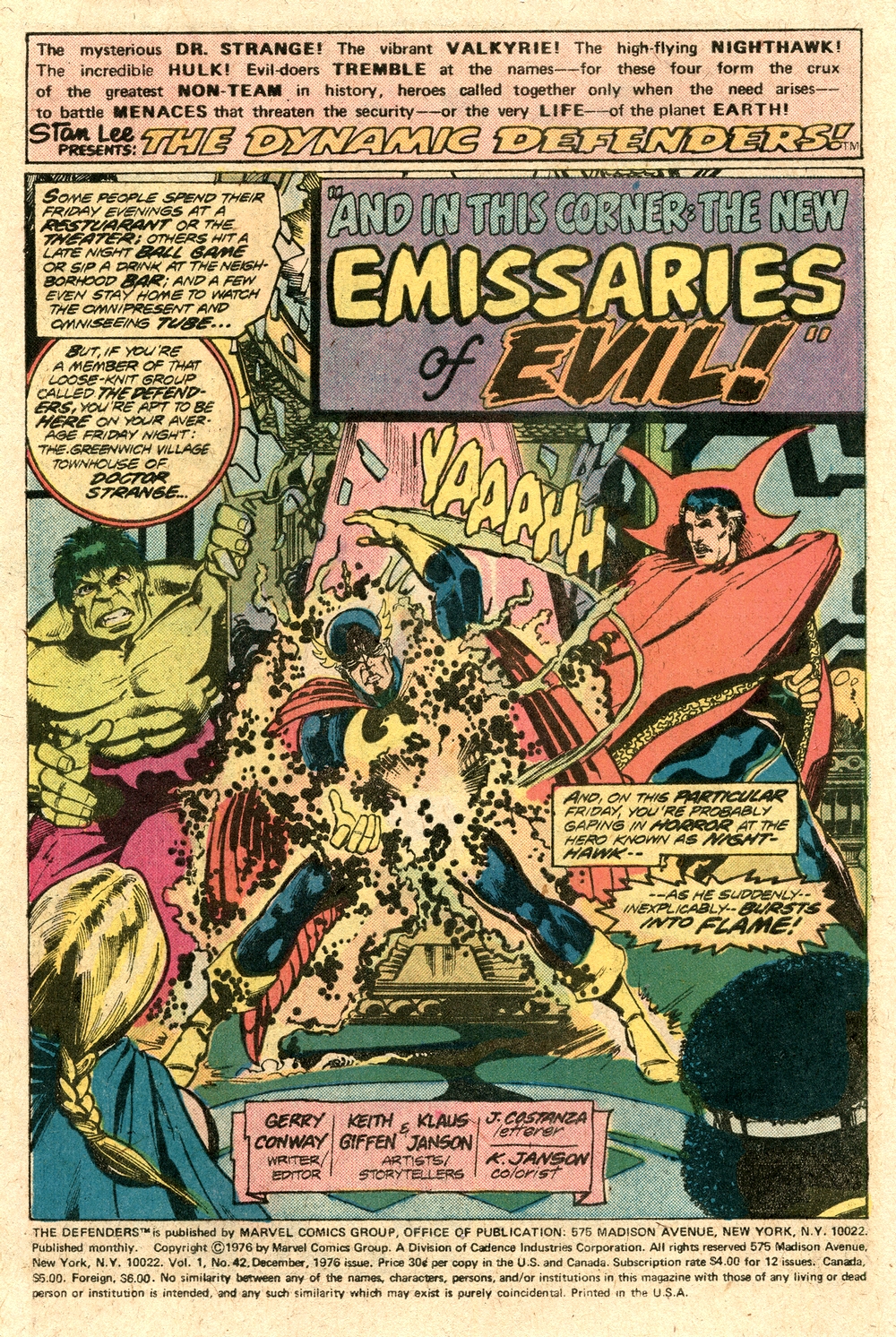
OVERVIEW -
Egghead sends Solarr and
Rhino to steal the Star of
Capistan from Dr. Strange. When
the Defenders stop them, Egghead
sends the Cobalt Man to New York,
hoping the latter will explode
and thus destroy the Defenders.
Part 1 of 2,
concluded in Defenders
#43 (January 1977)
|
|
|
|
| |
| Continuing
the topic of crossovers, the Defenders even saw their
inception play out in one. Roy Thomas kicked off the
origin of this "non-team" in Doctor Strange
#183 (November 1969), but due to the cancellation of that
title had to resolve the storyline in tww other titles he
was writing, namely Sub-Mariner #22 (February
1970), and Incredible Hulk #126 (April 1970). This
made sense, since Thomas teamed up Dr. Strange, the
Sub-Mariner and the Hulk to fight an alien threat to
Earth. In a second story arc (in Sub-Mariner
#34-35, February-March 1971), Namor calls on the Silver
Surfer and the Hulk to stop yet another disastrous threat
to the planet, which inadvertently also puts them in a
confrontational spot with the Avengers. |
| |
| The Defenders first
appeared under that name and with the
original line-up in Marvel Feature
#1 (December 1971), deciding to continue
to work as a team after disposing of yet
another alien threat. Although a fitting
character in that kind of context, the
Silver Surfer was dropped as Stan Lee
claimed exclusive writing rights for the
the Sentinel of the Spaceways; he also
came up with the name Defenders
(DeAngelo, 2013). The Defenders tryout
in Marvel Feature #1 proved a
success with readers, resulting in their
own title. Defenders #1 (August
1972) saw Roy Thomas as editor with Steve
Englehart initially providing the writing
(including another cross-over, the
"Avengers-Defenders War") and
Sal Buscema the artwork
The group (often described as a
"non-team") had a rotating
line-up throughout its run of 152 issues
from August 1972 until February 1986.
|
|
 |
|
 |
|
|
| |
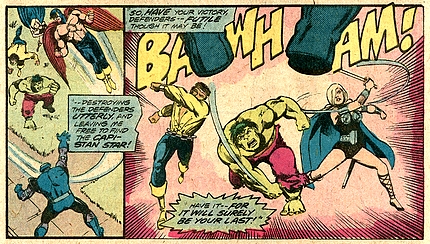
| Usually featuring Doctor Strange and the Hulk as
constant members, they were joined as Defenders for
longer or shorter periods of time by the likes of
Valkyrie, Nighthawk, Hellcat, Gargoyle, Beast. Luke Cage
- and even Son of Satan. |
| |
 |
|
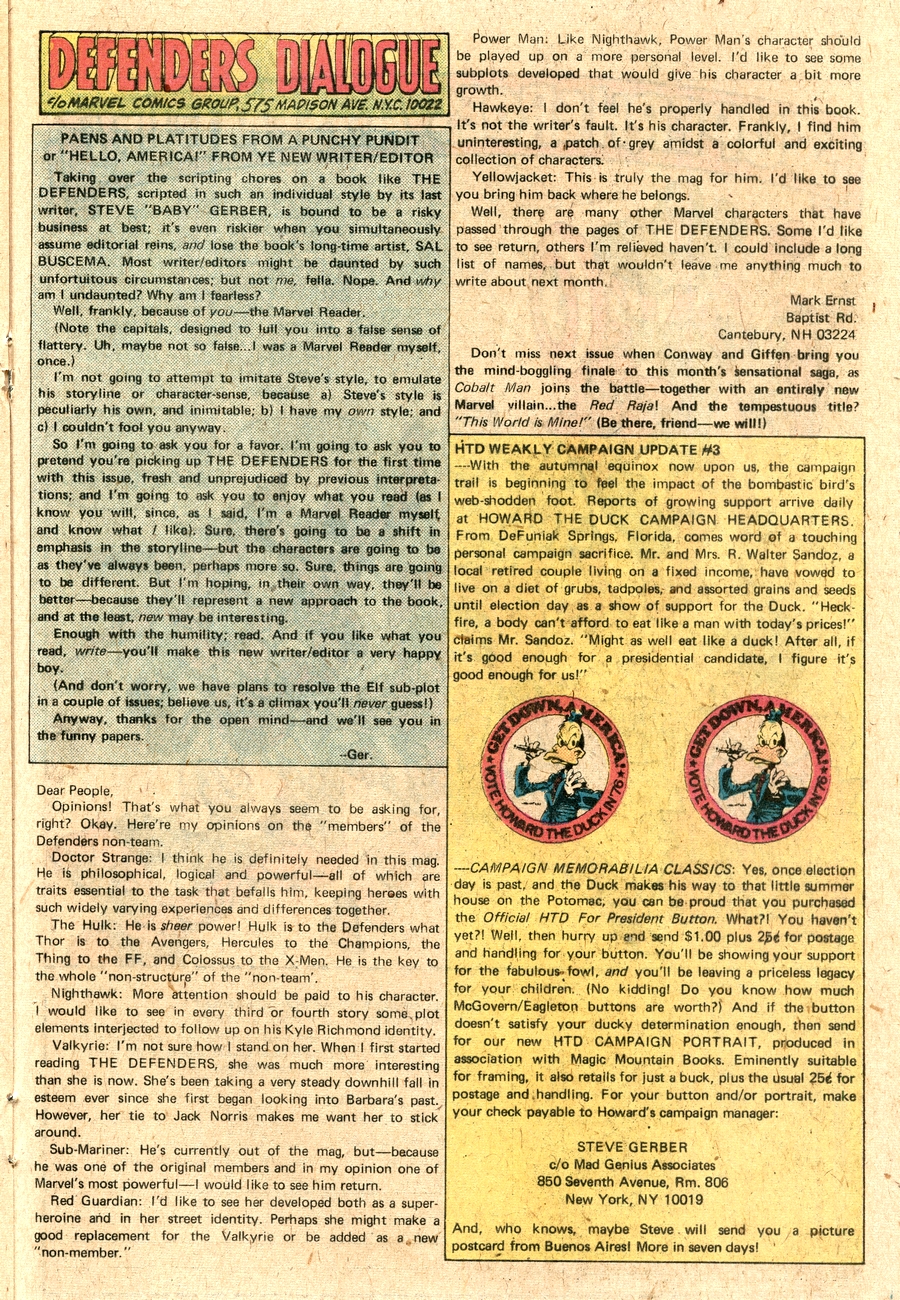
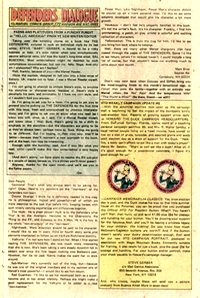
Steve Gerber had taken over the
writing as of Defenders #20, but it was
all change (including the artistic talent) for Defenders
#42 - as Gerry Conway, who took over the roles of
both editor and writer, felt compelled to point
out to readers on the letters page. Things were
moving ever so quickly (and sometimes chaotically
so) at Marvel towards the end of 1976, and the Defenders
comic book would even be without an actual plot
for issue #45, since Conway had been assigned
editor-in-chief in mid-production. As a result,
Keith Giffen drew the issue based solely on a
short "story conference" with Conway -
which really was exactly how the "Marvel
method" worked back in the 1960s.
|
|
| |
 |
|
Marvel Multi-Mags
would only occasionally feature
an issue of the Defenders
as part of their contents - only
eight confirmed instances are
known, occuring as far apart as
December 1972 and May 1981. |
|
|
|
| |
|
| |
|
|
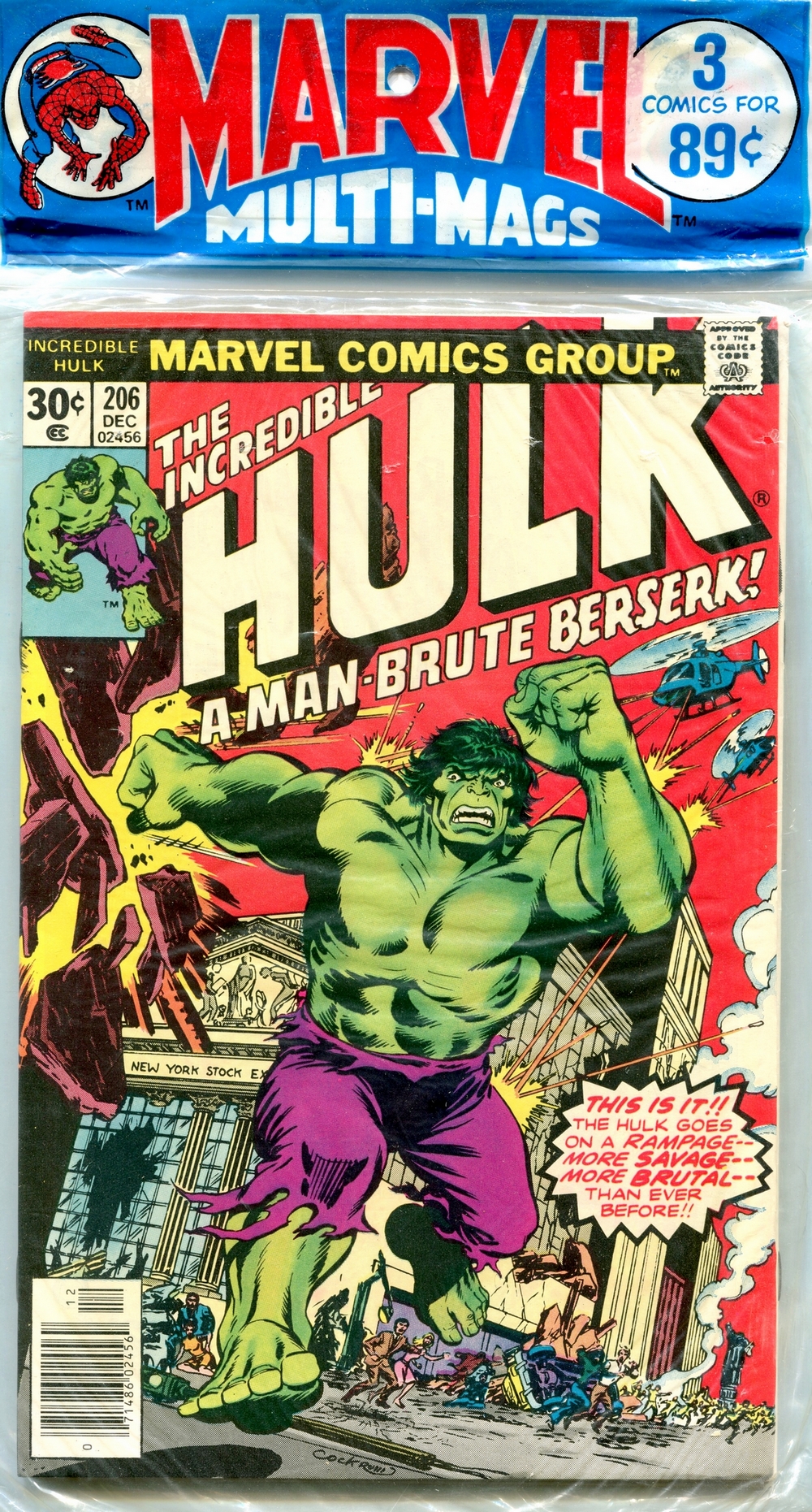
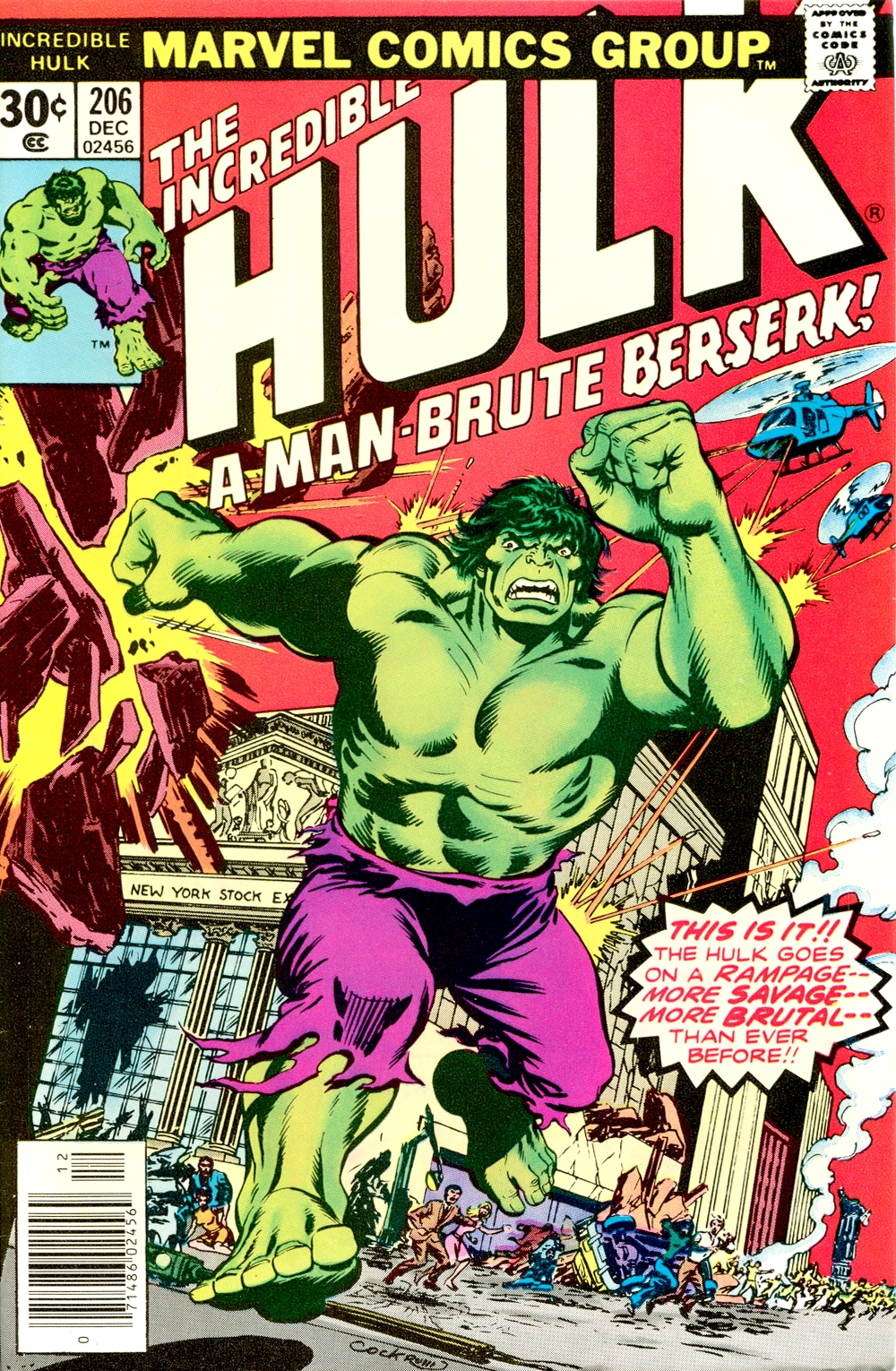
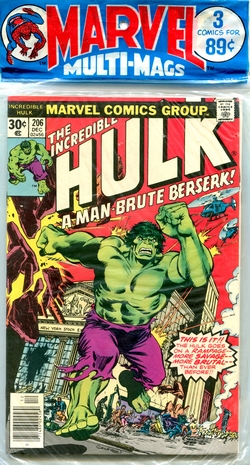
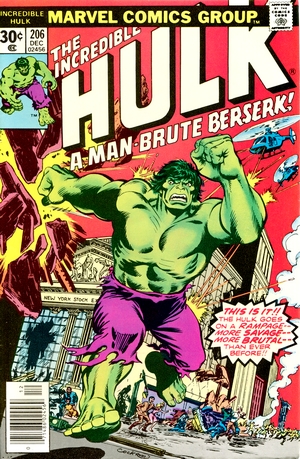
HULK #206
December
1976
(monthly)
On Sale: 21 September 1976
Editor - Len Wein
Cover - Dave Cockrum (pencils
& inks), John Romita
(alterations)
"A
Man-Brute Berserk!" (17
pages)
Story - Len Wein
Pencils - Sal Buscema
(breakdowns), Joe Staton
(finished art)
Inks - Joe Statont
Lettering - John Costanza
Colouring - Glynis Oliver
STORY
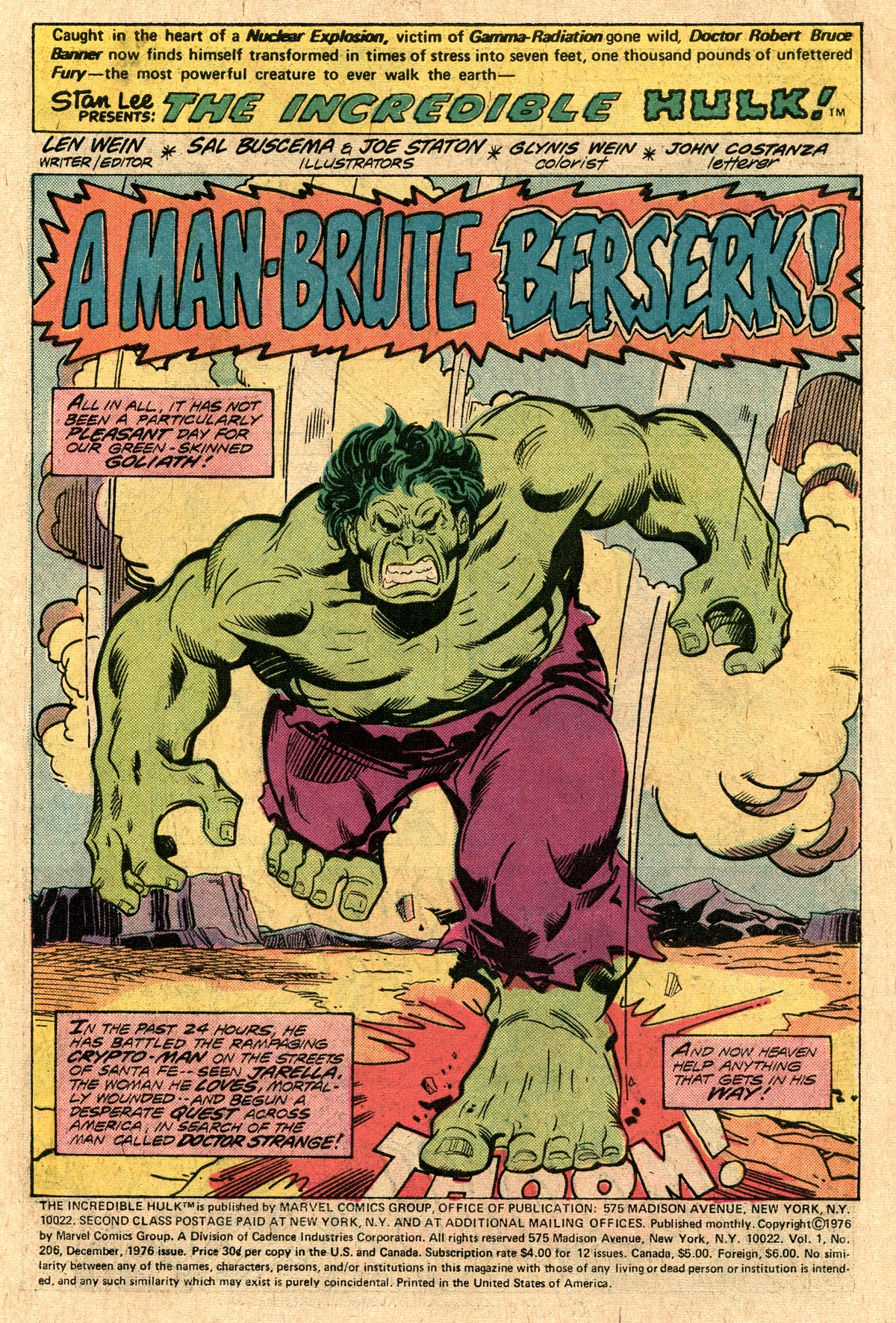
OVERVIEW - The Hulk
heads for Manhattan in search of
his friend Doctor Strange, hoping
his magic can bring his beloved
Jarella back to life. In the
process of fighting off
Thunderbolt Ross' attempts to
catch him the Hulk severly
damages the Statue of Liberty.
This brings Doctor Strange to the
scene in order to stop the Hulk -
and he's accompanied by Valkyrie,
Nighthawk and the Red Guardian.
|
|
|
|
|
| |
| As if there was any need for
further proof that Marvel really liked to run storylines
in and out of different titles, Incredible Hulk
#206 - the third comic book packaged into this Marvel
Multi-Mags - also picks up events that took place not in Hulk
#205 but rather in Defenders #41. |
| |
| This was definitely one of the
more natural story crossovers, since Old
Greenskin was, of course, an active member of the
Defenders. Len Wein had first penned the Hulk's
adventures (together with Roy Thomas) for Incredible
Hulk #145 (November 1971) before taking over
as the regular writer for issues #179 to #220
(September 1974 - February 1978) before doing his
final Hulk script for issue #222 (April 1978).
Artist Sal Bucema had an even longer tenure on
the title. He first provided the inks for a few
issues (with Hulk #124 (February 1970)
being the first), before becoming the regular
penciller for an extended run from issue #194
(December 1975) to issue #309 (July 1985), with
just a mere handful of issues in this run drawn
by other artists.
|
|
 |
|
 |
|
| |
| Both Wein and Buscema not only
had lengthy runs on the character, they both also had a
soft spot for the Hulk and clearly enjoyed working on the
character and his title. |

Len
Wein (1948-2017)
|
|
"At Marvel the Hulk was one of my
favorites." (Len Wein in Stroud,
2008)
Wein, who worked extensively for both Marvel
and DC in the 1970s, did notice the different
philosophies present at the two companies.
"I had a tendency more often than
not to put more plot in my Marvel stories
than is the general Marvel rule, which
sometimes seems to be, no characterization,
just hitting each other and having a good
time (..) I personally don’t think
that’s necessarily true. I really liked
what I did with Spider-Man, Thor, the Hulk. I
think part of the problem, again, the
professional as opposed to the creator, is
that I felt obliged to do them in the Marvel
style, to do what Stan had done, to do my
best to emulate it. And that isn’t
really the way I write." (Len Wein
in Slifer, 1979)
|
|
| |
Sal Buscema
shared Wein's enthusiasm for the character and
their work together.
"When I first
started working on the Hulk I was working
with Len Wein. He and I had a wonderful
relationship and I think we did some good
stuff together." (Sal Buscema in
Stroud, 2012)
He was not only a fan favourite
on the Hulk, the character was also his personal
favourite amongst all the work he did for Marvel.
"My favorite would
be the Incredible Hulk. Far and away. I love
the character and did it for almost 10 years
(...) definitely my favorite character and
I’d work on him in a minute given the
opportunity." (Sal Buscema in
Stroud, 2012)
|
|

Sal
Buscema (1936-2026)
|
|
| |
|
|
Marvel Multi-Mags
would regularly feature issues of
the Incredible Hulk as
part of their contents, including
a few runs of several continuous
issues. |
|
|
|
| |
|
| |
 |
|
Today,
any MARVEL MULTI-MAGS is a time
capsule; opening this plastic bag
right here offers a nostalgic
glimpse into what it was like to
be a comic book reader in late
1976.
So what else
was going on in December 1976?
|
|
|
|
 |
|
Rod
Stewart was at the top of
the US Billboard Chart in
mid-December 1976 with
"Tonight's
the Night (Gonna Be
Alright)",
whilst the UK saw
Showaddywaddy at number 1
with "Under the Moon
of Love". |
|
|
|
| |
 |
|
The New
York Times Bestseller
list for December 1976
was topped by Agatha
Christie's "Sleeping
Murder", with Anne
Rice's "Interview
with the Vampire"
the bestselling novel of
the year. |
|
|
|
|
| |
 |
|
Two
top box office hits in
the US in December 1976
were "King
Kong" and "The
Omen", which also
topped the British box
office at the same time. |
|
|
|
|
| |
 |
|
Popular
TV shows in the US in
December 1976 were
"Happy Days",
"Laverne &
Shirley" and
"Charlie's
Angels", while in
the UK the punk
group Sex Pistols caused
a storm of controversy
and outrage by swearing
on TV well before 9pm. |
|
|
|
|
| |
|
|
|
| |
FURTHER
READING ON THE
THOUGHT BALLOON
|
| |
 |
|
"Comic packs"
not only sold well for more than two
decades, they also offer some interesting
insight into the comic book industry's
history from the 1960s through to the
1990s. There's more on their
general history here. |
| |
|
|
|
|
|
There's
more on the background and the history of
the Marvel Multi Mags here. |
|
|
| |
|
| |
| BIBLIOGRAPHY BREVOORT
Tom (2007) "Marvel Multi-Mags", Blah Blah Blog,
originally published online 28 April 2007, reposted 18
April 2020
DeANGELO
Daniel (2013) "The Not-Ready-For-Super-Team Players:
A History of the Defenders", Back Issue!
#65, TwoMorrows Publishing
GREENFIELD
Dan (2019) "George
Perez: How The Avengers Made Me a Better Artist",
13th Dimension,
originally published online June 2019, reposted 5
December 2022
RUSS
Chris (2018) "Gerry
Conway’s Transitional Avengers", Multiversity Comics,
published online 21 August 2018
SLIFER
Roger (1979) "The Len Wein Interview", Comics Journal
#48 (published online 15 September 2017)
STROUD
Bryan (2008) "An
Interview With Len Wein - Co-Creator of Swamp Thing and
Wolverine", nerdteam30.com,
published online 4 April 2018
STROUD
Bryan (2012) "An
Interview With Sal Buscema - Helping To Define Marvel's
70's Style", nerdteam30.com,
published online 5 June 2019
|
| |
|
| |
|
| |
(c) 2026
uploaded
to the web 22 February 2026
|
| |
|
| |
|