![]() |
MARVEL UK PART ONE |
Footnotes
in square brackets indicate a quoted source; these are listed at
the bottom of this page
All dates given are cover dates unless specified
Click on covers for larger images
|
||||||
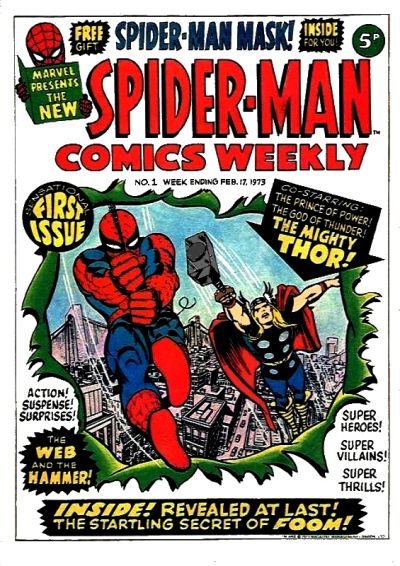
| Slinging his web out of the pages of MWOM, Spider-Man became the star of Spider-Man Comics Weekly, which introduced Thor (and later on also Iron Man) as a backup strip. The first issue was also used to promote the UK branch of Marvel's brand new US in-house fan club and fan magazine FOOM (Friends Of Ol' Marvel, which grew out of the original Merry Marvel Marching Society of the 1960s) - a clear indication that the House of Ideas had identified the UK as a lucrative market. | ||||||
|
||||||
| AVENGERS ASSEMBLE | ||||||
|
||||||
|
||||||
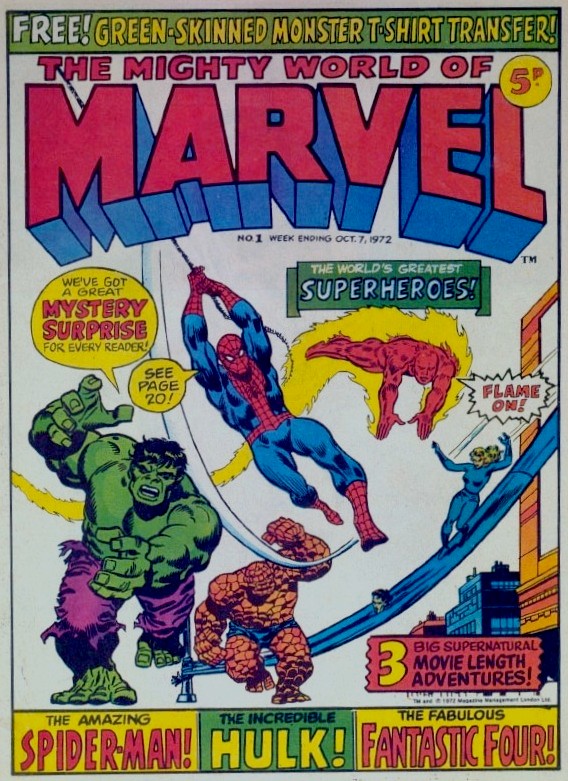
| Soon, Mighty World of Marvel and Spider-Man Comics Weekly both adopted the same format as The Avengers, with 36 interior pages and glossy paper covers. Much of the appeal of the UK reprints lies precisely with some of these covers. |
| Printed
to a larger format than American Marvel comic books, some
were just used pretty much as they appeared on their
original US material, but others had specific features or
were made especially for the UK publications, often in a
very glossy and flashy way and sporting a multitude of
blurs announcing the mixed contents of the comic book in
question. Whilst The Avengers was - like all other Marvel UK publications - slightly dull in comparison to Marvel's American comics in prime colours, the glossy covers quite often made up for the black and white content. Besides that, the quality of the paper was far better than that used by Marvel for its US comics. Due to the fact that the comic featured three different characters (other Marvel UK titles had even more) there would be a regular change in which title figure would make it onto the cover, and the sub-title would change accordingly, e.g. The Avengers featuring Dr. Strange or The Avengers starring Shang Chi Master of Kung Fu. Marvel UK had started out with then 21 year-old Tony Isabella as the American editor of Marvel's British weeklies, and the production was, for obvious reasons, strongly based in the US.
Sol Brodsky (1923 - 1984) had been one of the original three employees of the House of Ideas (together with Lee and secretary Flo Steinberg) and - as the production manager and thus main architect of Marvel's Silver Age expansion - was described by Stan Lee as his "right hand" [9]. As vice-president (operations) he was overseeing Marvel UK amongst other things such as the Marvel Books brand. Marvel UK was thus deeply rooted in the inner sanctum of the House of Ideas, but as its titles became more and more successful and the imprint brand established itself as a major publisher of weekly comic titles in Britain, more and more English (and locally based) staff joined the editorial team, such as Peter L. Skingley and Matt Softly who took on the job from Tony Isabella in 1974, or Neil Tennant (later of Pet Shop Boys fame) in 1975-77. The comic books were never printed in the USA but rather came from a printing company based in Ireland, and the copyright notice in every issue stated that these comic books were not to be sold in the US and Canada. |
![]() |
| MARVEL'S HOUSE STYLE WINS THE MARKET |
| By the second year of its existence, Marvel UK was a rip-roaring success and had built up an imposing presence on the British comic book market - not somehing which could have been taken for granted at the start of the enterprise, considering the fact that all of the material published in the first issues of Mighty World of Marvel, Spider-Man Comics Weekly and The Avengers had previously already been seen in the Odhams comics only a few years earlier. Apparently, this made little or no difference at all. |
| But just why were MWOM,
SMCW and The Avengers succeeding where
previous Marvel reprints had failed? Was it because they
had such lively and attractive covers? Or had the time
gap between the original publication in the US and its
reprint in the UK become wide enough to make these
weeklies the only opportunity for a new segment of
readership to enjoy the early Marvel material? It is fair to assume that all of this played its part in the successful launch of Marvel UK, but the key element was the authenticity. |
![]() |
| Unlike the reprints of the mid- to late 1960s, this was the House of Ideas at work, and readers in the UK now got their real share of Merry Marveldom - not only the visual house style of Marvel, but also the editorial house style, established by the Maestro Supreme Stan Lee. | |||
|
|||
| All of this was, quite simply, unique, and having the original and not a watered-down copy was a first for British comic book readers - and it struck a welcome sentimental chord with seasoned readers accustomed to the US publications. The "Bullpen Bulletins" were a feature of the UK weeklies as much as they were of Marvel's US comic books, and during the first two years of Marvel UK also contained an anglicised version of Stan Lee's soapbox, in which he presented news from the world of Marvel to British readers. The style, however, was unchanged - readers received this input ("nutty news") on an eye to eye level ("from one Marvel madman to another"). | |||
![]() |
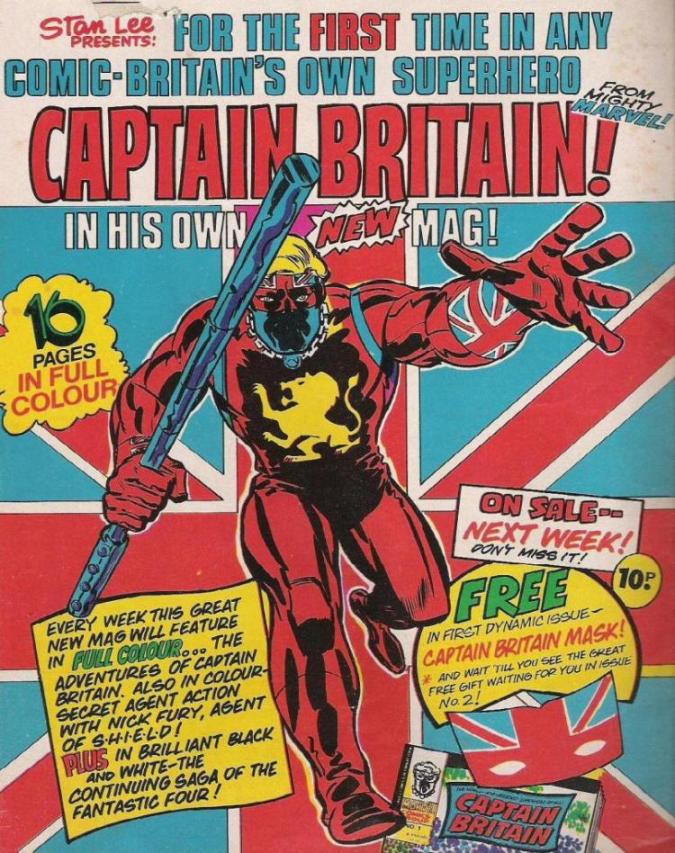
The in-house
advertising always served a double purpose at Marvel.
Firstly, it was, of course, a way of telling the readers
of one comic book title that there were others available
which would be just as interesting. But secondly - and
just as importantly - the in-house ads also served to
establish and strengthen the Marvel house style. Comic books weren't just that, they were "fabulous" and "winners" or, better still, "triumphs" and "masterworks". As the initial delights served by Marvel UK came straight out of the House of Ideas' NYC kitchen, it is no surprise that the advertising featured in the British reprint books followed the same vein of chatty and semi-spoof language and flashy and often bigger than life presentation. Marvel not only excelled in presenting its actual product, but just as much in presenting itself. Set up and guided by the master of the soapbox, Stan Lee, Marvel simply excelled at impression management. The very own concept of communication was another key element of the Marvel house style which won the British market for Marvel UK. Involving readers was a completely alien concept to British comic book publishers, and Marvel UK not only talked to and with its readers through editorial pages, but actually asked for and encouraged readers to participate and be a part of it all. |
| The gathering call of the world's mightiest group of superheroes thus turned to directly include and address the readership when "Avengers Readers Assemble!" was called out. |
| The authencity of
Marvel UK's weeklies was further strengthened through the
letters pages as the editors did not shy away from
discussing topics raised by individual readers which
actually concerned Marvel's American output. For those readers, this proved that Marvel UK was indeed part of the Marvel Universe, so to speak, and for readers with little or no knowledge about the US side of the House of Ideas, it opened up a much broader perspective - this was much more than a handful of weeklies, this was a part of "something big". |
|
|
Even highly practical
questions regarding the British weeklies and their
original US sources were discussed, as one reader's
question of why the American books were smaller than
their UK counterparts was replied to:
The direct link and thus pedigree connection to Marvel USA was even taken further by occasional in-house adverts for US comic books imported to the UK, such as the Giant Superhero Holiday Grab-Bag . No advertising was run for the regular monthly imports of US edition Marvels, but a one-shot special (such as this one) was obviously not seen as a competition for the weeklies. Selling for $ 1.50 in the US, it was priced at 50p in the UK. |
|
| As mentioned before, the weekly publication schedules of Marvel's British output created a need for new covers and new splash pages at very frequent intervals. The various editorial teams came up with several different possible approaches to this over the months and years, but again the awareness and the drive to create an overall feeling of authenticity was at the heart of both the production values and the success of Marvel UK's weeklies. | |||||||
|
|||||||
|
|||||||
|
|||||||
|
|||||||
|
|||||||
|
|||||||
| THE HORROR AND SCIENCE FICTION EXPANSION | |||||||
|
|||||||
| Tomb of Dracula is a comic book classic beyond its genre, and - as the jewel in the crown of Marvel's bronze age horror world [18] - a logical choice for Marvel UK when it came to expanding its range of weeklies. However, in a slightly confusing move, the reprints of Tomb of Dracula were launched in Great Britain under the title of Dracula Lives, which was the existing title of Marvel's US black and white magazine format comic book featuring the count since June 1973. | |||||||
| Whilst the horror
genre spearhead Dracula was already very well-established
in the US by autumn 1974, Marvel's science-fiction
venture to the Planet of the Apes had only been
launched a mere two months earlier in the USA with the
black and white magazine format Planet of the Apes #1
in August 1974. Eager to expand into any genre and theme
which held the promise of an increased comic books market
share at the time, Marvel launched the series with an
adaptation of the original 1968 movie starring Charlton
Heston. Originally a novel by French author Pierre Boulle
published in 1963, the uncanny story of the Planet of
the Apes features a group of astronauts who land on
a planet which seems to be a spitting image of the Earth
save one big exception - the status and roles of human
beings and primates on this planet are just the opposite
of what they are back home. Here, the apes shape and
control society and rule over human beings, who are
treated as an inferior species. This intriguing juxtaposition proved a box offixce hit which spun off four sequels from 1970 to 1973, followed in 1974 by a short-lived CBS television series. Marvel's US black and white Planet of the Apes would run for 29 issues and, besides adaptations of all five movies, featured original stories written by Doug Moench and Gerry Conway with artwork by Mike Esposito, Mike Ploog, George Tuska, and many others. In October 1975, Marvel launched a second tie-in title in the US, Adventures on the Planet of the Apes, in standard colour comic book format, which eventually ran for 11 issues until cancelled in December 1976. Material from both sources was reprinted in Marvel UK's Planet of the Apes (again, the acronym POTA became a household label), together with adapted material from the Killraven stories featured in the US Amazing Adventures #18-39 (May 1973 - November 1976) which was renamed Apeslayer and featured re-drawn ape-aliens. |
|
| Other than reprints of The Tomb of Dracula as the lead feature, Dracula Lives started out with back-up material from The Monster of Frankenstein and Werewolf by Night. As the fairly short-lived Frankenstein material came to an end, this slot was filled with the Living Mummy as of issue #42 in August 1975 in order to keep up the established formula with "three macabre masterpieces every issue". The weekly publication schedule resulted in a pronounced volatility of the UK comic book market in comparison to monthly or even bi-monthly installments, and only four months later the title of Marvel UK's horror weekly was expanded as of issue #60 in December 1975 to Dracula Lives featuring The Legion of Monsters - with no change to its featured contents. |
| However, as Marvel UK began to run out of Living Mummy material - which had enjoyed an even shorter life in the US than the Frankenstein Monster [19] - other Marvel horror genre characters eventually made their appearance in Dracula Lives featuring The Legion of Monsters, such as Man-Thing (debut in issue #63, January 1976) and Ghost Rider (first featured in issue #79, April 1976), who acted as a replacement for Werewolf by Night. |
SOURCES [1] STRINGER Lew (2008) The Road to Marvel UK, published online at Blimey! It's another blog about comics (lewstringer.blogspot.com/2008/01/road-to-marvel-uk-part-1.html) and accessed 23 February 2009 [2] STRINGER Lew (2008) The Road to Marvel UK, published online at Blimey! It's another blog about comics (lewstringer.blogspot.com/2008/01/road-to-marvel-uk-part-1.html) and accessed 23 February 2009 [3] STRINGER Lew (2008) The Road to Marvel UK, published online at Blimey! It's another blog about comics (lewstringer.blogspot.com/2008/01/road-to-marvel-uk-part-1.html) and accessed 23 February 2009 [4] STRINGER Lew (2008) The Road to Marvel UK, published online at Blimey! It's another blog about comics (lewstringer.blogspot.com/2008/01/road-to-marvel-uk-part-1.html) and accessed 23 February 2009 [5] LEE, Stan (1972) A special message from Stan Lee, editorial published in Mighty World of Marvel #1 [6] WYMANN, Adrian (2008) Superheroes from the Crypt - Marvel's Bronze Age World of Horror, available online at www.wymann.info/DoctorMarvel/BronzeAgeHorror.html [7] KNOWLES, Christopher (2007) Our Gods wear Spandex, Weiser [8] MITHRA, Kuljit (1997) Interview ith Tony Isabella, availabe online and accessed 19 March 2009 at www.manwithoutfear.com/interviews/ddINTERVIEW.shtml?id=Isabella [9] N. N. (1998) Roy Thomas Interview, published in The Jack Kirby Collector #18 [10] N.N. (2003) Stan Lee Interview, contained as extra feature on the double disk DVD release of the movie Daredevil (personal transcript) [11] MARVEL UK (1974) Letters page, published in The Avengers (UK) #67, 28 December 1974 [12] MARVEL UK (1974) Bullpen Bulletin, published in The Avengers (UK) #61, 16 November 1974 [13] MARVEL UK (1974) Bullpen Bulletin, published in The Avengers (UK) #61, 16 November 1974 [14] MARVEL UK (1974) Bullpen Bulletin, published in The Avengers (UK) #61, 16 November 1974 [15] MARVEL UK (1974) Bullpen Bulletin, published in The Avengers (UK) #64, 7 December 1974 [16] MARVEL UK (1974) Bullpen Bulletin, published in The Avengers (UK) #63, 30 November 1974 [17] WYMANN, Adrian (2008) Superheroes from the Crypt - Marvel's Bronze Age World of Horror, available online at www.wymann.info/DoctorMarvel/BronzeAgeHorror.html [18] WYMANN, Adrian (2008) Superheroes from the Crypt - Marvel's Bronze Age World of Horror, available online at www.wymann.info/DoctorMarvel/BronzeAgeHorror.html [19] WYMANN, Adrian (2008) Superheroes from the Crypt - Marvel's Bronze Age World of Horror, available online at www.wymann.info/DoctorMarvel/BronzeAgeHorror.html |
The illustrations presented here are copyright material
and are reproduced for strictly non-commercial and appreciative review purposes only.
Text is (c) 2009 Adrian Wymann
page published on the internet 13 May 2009